49 works in this view — arrow keys or swipe to move between them.
Dance in Art
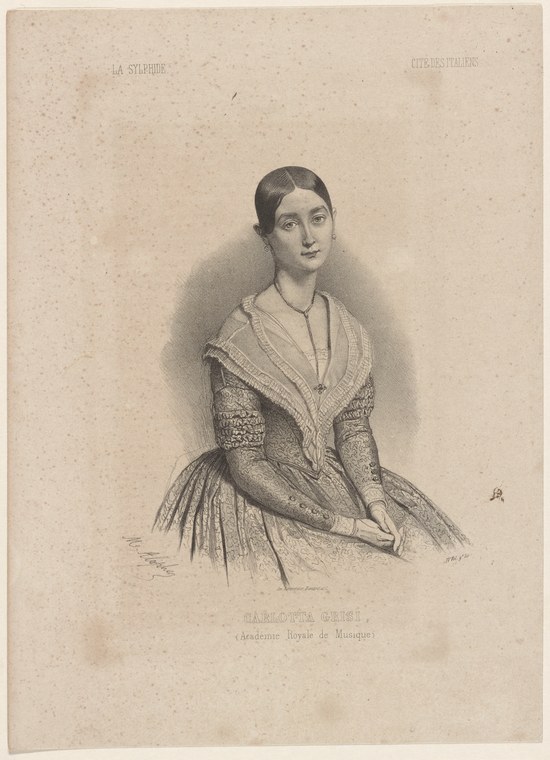
Carlotta Grisi, (Académie Royale de Musique)
Unknown artist
- Collection:
- Prints depicting dance
- Source:
- New York Public Library
- Rights:
- Public domain — free to use, share and adapt.
- Recorded as:
- Public Domain
Carlotta Grisi was central to the development of Romantic ballet and created one of the canonical roles in the classical repertory. This print documents how the ballet world of the nineteenth century constructed and circulated the visual identity of its stars, before photography. It exemplifies the way engraved portraiture functioned as both art object and commercial product in the theatrical economy.
What you are looking at
A three-quarter-length portrait of a young woman in mid-nineteenth-century dress, shown against a plain background. She wears a dark, fitted bodice with long sleeves and lace or patterned fabric detail, topped by a wide, white or cream-colored collar or shawl draped across her shoulders. Her skirt, gathered at the waist, falls in voluminous pleats and folds to the hem. Her dark hair is parted centrally and smoothed back from her face. She gazes slightly upward and to the left, her posture composed and dignified. Her left hand rests lightly in her lap, while her right arm hangs at her side. The work is executed in fine graphite or engraving, with delicate shading that creates volume in the fabric and softness in her features. The artist has signed the work in the lower right corner.
The dancing
The figure is a single dancer shown in a standing position, facing the viewer at a slight three-quarter angle. Her posture is upright and formal, with her weight evenly distributed. Her arms are relaxed and natural—not held in any particular dance frame or position—suggesting a moment of repose rather than active movement. Her expression and stillness convey the persona of a professional ballerina being presented to the public, but there is no evidence of active dance vocabulary in her stance or limbs.
The dance depicted
Carlotta Grisi was one of the foremost Romantic-era ballerinas of the mid-nineteenth century, best known for creating the title role in Adolphe Adam's *Giselle* (1841). This is a portrait study rather than a depiction of her dancing; it presents her as a professional performer of classical ballet in the Romantic period. The dress suggests her status as a prima ballerina of the Paris Opéra (Académie Royale de Musique), though the image shows her in street or semi-formal dress rather than in performance costume. The work documents her celebrity and the way she was visually marketed to the public during the height of Romantic ballet.
How it was made
This is a fine engraving or lithograph, executed with careful attention to tonal gradation and fabric texture. The medium allowed for precise linear detail while building volume through fine cross-hatching and shading. Such reproductive prints were the standard way to circulate images of celebrated performers to a broad public, before photography became the dominant medium. The quality of execution and careful signature suggest this was a commissioned work of some standing, likely distributed commercially to ballet enthusiasts and collectors of theatrical portraiture.
About this work
This is a portrait engraving of Carlotta Grisi, the celebrated Italian-born ballerina who dominated the Parisian stage in the 1840s–1850s and created the role of Giselle. Rather than capturing her in performance, it presents her in formal street dress as a marker of her celebrity and professional status. The work belongs to the rich tradition of theatrical portraiture that documented the star performers of the Romantic ballet era, when the ballerina became a figure of international fame and the ballet world depended on the circulation of printed images to sustain audience interest and box-office appeal.
The image is both a work of art and a document of how the ballet world marketed its female performers—as elegant, dignified, and remote. Grisi's fame was built on her technical virtuosity and her interpretations of Romantic roles that emphasized otherworldly grace and emotional intensity. This portrait captures her public persona, the image she presented offstage to a paying public who knew her through prints like this as much as through live performance.
How to look at it
This is a portrait study, not an action image, so the viewer should attend to what the stillness and formality of the pose conveys about professional identity and public persona. Note the careful attention to the textures of fabric—the fine pleating of the skirt, the contrast between the dark bodice and white collar—which demonstrate the artist's understanding of how fabric and garment constitute the visual identity of a stage performer. The slight upward gaze and the composed, dignified bearing are conventions of portraiture designed to evoke the grace and otherworldliness that were central to the Romantic ballet ideal. The unsigned inscription below gives her name and affiliation with the Opéra, anchoring the image in the institutional world of professional dance.
The artist
The artist is not recorded. The work bears a signature (visible in the lower right) but it is not clearly legible in this reproduction. Such portraits were often collaborative enterprises: a painter would produce the original, and an engraver would translate it into the medium shown here for commercial distribution. The quality suggests work by a competent professional working within the established conventions of theatrical portraiture.
The period
This portrait dates to the period of high Romanticism in ballet (c. 1830s–1850s), when the ballerina became the central focus of the art form and a figure of international celebrity. The Romantic era saw the development of pointe work, the rise of the sylph-like ideal, and the staging of narratives centered on female protagonists. Grisi arrived in Paris in 1836 and quickly became one of the most celebrated dancers of her generation. The circulation of engraved portraits was essential to sustaining interest in performances and to building the cult of the ballerina that was such a feature of nineteenth-century cultural life. Print technology allowed images of famous performers to reach audiences far beyond the capital cities where they performed.
Where it lives
The work is held in the New York Public Library's collection of prints depicting dance. It is a commercial reproductive print, part of the vast corpus of theatrical portraiture produced during the nineteenth century to meet public demand for images of celebrated performers.
Dance in this work
Questions about this work
Was Carlotta Grisi only known for Giselle?
Giselle is her most enduring legacy, but she was celebrated across a wide repertory of Romantic roles, including *La Péri*, *Le Jugement de Paris*, and works created specifically for her talents. She was known for her technical brilliance, her dramatic intensity, and her ability to embody the Romantic ideal of the ethereal, otherworldly ballerina.
Why would a ballerina have a portrait made in street dress rather than costume?
Such portraits served to present the performer as a professional and a public figure, not just a character on stage. They were intended for a broad audience of admirers and collectors, and they emphasized the person behind the roles—the celebrity, the artist, the woman. Costume-specific portraiture would have tied her to a single role; street dress allowed her to be presented as a star in her own right.
Who made this engraving?
The artist's name is not clearly recorded in the catalogue. The signature visible in the lower right corner has not been definitively read. Such prints were often collaborative, with a painter producing the original and an engraver executing the plate for publication.
When was this made?
The date is not recorded. Based on the style, technique, and Grisi's known career timeline (c. 1836–1860), it was most likely produced in the 1840s–1850s, when her fame was at its height and the market for theatrical prints was at its strongest.
More dance artwork





