49 works in this view — arrow keys or swipe to move between them.
Dance in Art
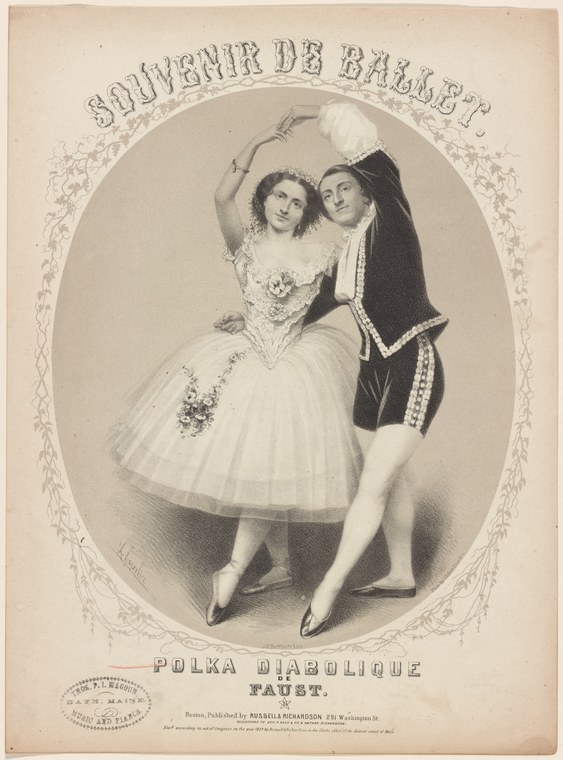
Mlle. [Louise] Lamoreux and Signor [Filippo] Barrati. de Faust
Unknown artist
- Collection:
- Prints depicting dance
- Source:
- New York Public Library
- Rights:
- Public domain — free to use, share and adapt.
- Recorded as:
- Public Domain
This print documents the specific moment when the polka crossed from European ballroom to Parisian stage ballet, and shows how star dancers and named choreographers were marketed to a public of prints-buying enthusiasts. It is rare pictorial evidence of how a social dance was adapted into theatrical form, and of the male-female partnering innovations that came with that adaptation.
What you are looking at
A young woman in a full white romantic ballet tutu and bodice stands en relevé, her body angled toward a male dancer in dark naval dress uniform who supports her from behind with one arm around her waist. Her left arm is raised gracefully overhead in an arabesque position, while her right arm extends forward. The man gazes at her face with evident tenderness. The composition is set within an ornamental oval frame decorated with floral and foliate scrollwork in the manner of mid-19th-century theatrical souvenirs. The background is pale and undefined, focusing all attention on the pair. The title at top reads "SOUVENIR DE BALLET" and at bottom "POLKA DIABOLIQUE" with attribution to "FAUST," indicating this documents a specific stage performance or scene.
The dancing
The woman is lifted slightly, en relevé or possibly en pointe, with her torso held upright and her raised arm demonstrating the elongated line characteristic of Romantic ballet technique. Her partner supports her weight from behind in what appears to be a supported arabesque or similar lift position. Their relative heights and the man's firm stance suggest classical ballet partnering of the period. The intimate proximity and the man's attentive gaze toward her face—rather than his own performance—marks this as a moment of dramatic connection rather than pure technical display.
The dance depicted
This is a scene from a Romantic-era ballet, most likely a Parisian production featuring the polka—a new and fashionable social dance form of the 1840s–50s that was rapidly adopted into theatrical ballet. The title "Polka Diabolique" (Diabolical Polka) suggests a dramatic narrative moment rather than straightforward social dancing. The image documents a specific star couple: Mlle. Louise Lamoreux and Signor Filippo Baratti, identifiable by the artist's inscription. The work shows how Romantic ballet integrated contemporary ballroom dances into its vocabulary, and how the polka in particular allowed dramatic male-female partnering that departed from the ethereal, largely unsupported aesthetic of earlier Romantic ballet.
How it was made
This is a lithographic print, characteristic of mid-19th-century theatrical promotion and souvenir publication. The lithograph process allowed fine rendering of costume detail—the pleating of the tutu, the shading of the uniform—and rapid commercial production for sale at theaters and to collectors. The ornamental frame is typical of the period's theatrical marketing, elevating the dancers to quasi-heraldic status. The quality of the image and the specificity of the dancers' names suggest this was a professional, probably Parisian print made for immediate sale to the ballet-going public.
About this work
This lithographic souvenir captures a moment from a mid-19th-century Romantic-era ballet featuring a polka—a social dance form that had become fashionable in Europe and was rapidly integrated into theatrical ballet. The print documents two named dancers, Lamoreux and Baratti, in an intimate partnering moment that exemplifies how Romantic ballet was evolving to include contemporary ballroom elements and more dramatic male-female interaction. The work sits at the intersection of social dance history and theatrical ballet history, showing how a commercial entertainment medium (the souvenir print) documented and promoted both the new dances and their star performers.
The piece is valuable as evidence of how ballet companies used merchandising to build fan culture around named dancers, and how the polka—imported from Central Europe and initially a low-class social form—became fashionable enough to appear in elite theaters. The souvenir format suggests a broad urban audience beyond the nobility, indicating the democratization of ballet spectatorship in the mid-1800s.
How to look at it
Observe the woman's body line: she is supported, not floating, and her partner is visibly exerting strength to hold her aloft. This male partnering role was relatively new in ballet and marks a shift from earlier periods. Notice too the social-dance vocabulary in her posture—the position she holds is ballroom-derived, not the ethereal floating line of earlier Romantic ballet. The artist has chosen a moment of dramatic repose rather than spectacular movement, emphasizing the emotional connection between the dancers through their eye contact and proximity. The ornamental border surrounding them, typical of the period, frames them as iconic celebrity images—this is as much a publicity portrait as a dance document.
The artist
The lithograph is attributed to a Parisian print house (Baudet & Richardson, 251 Washington St, as visible in fine print) but the artistic authorship is not recorded. The work is typical of mid-19th-century theatrical publicity prints, a substantial commercial category in Paris. Such prints were often executed by house artists whose names were not retained, making individual attribution difficult. The quality of the figure drawing suggests professional theatrical documentation rather than journalistic or caricatural work.
The period
The polka emerged in Prague around 1830 and spread rapidly across Europe in the 1840s, reaching Paris by the mid-1840s where it became a sensation in social dancing. By the 1850s, choreographers were incorporating the polka and other social dances into theatrical ballet, alongside the ethereal Romantic vocabulary of Giselle and La Sylphide. This mixing of contemporary social dance with Romantic ballet aesthetic created new technical and dramatic possibilities, particularly in partnering. The souvenir print format itself was a product of industrializing lithography and growing mass consumption of theatrical imagery in the 1840s–60s. Named dancers and "star systems" were becoming central to theatrical marketing, with prints serving as the era's equivalent of program notes and fan merchandise.
Where it lives
This print is held in the New York Public Library's collection of prints depicting dance. It is a commercial theatrical souvenir, published in Paris and distributed through theaters and print shops. The inscription gives the publication information but not the name of the designing artist, typical of collaborative theatrical print production of the period.
Dance in this work
Questions about this work
Is this a real scene from a ballet or an idealized image?
It documents a real ballet called Polka Diabolique with named performers, but the print is a theatrical souvenir, not a documentary record. The artist has composed the image for maximum drama and promotional effect—the framing, the lighting, the ornamental border all serve to glamorize the dancers rather than document a literal stage moment. However, the costumes and the pose do reflect actual stage practice of the period.
What is a polka in ballet context?
The polka began as a Central European social ballroom dance around 1830, characterized by a lively 2/4 meter and a hopping traveling step. By the 1850s, choreographers had adapted it into theatrical ballet, often giving it dramatic or comic character (hence "Diabolique"). It allowed for close partnering and a less ethereal, more grounded aesthetic than the Romantic ballet of the previous generation.
Who were Lamoreux and Baratti?
They are identified in the print itself but little is documented about them beyond this image. They were working dancers in Paris in the mid-1800s, likely at the Opéra or Opéra-Comique. The fact that the publishers bothered to name them suggests they were known enough to attract buyers, indicating a working reputation in Paris at that time.
Why is this called a souvenir?
The French title "Souvenir de Ballet" indicates this was a commercial print sold to audience members after performances—the equivalent of a modern program booklet or souvenir merchandise. Theaters and print shops sold such images of famous dancers and scenes, allowing fans to take home a visual memory of the performance. Such prints were collected and pasted into albums, a common 19th-century practice.
More dance artwork





