49 works in this view — arrow keys or swipe to move between them.
Dance in Art
Pas grec
Unknown artist
- Collection:
- Prints depicting dance
- Source:
- New York Public Library
- Rights:
- Public domain — free to use, share and adapt.
- Recorded as:
- Public Domain
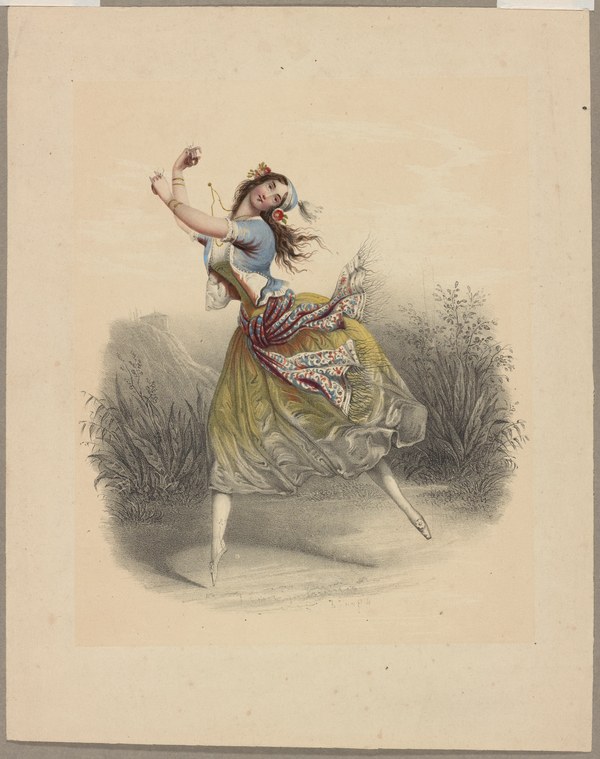
This print documents the visual language of Romantic ballet at the peak of its cultural dominance. For dancers and historians, it is evidence of the technical and aesthetic standards audiences expected, and of how ballet used the printed image to shape its own mythology. The precision of the pose and the care taken in its representation tell us that this was not casual movement but an exacting, codified art form.
What you are looking at
A young female dancer in a classical pose dominates this hand-colored engraving or lithograph. She wears a pale blue corseted bodice and a full skirt of soft yellow and white, with reddish-brown drapery visible at the hem. Her pose is the characteristic attitude derrière of Romantic ballet—one leg raised behind, the supporting leg extended in a gentle curve, arms lifted and curved overhead in a graceful arc. The setting is minimal: a ground line of pale earth at her feet, and tall grasses or reeds rendered in fine pen strokes flanking her on either side. The background is plain, allowing nothing to distract from her figure. The lighting is soft and diffused, typical of printed theatrical portraiture of the period, with subtle shading creating dimension in her skirts and the delicate line work emphasizing the elegance of her extended limbs.
The dancing
A single dancer, alone on stage or in an imagined space. Her weight is held on the supporting leg, which is nearly straight but not locked, allowing a graceful line from hip to ankle. The working leg is raised at an acute angle behind, the foot pointed. Her torso is upright and gently arched, the shoulders relaxed and level. Both arms are raised, elbows bent softly, hands open with fingers extended. The overall frame is symmetrical and composed, emphasizing verticality and extension. Every line communicates the ethereal, effortless quality Romantic ballet demanded.
The dance depicted
This is a Romantic-era ballet dancer in a classical pose. The title 'Pas grec' (Greek step) suggests either a reference to Hellenic movement vocabulary or a classical pas de deux or solo from a ballet with Greco-Roman subject matter—common in the 1840s-1860s. The pose itself is pure Romantic ballet: the attitude derrière, the lifted épaulement, the pointed feet, and the ethereal lightness of the skirt all signal the ballet aesthetic of Taglioni and her successors. Without more context, the specific ballet and dancer cannot be identified, but the image documents the physical ideal and technical vocabulary of mid-nineteenth-century theatrical ballet.
How it was made
This is a hand-colored engraving or lithograph, recognizable by the fine pen line work defining form and the watercolor or gouache tinting applied afterward to the printed base. The combination of precise line and soft color wash allowed inexpensive theatrical prints to circulate widely to the dance-going public, particularly in Paris and London. The technique required separate passes—printing the outline, then hand-coloring each copy—making each print slightly unique while keeping production costs manageable. This was the standard vehicle for the mass distribution of ballet imagery in the nineteenth century.
About this work
This is a portrait of an unknown dancer in the Romantic ballet style, printed as a commercial theatrical souvenir. The work captures the physical ideal of mid-nineteenth-century ballet: weightless extension, precise turnout, and an ethereal carriage. Such prints were produced in the thousands and sold at theater doors and through shops, making them the primary documentary record of how ballet dancers of the era were seen and remembered by audiences. The image is both an artwork and a historical artifact of the machinery that manufactured and circulated the Romantic ballet ideal.
How to look at it
Observe the exact moment chosen: the dancer is held in a pose of perfect balance, not caught mid-movement but presented as a complete and formal statement. This is not snapshot realism but an idealization—the artist has chosen the most flattering, most technically perfect moment and refined it further. Notice how the simple setting (just grass and ground) prevents any distraction from the body itself. The hand-coloring is deliberately soft and luminous, enhancing the impression of weightlessness and grace. Compare this to photographic dance documentation that would come later; this is image-making in service of an ideal, not documentation of what the eye actually saw.
The period
This work belongs to the mid-nineteenth century, when ballet had become a major form of commercial theatrical entertainment in Europe. The 1840s-1860s saw the dominance of Romantic ballet, with emphasis on pointe work, ethereal costuming, supernatural and orientalist themes, and the cult of the ballerina as an otherworldly being. The title 'Pas grec' may reference the classical revival that ran parallel to Romanticism, evident in ballets such as Le Jugement de Pâris or shorter divertissements with ancient Greek themes. Printed portraits of dancers—particularly of celebrated female soloists—became a mass-market phenomenon during this period, sold as theatrical souvenirs and collectibles analogous to modern theatrical photographs and playbills.
Where it lives
Held in the New York Public Library's collection of prints depicting dance. Such prints were produced and distributed commercially in editions, making them accessible primary sources for the study of nineteenth-century ballet aesthetics and performance practice.
Dance in this work
Questions about this work
What does 'Pas grec' mean?
Pas grec literally means 'Greek step' in French. It likely refers either to a specific classical pas (a formal choreographic unit) with ancient Greek subject matter or movement vocabulary, or to a suite of dances built around Hellenic themes. Many mid-nineteenth-century ballets incorporated classical and orientalist themes alongside the core Romantic aesthetic.
Can you identify the dancer?
No. The artist is also not recorded. Without a signature, inscription, or documented provenance, the print cannot be securely attributed to either dancer or artist. The NYPL catalogue records it only as a print from the mid-nineteenth century in the genre of theatrical dance portraiture.
Is this a photograph?
No. This is a hand-colored engraving or lithograph—a printed image tinted by hand. Theatrical photographs of dancers existed by the 1850s-1860s but were expensive and required longer exposure times. Printed portraits remained the dominant, affordable way to own an image of your favorite dancer throughout the nineteenth century.
How do I know this is Romantic ballet and not another style?
The pointe work (visible in the pointed foot), the ethereal costuming (the soft tulle skirt and pale bodice), the attitude derrière pose, and the isolated, spotlit presentation all follow the vocabulary of Romantic ballet that dominated European stages from roughly 1830 to 1870. The aesthetic is distinct from both earlier classical ballet and later twentieth-century modernism.
More dance artwork





