49 works in this view — arrow keys or swipe to move between them.
Dance in Art
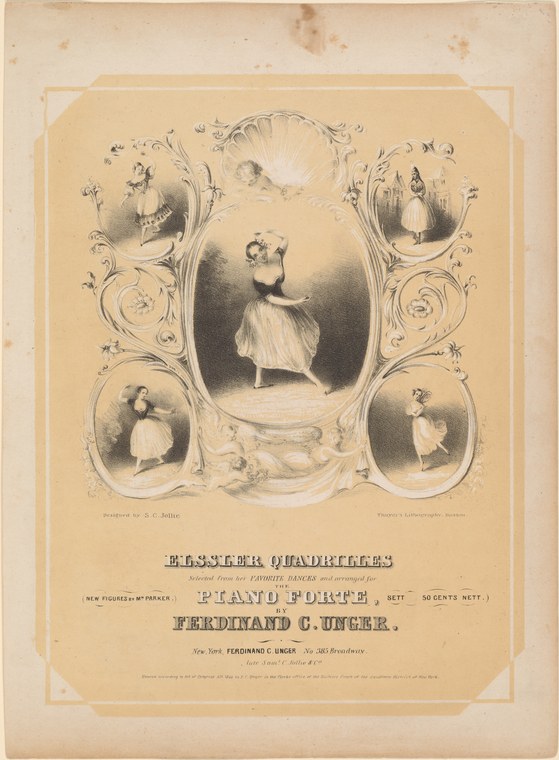
Elssler quadrilles: selected from her favorite dances and arranged for the piano forte, by Ferdinand C. Unger
Unknown artist
- Collection:
- Prints depicting dance
- Source:
- New York Public Library
- Rights:
- Public domain — free to use, share and adapt.
- Recorded as:
- Public Domain
This work documents a crucial moment in dance history: the moment when theatrical ballet performance became the basis for fashionable amateur social dancing, mediated entirely through commercial print and music publishing. Fanny Elssler was a major international star whose movement vocabulary was valued and consumed far beyond the theater; this print shows how her image and her choreography were being sold, reproduced, and domesticated. It reveals the infrastructure of 19th-century dance celebrity and the mechanisms by which professional dancers' work entered popular culture.
What you are looking at
This is a lithographic cover sheet for a published piano arrangement, decorated with a elaborate ornamental frame that showcases five separate vignettes of a female dancer. At the center, within an oval cartouche, stands a single figure in a white Romantic-era ballet dress—fitted bodice, bell-shaped skirt to mid-calf, and pointe shoes—captured in an upright pose with arms positioned in a classical fifth position or similar frame. She wears her hair in the style of the 1830s–40s, pulled back smoothly. Four smaller oval scenes surround the central figure: the upper left and right show what appear to be the same dancer or a related figure in similar dress and pose; the lower left and right show another figure, again in white dress. The entire composition is framed by ornamental scrollwork, floral motifs, and shell-like decorative elements typical of mid-19th-century commercial design. The effect is one of repetition and glamour—the dancer is presented almost as an icon or a repeatable image.
The dancing
The central figure stands in a classical ballet frame with the body lifted and composed, legs in a stance consistent with balletic training, and arms held in a restrained, formal position suggesting the Romantic ballet vocabulary of the period. The repetition of the figure across multiple ovals suggests not narrative variation but rather a commercial presentation of the dancer as a recognizable performer—a star turn shown from the same or near-identical angles. The posture is controlled and upright, typical of the 1830s–40s aesthetic: no dramatic extension or virtuosity is displayed, but rather a dignified and graceful presence.
The dance depicted
This is a Romantic ballet arrangement, specifically a quadrille based on choreography associated with Fanny Elssler, one of the most celebrated dancers of the 1830s and 1840s. The 'Elssler Quadrilles' were popular drawing-room dances arranged from her signature roles and performances, often for piano to be played in social settings. Quadrilles were fashionable partner dances performed in sets, but these arrangements transformed them into solo or group versions inspired by the movements and gestures of a celebrated theatrical dancer. The image presents Elssler as a public figure and star whose movement vocabulary was being packaged for amateur musicians and dancers to consume in the home—a common practice that made theatrical dance accessible to the middle classes.
How it was made
This is a color lithograph (or hand-colored lithograph), a reproductive print technology that became the dominant medium for popular entertainment imagery in the 1830s–1850s. Lithography allowed for rapid, inexpensive production and wide circulation, making such images accessible to middle-class households. The ornamental framing and the layering of the central image with smaller vignettes suggest careful commercial design meant to appeal to both musicians and dance enthusiasts. The decorative border and the repetition of the dancer figure indicate this was a title page or cover for a published score—the visual branding of a product intended for domestic consumption.
About this work
This is a lithographic cover for a published piano arrangement of quadrilles based on the choreography and performance style of Fanny Elssler, a leading Romantic-era ballerina. The work exemplifies a specific commercial practice of the 1830s–1840s: the packaging of celebrity dancer movements into social dances and amateur piano arrangements for the drawing room. The image is both a portrait of Elssler as a recognizable star and a advertisement for a reproducible product—the sheet music itself. It captures the moment when theatrical dance was being actively commodified and distributed to middle-class consumers through print media.
How to look at it
Look at the repeated figure in the ovals: she is presented as a static, instantly recognizable image rather than a body in motion. The Romantic pointe shoes and the white dress are coded markers of theatrical legitimacy and prestige. The ornamental surround and the commercial typography at the bottom reframe this not as a dance documentation but as a fashionable commodity—something to be owned, displayed, and performed at home. The effect is one of democratization: Fanny Elssler's movement vocabulary is here for anyone with a piano to purchase and imitate.
The artist
The title page credits Ferdinand C. Unger as the arranger of the quadrilles for piano. Unger was one of many 19th-century musicians and arrangers who specialized in creating social dance versions of popular theatrical choreography—a lucrative and culturally important trade. The image itself is attributed to D. C. Johnston as the delineator and Michelin as the lithographer, both commercial print professionals working in New York in the 1840s. This division of labor was typical: the choreographic/musical content came from one specialist, the visual design and promotion from another, and the technical reproduction from a third.
The period
The 1830s–1840s saw the full flowering of Romantic ballet, with ballerinas like Fanny Elssler and Marie Taglioni becoming international celebrities. Simultaneously, lithography and music publishing had created a mass market for affordable theatrical merchandise. Quadrilles themselves were the dominant form of fashionable social dancing in the mid-19th century—more popular than the waltz in some circles—and publishing houses competed to create new quadrille versions based on operatic airs, national dances, and the signature movements of celebrated dancers. This print sits at the intersection of these trends: it is evidence of how thoroughly theaters and concert halls had penetrated the drawing room and the home, and how celebrity was being produced and distributed through commercial reproduction.
Where it lives
This is a published lithograph from the New York holding of Ferdinand C. Unger at the New York Public Library. It is a title page from a set of published sheet music, one of thousands of such commercially produced dance arrangements that circulated in mid-19th-century America and Europe. The object belongs to the category of popular prints and domestic entertainment ephemera.
Dance in this work
Questions about this work
Who was Fanny Elssler?
Fanny Elssler (1810–1884) was an Austrian ballet dancer and one of the most celebrated performers of the Romantic ballet era, rivaling Marie Taglioni. She was known for her technical brilliance, her charisma, and her ability to perform both classical and character dances. She toured extensively and achieved international fame, particularly in the United States. Her movement vocabulary became so iconic that it was adapted and packaged for amateur dancers to learn and perform in the home.
What is a quadrille?
A quadrille is a social dance for four couples arranged in a square, performed to lively music, usually in sections (usually five). It became the dominant fashionable group dance in the 19th century. The 'Elssler Quadrilles' are not literally quadrilles in the original sense, but piano arrangements of themes and movements from Elssler's theatrical performances, repackaged as social dances or concert pieces.
What does it mean that this was a lithograph?
Lithography was a reproductive technology developed in the late 18th century that allowed images to be printed quickly and cheaply from a stone or metal plate. By the 1830s–1840s, lithography had become the dominant technology for producing popular prints, sheet music covers, advertisements, and theatrical images. It made mass production and wide circulation possible, which is why this image of Elssler could be printed and sold to thousands of people.
Why are there five images of the same dancer?
The repetition emphasizes Elssler as a recognizable, iconic figure. The five ovals create a sense of elegance and prestige through symmetry and ornament, while also making the image more striking and memorable. This visual strategy turns the dancer into a brand or a repeatable product—something customers could recognize and want to purchase.
More dance artwork





