49 works in this view — arrow keys or swipe to move between them.
Dance in Art
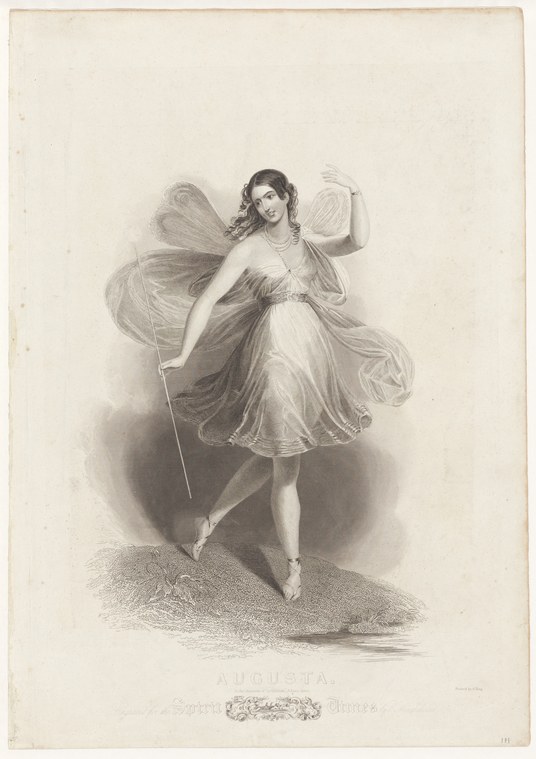
Augusta, in the character of La sylphide: a fancy sketch, engraved for the Spirit of the times
Unknown artist
- Collection:
- Prints depicting dance
- Source:
- New York Public Library
- Rights:
- Public domain — free to use, share and adapt.
- Recorded as:
- Public Domain
This is one of the most important roles in ballet history, and this engraving is an early visual document of how it was performed and understood by a dancer at the center of the romantic movement. It shows the aesthetic values of romantic ballet—weightlessness, ethereality, the supernatural—encoded in a single image, and it records a specific performer's claim on the role during a period when *La Sylphide* was being performed and reimagined across Europe.
What you are looking at
A winged female figure in classical dress hovers in a luminous space, her body tilted in an attitude of graceful suspension. She wears a fitted bodice and a translucent skirt that falls to mid-calf, and her long dark hair flows loosely around her shoulders. Two large, delicate wings extend from her back, rendered with fine detail and a gossamer quality. Her right arm reaches upward in an arc; her left arm is bent at the elbow. She stands en pointe or nearly so on her left leg, with her right leg extended behind her in an elegant line. The setting is atmospheric rather than literal—a soft ground suggests earth, while the background fades into pale tones that create an ethereal, otherworldly mood. The figure is isolated against this neutral background, spotlit by subtle gradations of tone that emphasize her weightlessness. The engraving technique creates a silvery quality throughout, with fine cross-hatching building form and shadow.
The dancing
The dancer's frame is upright but gently curved, the arc of her raised right arm complementing the extension of her left leg in a classic balletic line. Her weight appears to be supported on the ball of one foot, with the other leg lifted and lengthened behind her—a position characteristic of romantic-era ballet vocabulary. Her torso leans slightly forward from the hips, creating a sense of suspension and forward motion despite the static medium. The winged silhouette and the ethereal gesture suggest a being not bound by gravity—the arms and legs work together to create an impression of effortless flight rather than grounded dance.
The dance depicted
This depicts the Sylphide, the titular character of *La Sylphide*, the foundational work of romantic ballet first performed in 1832. The character is a supernatural creature—weightless, fleeting, and ultimately unattainable—and the costume and pose are iconic: the white tutu, the wings, the en pointe stance. Augusta was a celebrated dancer of the 1830s–40s, and this engraving preserves her interpretation of the role, one of the most coveted in early romantic ballet. The image captures the Sylphide as an apparition, emphasizing the dancer's role as an inhuman, ethereal being rather than as a character embedded in narrative action.
How it was made
This is a steel or copperplate engraving, executed with fine linear detail and tonal shading to create luminosity and form. The catalogue indicates it was engraved for publication in *Spirit of the Times*, a periodical likely aimed at theatre-goers and educated readers. The precision of the engraving allowed for wide circulation—this was a commercial print, not a unique object—and it served as a way to disseminate images of celebrated performers to audiences who may not have attended performances. The technique's ability to render delicate details—the wings, the fabric texture, the curling hair—made it ideal for capturing the ethereal quality central to the Sylphide fantasy.
About this work
This is a portrait engraving of the dancer Augusta in her most famous role, the Sylphide in *La Sylphide*. It documents a pivotal moment in ballet history: the emergence of the romantic movement in the 1830s, when ballerinas were repositioned as supernatural, weightless beings rather than mere virtuosos. The image is also a record of a specific performer's stardom—the engraving was made for mass publication, suggesting Augusta was a public figure of real significance.
The work belongs in a dance history collection as evidence of how the romantic ballet aesthetic was visualized, marketed, and consumed in its own time. It shows not what the performance looked like—it is a stylized, idealized image—but what audiences wanted to believe about the performance: that the dancer transcended the physical world. The engraving is also a rare survival of early theatrical celebrity culture, capturing the apparatus by which star dancers achieved fame beyond the stage.
How to look at it
Observe the moment the artist chose to freeze: not a step or a turn, but a suspended moment of weightless grace. The dancer's weight is poised on one foot en pointe, while the other leg stretches behind her; her arms frame an upward reach. This is not a moment of arrival but of ascent. The wings are not theatrical prosthetics but anatomical extensions, drawn as though they were part of her body. Notice how the engraver used tone and line to create an impression of glowing luminosity around the figure, isolating her against the void—a visual technique that reinforces the idea of the Sylphide as otherworldly. The image is less a document of technique and more a visualization of romantic fantasy: an impossible figure, impossibly poised.
The period
This engraving dates to the 1830s–40s, the height of romantic ballet in Europe. *La Sylphide*, choreographed by Filippo Taglioni and first performed in Paris in 1832, became the template for romantic ballet: a narrative centered on a male protagonist's desire for an unattainable supernatural female, set to music that emphasized mood over virtuosity. The romantic movement in ballet coincided with and drew aesthetic sustenance from romanticism in literature and visual art—a turn toward the ethereal, the Gothic, the emotionally intense, and the otherworldly. The engraving participates in this aesthetic, selling the fantasy of the supernatural to a public appetite for transcendence. Such prints were common during this period; they advertised performers and distributed star images far beyond the theatre, creating the first modern theatrical celebrity culture.
Where it lives
This engraving was published in *Spirit of the Times*, a periodical presumably aimed at theatre-goers and the culturally engaged public. The work is held in the New York Public Library's Prints Collection, part of a broader assembly of theatrical imagery from the 19th century. It is a commercial print, made for circulation and consumption, not a unique work of art.
Dance in this work
Questions about this work
Who was Augusta?
Augusta was a celebrated dancer of the 1830s–40s known for her performances in romantic roles, particularly the Sylphide. This engraving preserves her interpretation of one of the most coveted parts in romantic ballet, a role written for the ethereal, weightless bodies that defined the movement. Very little is known of her life outside the stage, but this image attests to her fame during her era.
What is La Sylphide?
*La Sylphide* (1832) is the foundational work of romantic ballet, choreographed by Filippo Taglioni for Paris. It tells the story of a young man enchanted by a supernatural sylph (a fairy-like creature) whom he desires but can never possess. The ballet became the template for romantic ballet aesthetics: emphasis on otherworldliness, weightlessness, and emotional intensity rather than technical display. The Sylphide herself—the role depicted here—is the ultimate unattainable beloved, a creature of fantasy rather than human desire.
What does 'en pointe' mean?
En pointe means dancing on the tips of the toes, supported by reinforced pointe shoes. It became the signature of romantic ballet, conveying weightlessness and ethereality. You can see the dancer in this engraving rising onto the ball of one foot, suggesting the height and buoyancy central to the Sylphide character. By the romantic era, en pointe had become so associated with otherworldly feminine figures that it was nearly synonymous with the supernatural.
Why was this engraved for Spirit of the Times?
*Spirit of the Times* was a literary and cultural periodical that covered theatre among other topics. Publishing an engraving of a celebrated performer was a form of theatrical marketing—a way of circulating the image of a star to a wider public and generating excitement around the role and the performer. This was the 19th-century equivalent of a publicity photograph or film still.
More dance artwork





