49 works in this view — arrow keys or swipe to move between them.
Dance in Art
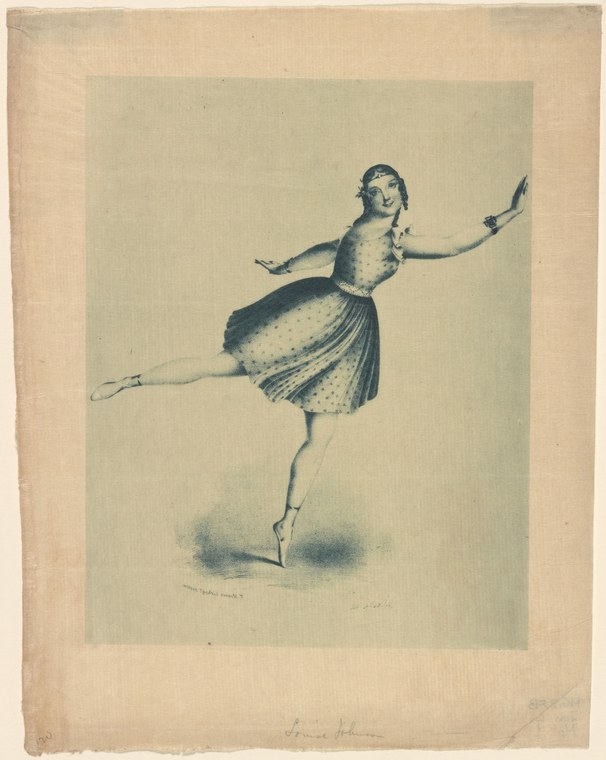
Louise Johnson as Columbine
Unknown artist
- Collection:
- Prints depicting dance
- Source:
- New York Public Library
- Rights:
- Public domain — free to use, share and adapt.
- Recorded as:
- Public Domain
This print is a rare named portrait of a female ballet dancer from the 1830s–1860s, a period when most dancers left little documentation. The extreme arabesque pose tells us that by this date, virtuosic ankle and leg work—typically male territory—was being incorporated into female performance; Johnson's body and the artist's choice to emphasize this moment reveal shifts in what female dancers were expected to achieve. The survival of the print, with Johnson's name attached, makes her briefly visible as a historical figure and performer in her own right.
What you are looking at
A young woman in theatrical dress performs a solo dance in a stark, minimally rendered interior. She stands on the ball of one foot in an exaggerated arabesque position, her body arched backward with her upper torso nearly horizontal and her free leg extended high behind her. Her arms are raised and spread, one bent and one extended, in the classical ballet port de bras. She wears a short, gathered skirt with polka dots, a close-fitting bodice, and what appears to be a short-sleeved or sleeveless top—a costume consistent with early 19th-century theatrical dress. Her face is delicate and idealized, turned upward toward the raised arm. The figure casts a soft shadow on the ground beneath her. The composition is rendered in sepia tones with fine linear work, against a plain background that emphasizes the isolation of the dancer.
The dancing
A single dancer performs an extreme arabesque penché—a signature pose of Romantic and early Classical ballet in which the supporting leg is nearly straight and the raised leg climbs high behind the body. The arms frame the body in a classical position with clear opposition to the leg line. Her weight is concentrated on the ball of the foot, demonstrating the turned-out, ethereal lightness prized in early 19th-century ballet. The extended posture suggests a moment of suspension rather than a grounded movement, which is characteristic of the male ballet virtuoso's vocabulary adapted here for a female dancer.
The dance depicted
This is plainly theatrical ballet, almost certainly Romantic-era ballet given the costume, the pose, and the idealization of the figure. The arabesque penché was a signature technical display, often seen in male variation choreography of the 1840s–1860s, and its appearance here in a portrait of Louise Johnson suggests either that she danced such virtuosic material or that the image capitalized on contemporary audience fascination with extreme technical feats. The specific attribution to Johnson 'as Columbine' indicates this may be a character study from a ballet or pantomime in the Commedia dell'arte tradition, a lineage that remained vital in theatrical dance through the 19th century. However, Columbine was traditionally a female lover or comedic character in lighter works; the extreme technical display here is unusual for that role and suggests either a fusion of character and spectacle or a misremembering of the title.
How it was made
This is a finely executed engraving or etching on paper, rendered in sepia ink or brown wash with delicate line work. The technique allows for precise anatomical rendering and the subtle modeling of form through cross-hatching and tonal gradation. The paper is aged to a warm tan, consistent with early-to-mid 19th-century print work. The fineness of line and the refinement of execution suggest this was produced as a distributed print—a portrait of a named performer for circulation among audiences and collectors. This mode of portraiture was common in theatrical culture of the 1830s–1850s, when dance and theater prints were collected as mementos and souvenirs.
About this work
This is a portrait print of Louise Johnson, a theatrical dancer, captured mid-pose in an extreme arabesque that displays the technical vocabulary of early 19th-century ballet. The image preserves a moment of virtuosic display that would have been both visually striking and ephemeral in live performance. It belongs in a dance art archive precisely because it documents not only what a performer looked like but how the body was arranged and idealized in a specific historical moment—the image reveals the aesthetic and technical priorities of Romantic-era ballet as much as it documents Johnson's own skill and fame. The work sits at the intersection of theatrical history, printmaking culture, and dance documentation.
How to look at it
Attend first to the precision of the line and the care taken to render the dancer's line from head to toe—the artist has made anatomical truth serve aesthetic beauty, which is the ballet principle itself. Notice the extreme architecture of the pose: the body is nearly folded in half, with the upper torso tilted so far forward that it creates a sense of impossible lightness and danger. The artist has chosen the moment of maximum extension, the instant of suspension, not a dynamic transition. This is a portrait of a pose, not a narrative moment, which reflects 19th-century convention in dance prints: the performer is shown in her most technically accomplished and visually flattering arrangement, removed from the flow of time.
The period
This print dates from the height of Romantic ballet, when the ethereal, weightless female dancer became the central theatrical ideal. Works like Taglioni's *La Sylphide* (1832) and *La Bayadère* (1877) celebrated the dancer's ability to create an illusion of effortlessness and flight, achieved through the arabesque, the relevé, and the pointe shoe. Male dancers, by contrast, were celebrated for explosive virtuosity—multiple pirouettes, beats, and elevation—a gender division that was beginning to blur by mid-century as female dancers absorbed and repackaged male technical vocabulary. Louise Johnson's portrait captures this moment of technical ambition: a female dancer holding a pose that declares her mastery of demanding technique. The print medium itself was the dominant form of dance documentation in this era, since photography was still slow and expensive; prints allowed the democratization of performance images and the construction of a performer's celebrity.
Where it lives
The work is held in the New York Public Library's collection of prints depicting dance. No artist is recorded in the catalogue; the attribution and date are unknown. It is catalogued by subject (Louise Johnson as Columbine) rather than by creator.
Dance in this work
Questions about this work
Was Louise Johnson a famous dancer?
Johnson appears in this print as a named performer, suggesting she had sufficient prominence in the 1830s–1860s to merit a portrait for public circulation. However, no other historical record of her has been easily located. She is one of many dancers whose work was preserved only in print form, often fading from theatrical histories if she did not dance in a major company or famous work.
What is this pose and why is it so extreme?
This is an arabesque penché (or high arabesque), a signature position in Classical and Romantic ballet. The raised leg climbs as high as possible behind the dancer while the upper body tilts forward to counterbalance. It is extreme because it tests the dancer's flexibility, core strength, and sense of balance; holding it is both beautiful and technically difficult. The pose was especially prized in male variation choreography as a moment of virtuosic display.
Why is she labeled 'as Columbine'?
Columbine is a stock character from Commedia dell'arte and 19th-century pantomime—usually a clever, flirtatious girl. The label suggests this is either a character study from a theatrical work or a promotional image tying Johnson to a particular role. The extreme technical pose is unusual for a Columbine character, which raises the question of whether the title is accurate or whether the image emphasizes technical virtuosity over character.
How do we know this is Romantic-era ballet?
The costume, the pose, the emphasis on weightlessness and vertical extension, and the idealized beauty of the figure are all hallmarks of Romantic ballet (roughly 1830–1870). The arabesque was a central vocabulary of this style, and the extreme version shown here reflects the period's fascination with technical display and the illusion of effortlessness.
More dance artwork





