49 works in this view — arrow keys or swipe to move between them.
Dance in Art
Le cake walk
Unknown artist
- Collection:
- Prints depicting dance
- Source:
- New York Public Library
- Rights:
- Public domain — free to use, share and adapt.
- Recorded as:
- Public Domain
The cake walk is one of the earliest dance forms to circulate globally through print media and to be transformed by that circulation from vernacular social dance into theatrical commodity. This image shows precisely how that transformation worked: through exaggeration of the body, theatricalization of dress, and removal of social context. For dance historians it is evidence of transnational appropriation, media circulation, and the role of commercial lithography in shaping what audiences thought they were seeing.
What you are looking at
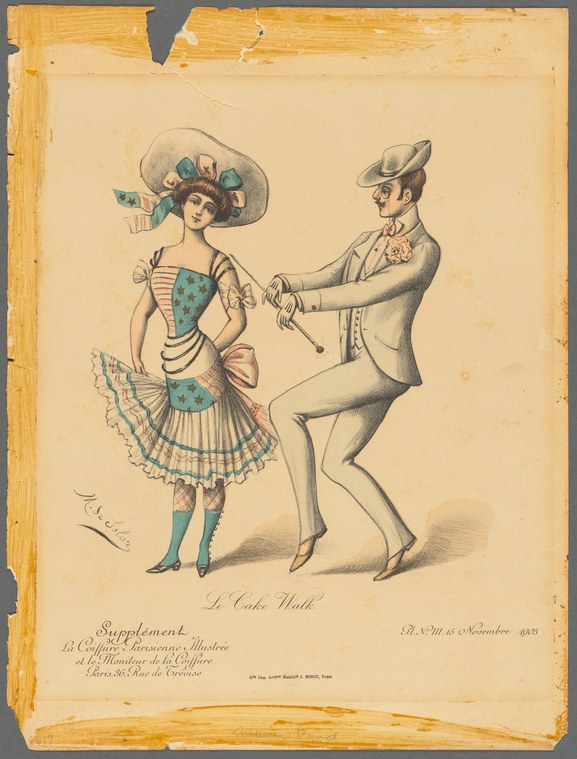
A man in a light tan suit and tall hat stands in profile, leaning backward with one leg extended in a high kick, his cane held aloft. Opposite him stands a woman in an elaborate costume: a large cartwheel hat trimmed with feathers and ribbons, a corset bodice with horizontal stripes, and a full skirt with deep pleats and ruffled hem in turquoise and cream. She poses with one hand on her hip, the other extended toward the man, her body turned three-quarter to the viewer. The setting is plain—a neutral background with minimal detail—which focuses all attention on the exaggerated postures and fashionable dress. The woman's skirt dominates the composition with its volume and patterning; the man's extreme lean and lifted leg create a diagonal thrust across the page. The line work is delicate and assured, with hand-coloring applied to costume detail.
The dancing
The two figures are not in contact and do not form a closed or standard ballroom frame. The man's posture is playfully exaggerated—his torso reclines sharply away from his partner while his right leg shoots upward, a comic inversion of balance. The woman's stance is more grounded and frontal, with weight anchored and arms gesturing openly. Neither figure demonstrates the vertical alignment or precise hold of a formal ballroom dance; instead, both bodies announce entertainment and social spectacle. The spatial relationship suggests they are performing for an audience rather than concentrating on partnered technique.
The dance depicted
This is the cake walk, a social dance that emerged in late 19th-century America with deep roots in African American culture and became an international novelty and craze in the 1890s-1900s. The cake walk was performed to ragtime or syncopated music and featured exaggerated, high-stepping movements, prancing walks, and playful body isolations—a deliberate parody of ballroom pretension. The man's extreme lean and high kick capture the dance's irreverent humor and show-off quality; the woman's poise and decorative costume suggest the spectatorial glamour it attracted. This appears to be a European document of the dance, likely French, rendering it as fashionable entertainment for the urban stage or print market rather than its vernacular origins.
How it was made
This is a hand-colored lithograph or engraving, identifiable by its linear construction, tonal modeling through line, and the precision of the costume detail. The coloring is selective and deliberate—applied chiefly to fabrics and trim rather than the faces or background—which is typical of commercial dance prints of the period. The technique allowed for multiple impressions at low cost, making such images accessible to a broad middle-class audience. The high finish and theatrical presentation suggest this was a commercial supplement or promotional image rather than a sketch or study; the inscription at the base confirms publication.
About this work
This is a European fashion and entertainment print documenting the cake walk, one of the most successful transatlantic dance crazes of the 1890s-1900s. The image captures the dance in its performed, spectatorial mode: exaggerated, witty, and luxuriously dressed. It is neither a documentary of vernacular cake walking nor a record of concert performance, but rather a commercial image that standardized and glamorized the dance for European consumption. The print belongs to a large corpus of illustrated dance supplements and fashion ephemera produced for urban periodicals and collectors; the catalogue identifies it as a supplement to a French periodical. Within that context it is a primary document of how Euro-American audiences understood and commodified a dance of African American origin.
How to look at it
Notice the radical asymmetry of the two bodies: the man is all lean and lift, the woman all poise and decoration. This is not a moment of partnered dance but a theatrical pause—a performed exaggeration of the cake walk's most comic and eye-catching gestures. Observe too the costume: the woman's hat alone is an exercise in absurdist trimming, and it is no accident that the lithograph dwells on it. The print is selling the visual spectacle of the dance, not its rhythm or social function. The man's cane and the woman's assured posture remind us that this is entertainment for an elite or aspirational audience, not a record of the dance as it was danced in the communities where it originated.
The artist
The artist is not recorded in the catalogue. The style, subject, and production method are consistent with French commercial lithography of the 1890s-early 1900s, a period of high demand for dance and fashion ephemera. The signature on the stone (lower left) is illegible in the image. Such prints were typically produced by commercial houses in Paris for weekly and monthly periodicals; artists often worked anonymously or semi-anonymously. The quality of observation of the costume and the satirical sharpness of the pose suggest a professional illustrator with expertise in fashion and stage spectacle.
The period
The cake walk achieved international fame between roughly 1895 and 1910, arriving in Europe as an American novelty and becoming a fashionable entertainment in music halls, ballrooms, and print culture. In Paris especially, it was absorbed into the repertory of commercial dance and music-hall spectacle alongside cancan, chahut, and other ragtime-era attractions. European lithographic prints like this one played a crucial role in mediating the dance across the Atlantic: they standardized its visual form, emphasized its theatrical exaggeration, and stripped away its social and racial specificity, repackaging it as cosmopolitan high-fashion entertainment. The extreme silhouette and patterned fabrics also reflect high Edwardian fashion, with its large hats and corseted shapes.
Where it lives
The work is held in the New York Public Library's collection of prints depicting dance. It is identified as a supplement to a French periodical of the Gilded Age (date and exact publication unknown). The catalogue indicates it was a commercial print product, likely distributed as an inexpensive insert or standalone image for collectors of dance and fashion ephemera.
Dance in this work
Questions about this work
What is the cake walk?
The cake walk is a social dance that originated in African American communities in the American South, likely in the late 19th century. It featured high-stepping, strutting walks, exaggerated body isolations, and playful humor, and was performed to syncopated and ragtime music. It became an international craze in the 1890s-1900s, especially in Paris. This print shows it as a theatrical spectacle rather than how it was danced in its vernacular contexts.
Who made this print?
The artist is not recorded. The image is a hand-colored lithograph or engraving produced in France, likely in the 1890s-1900s, for a commercial periodical. The signature on the stone is not legible in the reproduction. Such prints were typically produced by commercial houses and distributed widely to urban audiences.
Why is the man leaning so far back?
The extreme backward lean and high kick are exaggerations of the cake walk's most theatrical and eye-catching gestures, chosen to amuse and astound. The artist is capturing the dance at its most comic and performative, not at a moment of actual social dancing. This was part of how European audiences understood the cake walk: as spectacle, novelty, and entertainment.
Why are the costumes so elaborate?
The woman's costume reflects both 1890s-1900s high fashion and the theatrical glamorization of the cake walk as it circulated through European print and stage culture. The man's light suit and tall hat suggest formal evening wear adapted for comic performance. Together they communicate that this is a fashionable entertainment for a prosperous, urban audience.
More dance artwork





