49 works in this view — arrow keys or swipe to move between them.
Dance in Art
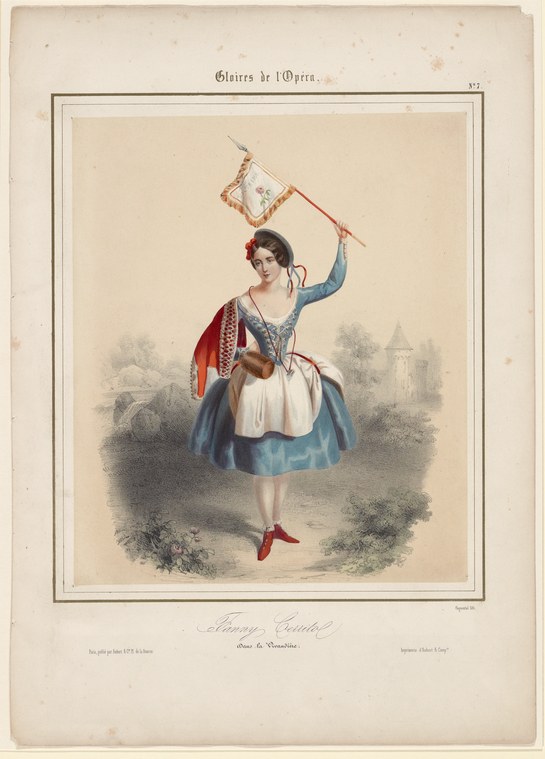
Fanny Cerrito dans La vivandière
Unknown artist
- Collection:
- Prints depicting dance
- Source:
- New York Public Library
- Rights:
- Public domain — free to use, share and adapt.
- Recorded as:
- Public Domain
This work documents a canonical role in Romantic ballet history by one of the era's greatest dancers. For historians, it provides evidence of how Romantic ballet characters were visualized, costumed, and promoted; for dancers, it shows the bodily ideals and technical standards of the period frozen in a single, unforgettable image.
What you are looking at
A young woman in Romantic-era theatrical costume stands alone against a softly sketched landscape of trees and distant architecture. She wears a white muslin skirt with a fitted blue bodice, a red shawl draped across one shoulder, and red heeled slippers. Her dark hair is styled in the fashion of the 1840s. She holds aloft in her right hand a small banner or flag bearing a coat of arms, her arm extended upward in a gesture of proud display. Her body is lifted onto the ball of one foot in a pose suggesting lightness and elevation; her left leg extends behind her. The figure is rendered in hand-colored lithographic print, with soft pastels used for the flesh tones, costume details, and background wash. The title identifies her as Fanny Cerrito in *La vivandière* (The Vivandière, or Sutler's Daughter).
The dancing
A single dancer captured in an attitude—a balletic pose with the supporting leg turned out and the free leg extended behind, the torso upright and the head proud. Her right arm rises high to display the banner; her left arm is softly positioned to balance the composition. The pose demonstrates the turned-out hip and ankle placement characteristic of classical ballet of the period. Her weight is on the ball of the supporting foot, creating an illusion of weightlessness and elevation typical of Romantic ballet aesthetics. The body is slender, elongated, and held with the upright carriage demanded by the style.
The dance depicted
Fanny Cerrito (1817–1909) was one of the leading ballerinas of the Romantic era, famous for her virtuosity and dramatic presence. *La vivandière*, choreographed by Joseph Mazilier with music by Léon Minkus, premiered at the Paris Opéra in 1844 and became one of her most celebrated roles. The character of the vivandière—a woman who follows an army to sell provisions—allowed Cerrito to perform a spectacular solo combining pantomime, character dancing, and classical ballet technique. The banner suggests the military or patriotic content of the narrative. This print captures the Romantic ideal of the ballerina as ethereal yet dramatically expressive, blending technical virtuosity with theatrical storytelling.
How it was made
This is a hand-colored lithographic print, a technique that allowed for wider circulation of dance imagery than oil painting. The artist has worked with soft pastels and watercolor washes to achieve the delicate modeling of skin tone, the translucency of the muslin skirt, and the atmospheric recession of the background. Lithography was the dominant medium for theater prints and celebrity portraiture in the 1840s, making images of famous dancers affordable and collectible. The inscription at the foot—"Fanny Cerrito dans La vivandière"—identifies both performer and role, confirming this as a promotional or commemorative print.
About this work
This is a hand-colored lithographic print of Fanny Cerrito in the title role of *La vivandière*, a ballet that became a signature vehicle for her artistry. The image captures the aesthetic and technical ideals of Romantic ballet: a single figure, weightless and uplifted, dressed in the contemporary fashion of the character she portrays, frozen in a moment of pride and display. The work belongs to a large corpus of mid-19th-century theater prints that documented the celebrated dancers of the Paris Opéra and disseminated images of their famous roles to a broad public audience.
Cerrito's pose—the lifted attitude, the turned-out leg, the proud bearing—encodes the classical ballet training and the theatrical personality that made her famous. The print is both a record of a specific historical performance and an advertisement for a star at the height of her powers. It is exemplary of how Romantic ballet was consumed visually and commercially in its own time.
How to look at it
Look at how the artist has chosen the moment of display—the flag held high, the body lifted, the gaze confident—rather than a moment of complex movement or interaction. This is the grammar of celebrity portraiture as much as dance documentation: the pose is one the dancer could hold for a portrait session, yet it also encodes the balletic vocabulary of the time (the turned-out hip, the lifted torso, the upright carriage). The soft coloring and atmospheric background create an almost dreamlike quality, suspending the figure between theatrical reality and romantic fantasy. The vivandière's folk costume—the red shawl, the white skirt, the heeled slippers—was as much a fantasy of military camp life as the ballet technique was a fantasy of weightlessness.
The artist
The artist is not recorded in the catalogue, but the print carries a publisher's mark that would have identified the house responsible for its production and distribution. Lithographic prints of theater celebrities were a major industry in 1840s Paris, produced by workshops that employed skilled colorists and distributors. The style and finish of this work suggest it came from one of the leading Parisian theater print publishers, most likely Martinet or a comparable house.
The period
The 1840s were the height of the Romantic ballet era in Europe. The Paris Opéra dominated the world of dance, and its leading ballerinas—Cerrito, Marie Taglioni, Lucile Grahn, Carlotta Grisi—were international celebrities whose images were collected and traded. Theater prints had become a major form of visual media, allowing fans to own likenesses of their favorite performers and to follow new roles as they premiered. The vivandière character and the patriotic or military themes in ballets of this period reflected broader European political interests in nationalism and history. At the same time, Romantic ballet aesthetic idealized the ballerina as ethereal, otherworldly, and technically sublime—a transformation of the human body into something transcendent.
Where it lives
The work is held in the New York Public Library's collection of theater prints and dance imagery. It is one of thousands of mid-19th-century lithographs documenting European Romantic ballet, a collection that provides visual and material evidence for the history of performance in this period.
Dance in this work
Questions about this work
Who was Fanny Cerrito and why was she famous?
Cerrito (1817–1909) was an Italian-born ballerina who rose to prominence at the Paris Opéra in the 1840s. She was renowned for her technical brilliance, her dramatic presence, and her skill in creating roles that blended classical technique with character dancing and pantomime. She rivaled Marie Taglioni as the leading ballerina of the Romantic era and created starring roles in works like *La vivandière*, *Ondine*, and *Marco Spada*.
What was a vivandière and why did ballet dancers perform this role?
A vivandière was a woman who followed an army into the field to sell provisions, laundry services, and other supplies to soldiers. The character became a fixture in 19th-century Romantic ballet and opera because it allowed for a mix of folk-like character dancing, dramatic storytelling, and opportunities for virtuosity. In Cerrito's *La vivandière*, the role combined patriotic sentiment, military spectacle, and opportunities for a star ballerina to display both technical skill and dramatic range.
How did theater prints like this one circulate, and who bought them?
Theater prints were produced in large quantities by Parisian publishing houses and sold through print shops, bookstalls, and by street vendors. They were affordable enough for a broad middle-class audience and were collected by theater fans, dancers, and others interested in fashion and celebrity. The prints served as both souvenirs of performances and advertisements for the next season's offerings. Some were pasted into scrapbooks or used as decoration; others were collected systematically.
What does the pose tell us about Romantic ballet technique?
The attitude pose—standing on one leg with the other extended behind at a turned-out hip—was a foundational position in classical ballet. The illusion of weightlessness and elevation, created here by the lifted torso and pointed foot, was central to Romantic ballet aesthetics. The upright carriage, the turned-out legs, and the graceful arm placement all demonstrate the technical standard expected of a prima ballerina of this period.
More dance artwork





