49 works in this view — arrow keys or swipe to move between them.
Dance in Art
Répétition à l'Opéra
Unknown artist
- Collection:
- Prints depicting dance
- Source:
- New York Public Library
- Rights:
- Public domain — free to use, share and adapt.
- Recorded as:
- Public Domain
This work documents the actual practice of Romantic ballet at a moment when rehearsal images were themselves becoming subjects of artistic and commercial interest. It shows how the corps de ballet—the collective body at the centre of 19th-century ballet spectacle—was trained, arranged, and conducted. For historians and dancers, it offers rare visual evidence of pedagogical method, spatial organization, and the scale of ensemble work in the mid-to-late 19th century.
What you are looking at
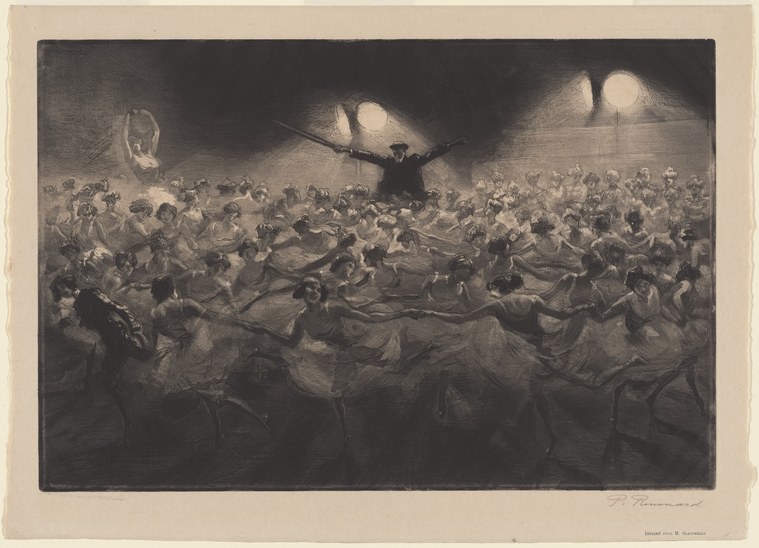
A nocturnal rehearsal scene at an opera house, rendered in dramatic chiaroscuro. Dozens of dancers in pale, flowing costumes—legs extended, bodies arched, arms reaching—fill the darkened stage in a mass choreography. A conductor or master figure stands elevated in silhouette at center, arms raised to direct the ensemble below. The stage is lit by work lights creating pools of illumination against deep shadows; the architectural vault and rigging of the theatre are barely visible overhead. The composition is dense and rhythmic, with bodies overlapping and interlocking in a geometric pattern that suggests both a formal ballet arrangement and the candid chaos of active rehearsal. The costumes are diaphanous and classical—Romantic tutus or simple draped skirts—but the lighting and medium lend the scene an otherworldly, almost dreamlike quality.
The dancing
The dancers are arranged in fluid, extended positions typical of Romantic-era ballet: arabesque-like leg extensions, lifted torsos, and raised arms creating vertical and diagonal lines across the composition. Bodies are grouped in loose patterns rather than rigid formations, suggesting the organic movement of rehearsal rather than the precision of performance. The conductor's raised arms establish a focal point and suggest an active moment of instruction or coordination. The dancers' poses show considerable extension and lightness—they appear to be airborne or weightless, typical of the pointe work and ethereal quality of 19th-century ballet vocabulary.
The dance depicted
This is unmistakably a Romantic ballet rehearsal, most likely from the mid-to-late 19th century. The dancers' Romantic tutus, the ethereal poses, the massed ensemble work, and the theatre setting all point to the classical ballet tradition of the period. The informality of the rehearsal setting—the work lighting, the density of bodies, the conductor's active instruction—suggests an artist interested in capturing the labour and process behind the glamour of stage performance rather than the polished final spectacle. The scale of the ensemble indicates this is likely a corps de ballet rehearsal, possibly for a major ballet such as *Giselle*, *Swan Lake*, or similar works that required large synchronized groups.
How it was made
This is a lithograph or engraved print (the exact medium is not recorded, but the technique is clearly reproductive printmaking, not an original drawing). The tonal range and soft modeling of light and shadow suggest lithography's characteristic ability to render graded tones and atmospheric effects. The print's theatrical use of darkness—with figures emerging from shadow—is distinctly suited to the medium's capacity for dramatic chiaroscuro. The work shows the technical skill required to translate a complex, crowded composition into print while maintaining both clarity and mood. As a reproductive print, this would have been accessible to a broad 19th-century audience interested in ballet and theatre culture.
About this work
This is a glimpse into the 19th-century ballet studio during active rehearsal, captured in a medium that was itself a vehicle for theatrical imagery and cultural circulation. The print belongs to a broader 19th-century fascination with depicting not just the polished performance but the hidden process of artistic creation—the sweat, labour, and communal effort behind the ethereal spectacle audiences saw onstage. The Romantic era's obsession with lightness, transcendence, and the feminine ideal is visible in every extended leg and arched back, yet the rehearsal setting anchors it in the real, material world of the dance-maker's studio. The print's dramatic lighting and dense composition convey the energy and complexity of massed ensemble training, a labour-intensive process central to 19th-century ballet production.
How to look at it
The eye should first be drawn to the conductor's raised arms at the composition's centre, which organizes the entire scene around a moment of active direction. From there, scan the overlapping bodies around him, noting the variety and repetition of extended poses—the overlapping arabesques and raised arms create a rhythmic pattern that mirrors the actual choreography being taught. Look closely at the feet: where visible, they suggest the weight and suspension typical of ballet training. Observe how the dramatic lighting isolates and clarifies individual bodies while also merging them into a collective, almost chorus-like mass. The contrast between the sharply lit figures and the deep shadow creates a sense of concentrated attention—the viewer is witnessing an intimate moment of labour, not a public triumph.
The period
This rehearsal scene dates to the height of the Romantic ballet era (likely 1850s–1880s), when ballet in France was dominated by the Paris Opéra and works like *Giselle* (1841), *La Sylphide*, and later *Swan Lake*'s European productions. The 19th century saw an explosion in theatrical imagery and prints capturing behind-the-scenes moments as part of a broader cultural appetite for theatre ephemera and the demystification of artistic process. Lithography and engraving were the primary means of mass-producing and distributing such images, making them affordable and accessible to middle-class audiences. The conductor figure in this print reflects the formalization of ballet instruction under rigid pedagogical systems—the codification of classical technique that would culminate in syllabi like the Cecchetti method.
Where it lives
The work is held in the New York Public Library's collection of prints depicting dance. As a lithograph or engraving, it belongs to the class of reproductive prints that were the primary medium for disseminating theatrical imagery in the 19th century.
Dance in this work
Questions about this work
Where is this rehearsal taking place?
The title identifies this as a rehearsal at the Opéra—almost certainly the Paris Opéra, the preeminent ballet institution of the 19th century. The stage architecture, the scale of the ensemble, and the formality of the rehearsal all reflect the hierarchical, well-resourced practice of the major European opera houses.
What ballet is being rehearsed?
The print does not identify a specific ballet. The scale of the corps and the Romantic-era costumes and poses suggest a major Romantic-era work, likely one of the canonical ballets of the mid-to-late 19th century, but the specific work cannot be determined from the image alone.
Who is the figure in the centre?
The raised arms and elevated position suggest a ballet master, conductor, or choreographer directing the rehearsal. In the 19th-century hierarchy of the opera house, this would have been a senior figure responsible for instruction and artistic direction of the ensemble.
Why is this scene lit so dramatically?
The theatrical lighting is partly a choice by the artist to convey the drama and intensity of the rehearsal, but it also reflects how rehearsals at major opera houses were actually lit—by gaslight and work lights that created pools of visibility in otherwise dark theatres. The dramatic effect emphasizes the labour and concentration at work.
More dance artwork





