49 works in this view — arrow keys or swipe to move between them.
Dance in Art
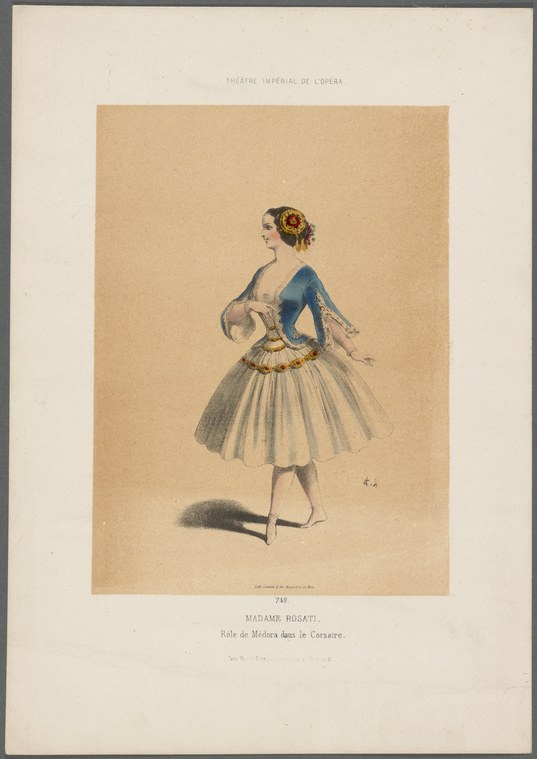
Théâtre impérial de l'Opéra. Madame Rosati, rôle de Médora dans Le corsaire
Unknown artist
- Collection:
- Prints depicting dance
- Source:
- New York Public Library
- Rights:
- Public domain — free to use, share and adapt.
- Recorded as:
- Public Domain
Madame Rosati was one of the most celebrated Italian ballerinas of the 1850s, and *Le Corsaire* was a defining work of the Romantic ballet repertory. This print is documentary evidence of how the role was performed, danced, and marketed in its own era. For historians and dancers, it anchors questions about Romantic technique, costume, and the star system to a specific, traceable image.
What you are looking at
A woman in mid-nineteenth-century theatrical dress stands alone against a warm tan background, her body angled in profile facing left. She wears a dark blue bolero jacket with fitted waist and long sleeves, paired with a voluminous pale skirt that falls below the knee in the characteristic silhouette of the 1840s-50s. Her hair is swept up and pinned, with a golden ornament or jewel catching the light. Her left arm extends gracefully forward at shoulder height, the hand positioned as if reaching or gesturing; her right arm hangs at her side. The figure casts a distinct dark shadow on the ground, emphasizing the theatrical lighting. The pose is one of controlled elegance, the body weightless and composed, the gaze directed away from the viewer—a moment of suspended narrative rather than energetic movement.
The dancing
The dancer stands in an upright, vertically extended frame typical of Romantic-era ballet, with elongated lines from crown to toe. The extended left arm and the reach of the gesture suggest a classical port de bras, while the free-standing posture and the way the weight appears concentrated and lifted (rather than planted) is consistent with the demands of pointe work. The silence and stillness of the figure are deliberate: this is not a moment of vigorous turning or beating, but of poised, sustained control. The detailed rendering of the skirt's folds suggests the garment is substantial and structured—likely the tulle or silk net skirts required for the full Romantic tutu.
The dance depicted
This is a portrait of Madame Rosati in the role of Médora from *Le Corsaire*, a ballet first performed in 1856 with a libretto by Eugène Coralli and Joseph Mazilier and music by Adolphe Adam. Médora is a young captive dancer and slave who becomes the hero's romantic interest; the role demands virtuosity in both allegro technique and expressive pantomime. The still, isolated presentation of the dancer—removed from any narrative context or corps de ballet—emphasizes the star performer and her grace in repose rather than in motion, a convention of the Romantic ballet print.
How it was made
This is a hand-colored lithographic print, a medium that allowed for rapid, economical production and wide circulation in the mid-nineteenth century. The soft handling of the tan background and the delicate gradations of color in the skirt show lithography's capability for subtle tonal effects; the black outlines of the jacket and the precision of the hair ornament demonstrate its capacity for crisp detail. The coloring appears to be applied by hand rather than mechanically, suggesting a higher-end variant of this print technology. The medium made theatrical portraiture accessible to a broad public and was standard for promoting stars and ballets of the period.
About this work
This is a celebrity portrait of a nineteenth-century prima ballerina in one of the era's most famous roles, preserved in the form of a hand-colored lithographic print. It documents both the physical presence of a celebrated performer and the aesthetic conventions of Romantic ballet—the ethereal silhouette, the poised and controlled body, the emphasis on grace and nobility of line. The print was likely sold at the theatre, in print shops, or through subscription, making it a mass-market yet artistically refined record of a specific performer in a specific role. It belongs in a gallery of dance art because it captures a precise historical moment in how ballet was danced, costumed, promoted, and consumed.
How to look at it
Attend to the pose: it is not a moment of technical display (no extension, no turn, no leap) but of narrative pause—a moment in which the character presents herself to the audience, inviting recognition and sympathy. The artist has chosen stillness over movement, and the shadow and the empty space around the figure emphasize her isolation and vulnerability. The soft, warm tone of the background is characteristic of lithography and contrasts with the precise detailing of the costume, making the figure seem both ethereal and real. Notice how the skirt dominates the image, occupying more space than the upper body; this was the visual trademark of the Romantic tutu and a marker of fashion and prestige.
The artist
The artist is not recorded in the catalogue. The print carries a signature or mark (visible as 'A.4.' or similar in the lower right), but it has not been identified. Such unsigned or sparsely credited prints were common in theatrical print production of the period; they were commercial products rather than fine art prints, and their makers—who might be lithographers, colorists, or designers—often went unnamed. The style and technique are consistent with the output of Parisian theatrical print shops, which dominated this market in the 1840s-50s.
The period
This print dates to the height of Romantic ballet, when the genre moved away from virtuosity and spectacular machinery toward themes of the exotic, the supernatural, and the melancholic. *Le Corsaire*, though premiered in 1856, exemplified an earlier phase of this movement—tales of adventure, slavery, and rescue in distant lands. Lithography had become the standard medium for theatrical promotion by the 1840s, and star dancers had become celebrities whose likenesses were collected and traded much as photographs of film stars would be later. The isolated, formal presentation of the dancer—alone, in full costume, in a studio-like setting—was the standard format for ballet prints of the period, designed to be framed or pasted into albums.
Where it lives
This print is held by the New York Public Library in its collection of prints depicting dance. It is one of thousands of such theatrical prints—portraits of dancers, scenes from ballets, and costume studies—that were produced, sold, and collected in the nineteenth and early twentieth centuries. The NYPL collection preserves them as documents of performance history and visual culture.
Dance in this work
Questions about this work
Who was Madame Rosati?
Carolina Rosati (1826–1905) was an Italian-born prima ballerina who became one of the most celebrated dancers of the Romantic era. She performed throughout Europe and was known for her virtuosity, elevation, and dramatic presence. She originated or performed in leading roles in many of the most famous ballets of the 1840s-50s, including *Le Corsaire*, and was a favorite of audiences and critics.
What is *Le Corsaire* and what happens in it?
*Le Corsaire* (The Corsair) is a three-act ballet first performed in 1856, with music by Adolphe Adam and choreography by Eugène Coralli and Joseph Mazilier. The plot follows a corsair (pirate) and his encounter with a slave girl, Médora, whom he rescues. It includes famous scenes such as the shipwreck, the slave market, and a grand pas d'action. Médora is one of the principal roles and a showcase for a ballerina's technique and expressivity.
How was this print made and distributed?
This is a lithographic print, hand-colored after printing. Lithography allowed rapid production at lower cost than engraving, making theatrical prints affordable and widely available. Prints like this were sold in theatre foyers, in print shops, and through subscription services. Collectors—both theatre patrons and dance enthusiasts—would purchase and frame them or paste them into albums as records of favorite performers and roles.
Why is the dancer so still?
The stillness is not a limitation but a convention. Theatrical prints of the period rarely depicted dancers in the midst of a jump or spin; instead, they presented them in a moment of repose or transition, allowing the full costume and silhouette to be visible and recognizable. This format also emphasized the performer's presence as a star and personality, not just a technician.
More dance artwork





