49 works in this view — arrow keys or swipe to move between them.
Dance in Art
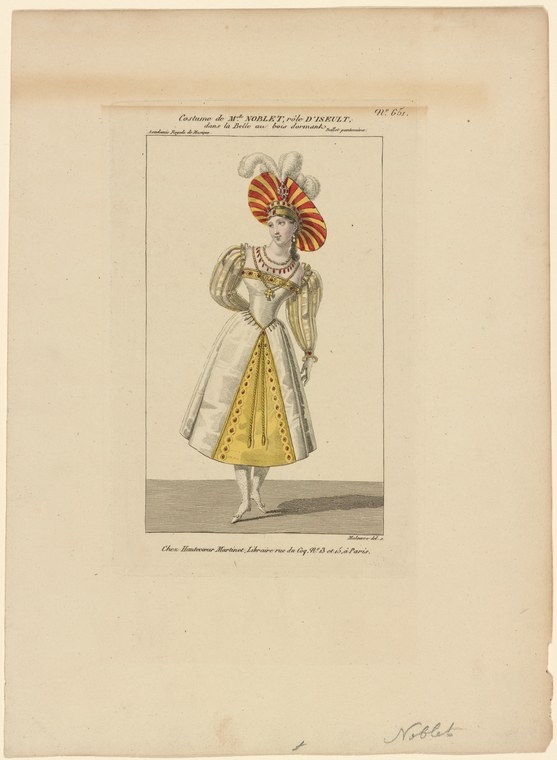
Costume de Melle. Noblet, rôle d'Iseult, dans La belle au bois dormant: Ballet pantomime, Académie Royale de Musique
Unknown artist
- Collection:
- Prints depicting dance
- Source:
- New York Public Library
- Rights:
- Public domain — free to use, share and adapt.
- Recorded as:
- Public Domain
Costume studies like this one are among the only reliable visual records of how celebrated dancers of the Romantic era dressed on stage and how roles were imagined and presented to the public. The specificity—naming the dancer, the role, and the theater—makes this a primary document in the history of French ballet, and the exotic character costume reveals the theatrical and aesthetic preoccupations of the period.
What you are looking at
A female dancer stands alone against a neutral ground in a formal frontal pose, gazing toward the viewer with a composed expression. She wears an elaborate costume of the Romantic era: a white muslin corsage with short puffed sleeves trimmed in gold, a full yellow skirt with gold spotted or embroidered details, and a striking headdress of red and gold radiating fan-like wings or pleats that frames her face. A pale blue-grey wrap or shawl drapes from her shoulders. The figure is presented as a costume study or stage portrait—a single performer in character, not part of a scene. The hand-colored engraving captures the precise detail of fabric textures and the jewelled ornaments at her neck, suggesting this is a record of an actual stage costume worn in a specific production.
The dancing
The dancer stands in a relaxed vertical alignment with her weight centered, arms at her sides in a natural pose rather than an active movement position. Her posture is upright and dignified, with shoulders back and chin level. There is no indication of motion, extension, or the dynamic positions typical of Romantic ballet technique—this is a pose of presentation and display, like a fashion illustration or costume plate, rather than a captured moment of dancing.
The dance depicted
This is a costume study for Mlle. Noblet, a dancer of the Paris Opéra, in the role of Iseult from the ballet-pantomime *La Belle au Bois Dormant* (The Sleeping Beauty), choreographed for the Académie Royale de Musique (the Opéra). The costume indicates a serious Romantic-era principal role, with the exotic headdress suggesting either an enchantress character or a dramatic interpretation of the fairy tale. The work documents stage costume rather than technique, serving as a reference or promotional image for the production.
How it was made
This is a hand-colored engraving, identified by the fine linear hatching visible in the ground and background, the precision of the drawn contours, and the application of watercolor or gouache for the costume details. The technique allowed for rapid multiplication of images and wide circulation—costume studies like this were distributed to audiences, collected by enthusiasts, and used as records of celebrated performances. The hand coloring was applied to each impression individually, making each a semi-unique object.
About this work
This is a costume study engraving of a Romantic-era ballet dancer in character dress, created to document or promote a specific production at the Paris Opéra. The image belongs in a gallery of dance art because it records not just a costume but a moment in the history of ballet theater—the role, the dancer, and the visual vocabulary of mid-nineteenth-century stage spectacle. The work sits at the intersection of fashion, theatrical documentation, and ballet historiography, offering evidence of how roles were created, promoted, and remembered before photography made such hand-drawn records obsolete.
How to look at it
Attend to the headdress as the key to understanding the character and the era's stage aesthetics. The radiating fan-wings are typical of Romantic-era exotic or supernatural roles—a visual marker that signals Iseult as an enchantress or otherworldly figure. Notice also the formal, almost heraldic simplicity of the pose and the symmetrical arrangement of the figure on the page; this is not a dancer captured in motion but a costume displayed for inspection, in the manner of a fashion plate or a theatrical playbill. The hand coloring—the gleaming yellows and reds—emphasizes the splendor and expense of stage costume.
The artist
The artist is not recorded in the catalogue, which is typical for reproductive engravings of this period. The work was almost certainly created by a specialist theatrical engraver working for the Opéra or a Parisian print publisher, as part of a series documenting celebrated performers and productions. Such engravings were often based on sketches or observations made at dress rehearsals or performances.
The period
This work dates to the mid-nineteenth century, the height of the Romantic ballet period in France (roughly 1830–1870). The era saw the development of the pointe shoe, the tutu, and the aesthetic of weightless, ethereal femininity. The role of Iseult in *La Belle au Bois Dormant* belongs to this tradition of story-ballets adapted from medieval and fairy-tale sources. Paris was the capital of ballet during this period, and the Opéra was its presiding institution. Costume studies were a standard form of theatrical promotion and documentation.
Where it lives
The work is held in the Prints collection of the New York Public Library, part of a larger archive of theatrical prints and dance imagery. It appears to be a single leaf from a published or distributed series of costume studies, and the source notation 'nypl' indicates its acquisition by or receipt into the Library's collections.
Dance in this work
Questions about this work
Who was Mlle. Noblet?
Mlle. Noblet was a principal dancer of the Paris Opéra during the Romantic era. This engraving documents one of her celebrated roles, but more detailed biographical information is not available from the print itself. Historians of ballet may recognize her name; she belonged to the generation of Romantic prima ballerinas.
Is this the famous Sleeping Beauty ballet?
No. *La Belle au Bois Dormant* (The Sleeping Beauty) predates the most famous Sleeping Beauty, the 1890 Petipa-Tchaikovsky production created in Russia. This is an earlier French ballet of the Romantic era. Multiple ballets on the Sleeping Beauty theme existed during the nineteenth century.
Why is the dancer not actually dancing?
This is a costume study, not a scene from the ballet. It was created to document and display the costume, the role, and the dancer for audiences and collectors. Such prints were often sold at the theater or distributed as promotional images, much like a modern playbill or cast photograph.
What does the headdress tell us?
The exotic, fan-like headdress signals that Iseult is an enchantress or supernatural character—a visual convention of Romantic-era ballet costume. It marks her as otherworldly and elevates the drama beyond a simple fairy-tale adaptation.
More dance artwork





