49 works in this view — arrow keys or swipe to move between them.
Dance in Art
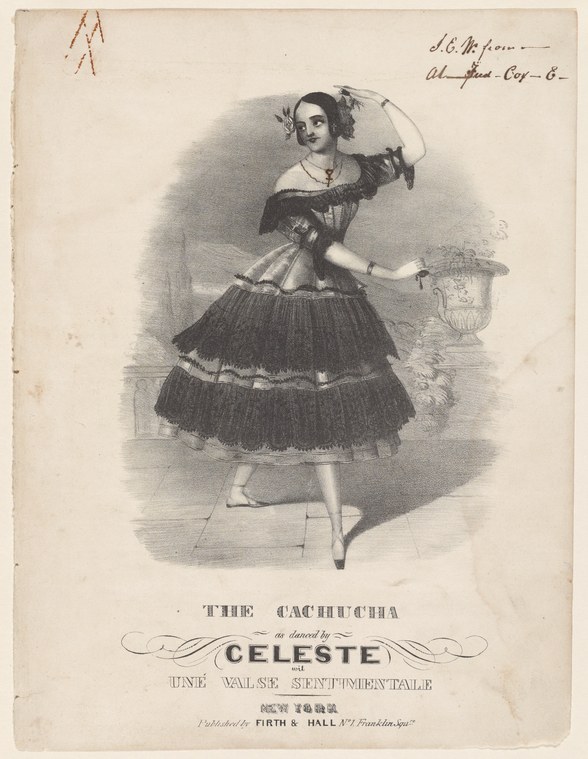
The cachucha as danced by Celeste wit [sic] Une valse sentimentale
Unknown artist
- Collection:
- Prints depicting dance
- Source:
- New York Public Library
- Rights:
- Public domain — free to use, share and adapt.
- Recorded as:
- Public Domain
The cachucha was one of the first dances to cross from Spanish vernacular tradition into international theatrical ballet and retain its cultural identity and rhythmic complexity while doing so. Celeste's performance of it—and prints like this one—document a crucial moment in nineteenth-century dance history when theatrical innovation depended on the star performer's ability to absorb, transform, and embody material from cultures outside the European balletic tradition.
What you are looking at
A female dancer in Romantic-era theatrical dress stands alone against a plain background, captured mid-movement in a pose of studied elegance. She wears a black tulle skirt with white trim at the hem and waistband, cut to mid-calf in the fashion of the 1830s–40s, with a black off-shoulder bodice and a white chemisette or collar. Her dark hair is styled with a decorative comb or ornament. The dancer's weight rests on her left leg while her right leg extends lightly, and both arms are held with studied grace—her left arm raised and angled back, her right arm extended forward—in the vocabulary of ballet ports de bras. The pose suggests a moment of turning or traveling, captured with the lightness and verticality that characterises Romantic ballet. The background is neutral and undefined, rendered in soft gray wash, which keeps all focus on the solitary figure and her movement.
The dancing
The dancer is shown in a pose that emphasizes the lifted, weightless quality central to Romantic ballet: her torso is upright and elegant, her arms are held in a graceful, open frame suggesting motion across space, and her stance shows the pointed feet and extended line of a trained performer. Her right knee is slightly bent while her left supports her weight, suggesting either the moment approaching a turn or a traveling step. The pose demonstrates technical command—the body is aligned vertically, the limbs are extended through space with control, and the overall frame conveys the ethereal, floating quality that Romantic ballet audiences prized.
The dance depicted
This is a theatrical representation of the cachucha, a Spanish or Spanish-Cuban social dance that became an international stage sensation when performed by the dancer Celeste (Céleste Keppler, 1814–1843). The cachucha was originally a rhythmic, earthy partnered or solo folk dance performed to castanets and guitars; in its theatrical form, it was transformed into a virtuoso solo vehicle showcasing balletic technique with Spanish-inflected character and rhythmic complexity. The composition and printing style indicate this is a publicity image or playbill illustration, likely created to document Celeste's celebrated performance of the role. The inscription attributes the dance to Celeste and references an accompanying waltz ('une valse sentimentale'), suggesting that the cachucha was performed as part of a longer theatrical work or mixed program.
How it was made
This is a steel or copper engraving with hand-applied or printed tonal wash, a reproductive technique that allowed wide circulation of theatrical images in the 1830s–40s. The fine linear hatching creates the soft modeling of the dancer's form and the background, while the wash adds depth and atmosphere. Engravings of this type were often produced and sold immediately after a dancer's premiere or celebrated performance, serving as both publicity and souvenirs for theatergoers. The quality and finish suggest a commercial print made for circulation rather than a one-off drawing, and the attribution and title printed beneath the image confirm this was a named, marketed product.
About this work
This is a theatrical dance print documenting the celebrated cachucha solo performed by the Romantic-era dancer Celeste, likely in the 1830s or early 1840s. The cachucha itself was an adaptation and stylization of Spanish popular dance, but in Celeste's hands and on the theatrical stage, it became a virtuoso ballet vehicle—a showcase for lifted, ethereal movement combined with rhythmic footwork and theatrical flair. The image captures the dancer mid-performance in a pose that balances the weightless elegance of Romantic ballet with the earthy energy of the Spanish source material. As a printed artifact, it belongs to a now-vanished world of theatrical publicity and souvenir production, in which a single star's interpretations of signature roles were marketed to the public through engravings and lithographs.
How to look at it
Look at how the artist has balanced two competing demands: the upright, weightless, balletic line that Romantic audiences expected, and the grounded, rhythmic character of Spanish dance. The extended arms and lifted posture are pure ballet; the costume—the short black skirt and Spanish-inflected dress—signals the dance's cultural source. The pose captures neither a moment of stillness nor of violent motion, but rather a transition or traveling step, which allows the viewer to read both the technical control and the character of the movement. The neutral background and solitary figure were standard for theatrical celebrity prints and emphasize that this was a showcase for the individual performer and her interpretation.
The artist
The artist is not recorded in the catalogue. The engraver's initials or signature may be present on the print but are not legible in the available image. The print bears the imprint 'Firth & Hall 347 Broadway' (New York), indicating production by a major American theatrical publishing house active in the 1830s–40s. Firth & Hall was known for producing high-quality engraved playbill illustrations and theatrical portraits, distributed to theaters and sold to playgoers.
The period
This print dates to the height of Romantic ballet, a period (roughly 1830–1850) when the art form embraced poetic narrative, supernatural subjects, ethereal technique, and the cult of the prima ballerina. At the same time, the 1830s saw growing European and American fascination with Spanish culture and music—a phenomenon known as Hispanicism—which made Spanish-inflected dances commercially attractive on the stage. The cachucha, which had been a Spanish folk dance, entered the theatrical repertory through dancers like Fanny Elssler and was performed across Europe and America. Celeste's version, documented here, contributed to this phenomenon and cemented the cachucha as a signature solo for female dancers of the period.
Where it lives
This print is held in the New York Public Library's collection of prints depicting dance. The imprint indicates it was published by Firth & Hall, a New York music and theatrical publishing house, placing it among the commercial theatrical ephemera produced for American audiences in the antebellum era.
Dance in this work
Questions about this work
Who was Celeste?
Céleste Keppler (1814–1843) was a French-born dancer who became an international star of the Romantic ballet era. She was known for her technical brilliance, her dramatic intensity, and her ability to perform character dances drawn from popular European traditions. The cachucha became one of her signature roles and was performed by her across Europe and America until her early death in 1843.
What is a cachucha?
The cachucha is a Spanish or Spanish-Cuban social dance, originally performed to castanets and guitar music, with a rhythmic, earthy character. When adapted for the theatrical stage in the 1830s, it became a virtuoso solo vehicle for female dancers, who combined balletic technique with Spanish-inflected footwork and character. It remained a popular part of the ballet repertory throughout the nineteenth century.
Why would a Romantic ballet star perform a Spanish dance?
Romantic ballet thrived on variety, theatricality, and the exotic. Spanish culture held a particular fascination for European and American audiences in the 1830s–40s (a phenomenon called Hispanicism), and performers capitalized on this by incorporating Spanish and Spanish-Cuban dances into their repertories. These dances added rhythmic and character interest to the ethereal, weightless aesthetic that defined the ballet of the period.
Why is this image important?
It documents the intersection of Spanish vernacular tradition and European theatrical ballet—a rare moment in dance history when material from outside the academic ballet tradition was incorporated into the mainstream theatrical repertory while retaining its cultural specificity. It also preserves a record of how a celebrated nineteenth-century star was marketed and documented for public consumption.
More dance artwork





