49 works in this view — arrow keys or swipe to move between them.
Dance in Art
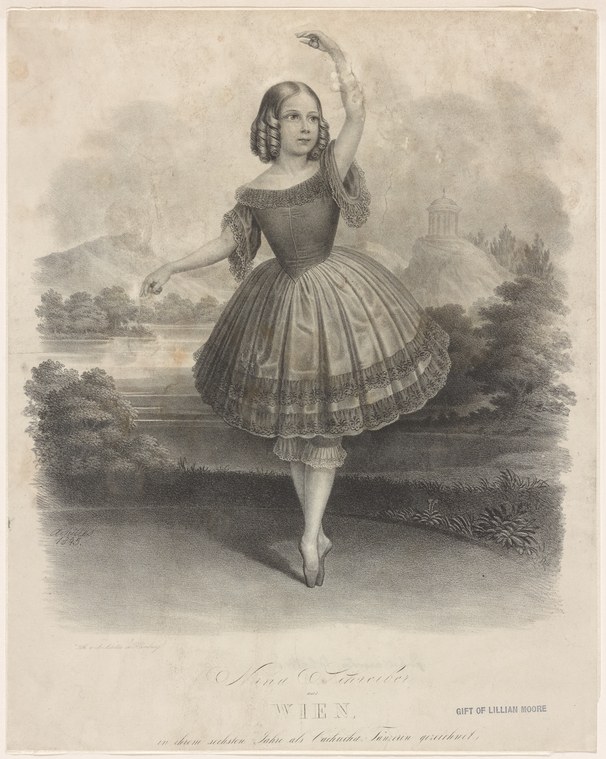
Nina Schreiber aus Wien in ihren sechsten Jahre als Cachucha-Tänzerin gezeichnet
Unknown artist
- Collection:
- Prints depicting dance
- Source:
- New York Public Library
- Rights:
- Public domain — free to use, share and adapt.
- Recorded as:
- Public Domain
This image documents the emergence of child performers as celebrities in 19th-century theatrical dance and shows how the Cachucha—originally a Spanish social dance—was transformed into a Romantic ballet vehicle for trained, costumed performers. It is also a rare visual record of how young dancers were trained and presented in this period, and what audiences expected to see: a child rendered as a miniature adult virtuoso, posed in the formal language of classical ballet.
What you are looking at
A young girl in theatrical costume stands alone in a landscape, caught in a moment of balletic pose. She wears a dark corseted bodice with short puffed sleeves and a voluminous skirt of white or pale fabric with decorative tiers and a deep lace border at the hem. Her right arm is raised and curved overhead in a graceful arc; her left arm extends to the side. She stands en relevé or on the balls of her feet, with her left leg supporting her weight and her right leg extended behind. The setting is a Romantic landscape with water, trees, and distant classical architecture—a small temple or pavilion visible across a body of water. The entire scene is rendered in fine engraving technique with careful attention to the texture of fabrics, the modeling of the figure, and atmospheric depth through subtle tonal gradation.
The dancing
A single dancer, a child of perhaps six to eight years old, is positioned in profile-frontal orientation. Her frame shows the balletic vocabulary of early Romantic ballet: the raised arm curves in a soft, extended port de bras; the supporting leg is straight and lifted; the free leg extends behind in what appears to be an arabesque or attitude position. Her posture is upright and refined, the head held with the composed bearing expected of a trained dancer. The body demonstrates the turned-out carriage and elongated proportions of ballet training, even at this young age.
The dance depicted
This is a portrait of a child performer dancing the Cachucha, a Spanish dance that became a fashionable theatrical entertainment in the 1830s–1840s across Europe. The Cachucha was typically performed by female dancers, often solo, as a vehicle for technical display and international exoticism. The theatrical pose—the artificial landscape backdrop, the formal costume, the balletic propriety of the frame—all indicate this is a performance image rather than documentation of social or folk practice. The Cachucha in this era was absorbed into the Romantic ballet repertoire and performed in theatrical contexts with trained dancers. The inscription on the print confirms this is Nina Schreiber of Vienna, recorded at age six performing this role.
How it was made
This is a steel engraving, a fine-art print medium that allowed detailed rendering and wide circulation. The delicate line work, the subtle tonal modeling through cross-hatching, and the capacity to capture the fall and texture of fabric mark this as professional reproductive engraving of high technical accomplishment. The print was likely a commercial theatrical portrait—the kind of souvenir sold at theatrical venues or by subscription to dancers' admirers—and would have circulated among the middle-class ballet public of mid-19th-century Vienna and beyond. The presence of the artist's signature area (though not clearly legible in this image) and the credit line 'GIFT OF LILLIAN MOORE' in the lower right indicate this was once part of a collector's archive of dance imagery.
About this work
This is a theatrical portrait engraving of a child dancer performing the Cachucha, a Spanish-derived solo dance that became a celebrated vehicle for Romantic-era ballerinas. The work records not only a specific performance (Nina Schreiber of Vienna at age six) but also the visual language of early Romantic ballet spectacle: the exotic costume, the refined balletic pose, the landscape setting that removes the dancer from everyday space into theatrical fantasy. The engraving technique indicates this was a commercial print, widely distributed to support the fame of young performers and the appetite of the ballet-going public for images of their favorite dancers.
How to look at it
Notice the precision with which the engraver has rendered the dance pose: the curve of the raised arm, the tautness of the supporting leg, the extension of the free leg. The pose is held at a moment of apparent effortlessness—a Romantic convention that concealed the physical rigor demanded. Observe how the costume is designed to present the dancer's body as the primary visual focus: the fitted bodice emphasizes upright carriage, and the full skirt is arranged to show the line of the supporting leg and the extension of the free one. The landscape setting is secondary—a theatrical convention that places the dancer in an idealized, timeless space apart from everyday reality.
The artist
The artist is not recorded in the catalogue. The quality of the engraving suggests a professional reproductive engraver working for a theatrical print publisher in Vienna or a major European cultural center. The credit 'GIFT OF LILLIAN MOORE' indicates this print was part of the Lillian Moore collection, a major 20th-century archive of dance history materials now held by the New York Public Library.
The period
This print dates from the height of the Romantic ballet era in Europe, when the 1830s–1840s saw the rise of exotic and fantastical ballet subjects and a cult of the ballerina as an ethereal, otherworldly figure. The Cachucha became a sensation across European stages after its introduction by the Spanish dancer Dolores Serral around 1836; it appeared in ballets like *Le Diable boiteux* and was danced by many leading performers. The appetite for theatrical portraiture was enormous in this period, and commercial prints of celebrated dancers—particularly those in exotic or virtuosic roles—were mass-produced and sold to support the star system. The appearance of a six-year-old dancing this role indicates the high degree of technical training expected of child performers and their value as public attractions.
Where it lives
This print is held in the Dance collection at the New York Public Library, part of the Lillian Moore Archive. It is catalogued as a work depicting dance in the collection's Prints and Photographs division.
Dance in this work
Questions about this work
What is the Cachucha?
The Cachucha is a Spanish solo dance in triple meter that became a fashionable theatrical attraction in 1830s Europe. Originally a social and folk dance, it was adopted by Romantic-era ballet companies and performed by leading ballerinas as a vehicle for technical display and exotic spectacle. It combined Spanish folk elements with balletic training, and dancers typically wore Spanish-inspired costumes and performed it in theatrical productions.
Who was Nina Schreiber?
Nina Schreiber was a child performer in Vienna in the 1830s–1840s. This print records her performing the Cachucha at the age of six, indicating she was part of the Viennese theatrical dance world and had already received formal training. Beyond this record, little is documented about her career or later life.
Why were child dancers trained and displayed this way?
Child performers in the 19th-century Romantic ballet were presented as prodigies and attracted paying audiences, much as child musicians did. They were trained in the same vocabulary as adult professionals and performed the same repertoire, offering novelty value and an idealized image of innocence combined with virtuosity. The theatrical system commodified their bodies and technical accomplishment.
What does this print tell us about Romantic-era ballet?
It documents the theatrical spectacle, costume design, and pose conventions of the period. The exotic setting, the refined balletic frame, the emphasis on the dancer's body as an object of aesthetic display, and the commercial circulation of performer portraits all reflect the values and practices of Romantic ballet, including the star system and the cult of the ballerina.
More dance artwork





