49 works in this view — arrow keys or swipe to move between them.
Dance in Art
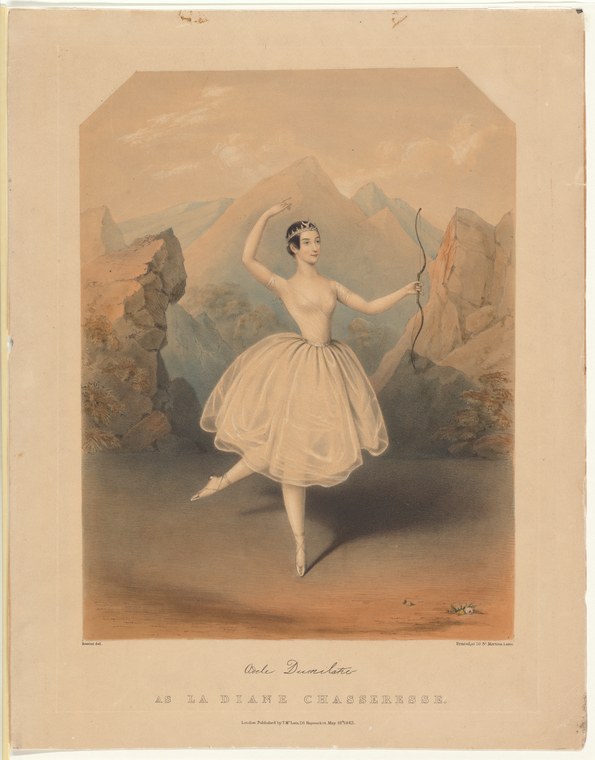
Adele Dumilatre [facsimile signature] as la Diane chasseresse
Unknown artist
- Collection:
- Prints depicting dance
- Source:
- New York Public Library
- Rights:
- Public domain — free to use, share and adapt.
- Recorded as:
- Public Domain
This print preserves a crucial moment in ballet history: the celebration of individual ballerinas as named artists with distinctive roles and styles, at the moment when lithography made such images affordable and widely circulated. For dance historians, it documents both the technical and aesthetic values of Romantic ballet—the body position, the costume, the narrative theme—and reveals how performance was marketed and remembered before photography could capture motion. The identification of the dancer by name elevates her from anonymous performer to celebrated artist, reflecting the emergence of the ballerina as a major cultural and commercial figure.
What you are looking at
A female dancer stands alone in a mountainous landscape, poised in a moment of classical grace. She wears a pale tulle skirt in the romantic ballet style, with her torso bare or draped, her dark hair crowned and her body caught mid-movement. Her left arm is raised and bent, her right arm extends outward holding a bow; her weight is lifted on relevé, the supporting leg straight and the other leg extended behind or to the side. The setting is a rocky, misty terrain with towering peaks and stone outcroppings rendered in warm ochres and grays, creating depth behind her. The lighting is soft and diffused, casting the figure in gentle relief against the landscape. The composition frames her as a solitary, idealized figure—not a mortal woman but a mythological huntress suspended in perpetual grace.
The dancing
The dancer's body displays the hallmarks of early nineteenth-century classical ballet technique: a fully extended supporting leg, lifted carriage, and arms positioned in a manner suggesting the école de danse. The raised arm and extended bow gesture indicate the narrative moment of the huntress Diana, caught between repose and action. Her feet appear to be en relevé or en pointe, lifting the body into the ethereal verticality that defined Romantic ballet aesthetics. The isolation of the single figure, with no partner or corps de ballet, emphasizes the technical and expressive virtuosity expected of a prima ballerina.
The dance depicted
This is an image of Romantic ballet, almost certainly representing a specific solo variation or scene from a ballet on a classical or mythological subject. The inscription identifies the performer as Adèle Dumilatre in the role of Diana the Huntress (la Diane chasseresse)—a common subject in nineteenth-century ballet, drawn from classical mythology. The costume, pose, and setting align with the Romantic era's fascination with supernatural and legendary female characters, typically performed by the era's celebrated ballerinas. Diana as huntress allowed choreographers to display technical virtuosity (the bow and arrow gesture demonstrates narrative mime) alongside the ethereal, weightless quality prized in Romantic aesthetics.
How it was made
This is a hand-colored lithograph or aquatint, a reproductive print technique that was the primary means of circulating images of celebrated dancers in the nineteenth century. The soft modeling of light and the delicate color palette—pale flesh tones, warm ochre earth, gray-blue mountains—are characteristic of tinted lithography used for dance portraiture of this period. The technique allowed for wide distribution of images of famous performers to an audience hungry for souvenirs of theatre performances; such prints were sold at theatres and through print shops, functioning both as artistic records and as celebrity promotion. The signed or captioned inscription at the base was standard practice, naming both the artist and the celebrated performer, which enhanced the print's commercial and cultural value.
About this work
This is a Romantic-era ballet portrait, a tinted lithograph or hand-colored aquatint recording a celebrated moment or solo from a mythological ballet. It dates to the heyday of Romantic ballet in the 1830s–1840s, when lithographed dance prints became a major form of theatre publicity and artistic circulation. The work captures the period's aesthetic ideal: a ballerina in a weightless, classically poised moment, dressed in the tulle skirts and barefoot technique that defined the style, set against a dreamlike landscape that removes her from the mundane world. Such prints were essential to how nineteenth-century dance was documented, distributed, and remembered—more widely seen than the performances themselves, they shaped public understanding of what ballet looked and meant.
How to look at it
Observe the specific moment the artist chose to freeze: not a static pose but a transitional instant, with the body in mid-gesture, the weight lifted, one arm rising and the other extended with the bow. This captures the Romantic ideal of the ballerina as an ethereal being, briefly tangible in the mortal world. The surrounding landscape—the misty peaks, the rocky foreground—is not mere decoration; it places the dancer in a realm between reality and myth, a convention borrowed from Romantic painting and essential to how ballet communicated its aesthetic. The costume details—the tulle, the bare torso, the classical drapery—anchor this print in a specific moment of ballet history, when these elements had just become standard for the leading female dancer.
The artist
The artist is not recorded in the catalogue, but the work's style and format are consistent with the Paris-based printmaking industry of the 1830s–1840s. At this period, numerous specialist theatrical printers produced hand-colored lithographs of famous dancers, often working from drawings made at performances or from studies by ballet-trained artists. These prints were typically unsigned or credited to the printer rather than the original designer. The quality and care evident in this work suggest a professional atelier accustomed to dance subjects, capable of rendering both the delicate anatomy of the ballerina and the romantic landscape convention.
The period
This work was created during the height of Romantic ballet, a movement that had its center in Paris in the 1830s and 1840s. The era was marked by the ascendance of the ballerina as the primary vehicle for choreographic expression, a shift away from the male dancer and towards emphasis on weightlessness, ethereality, and otherworldly femininity. Lithographic dance prints proliferated in this period as a new art form and commercial product; they were displayed in shop windows, collected by ballet enthusiasts, and served as the primary visual record of performances before the camera could capture motion. Mythological and supernatural subjects—sylphs, nymphs, huntresses, odalisques—dominated the repertory, allowing choreographers to explore narrative and spectacle. The technical innovations of the pointe shoe and the romantic tutu were simultaneous with this visual documentation, making prints like this invaluable witnesses to how the ballet body was imagined and displayed.
Where it lives
The work is held in the New York Public Library's collection of dance-related prints, a major archive of nineteenth-century theatrical imagery. Such collections were often assembled from theatre collections, print dealer stock, and donations from ballet enthusiasts; this print's presence in a major institutional collection reflects its significance as a record of a celebrated performer and the era's most popular dance form.
Dance in this work
Questions about this work
Who was Adèle Dumilatre?
Adèle Dumilatre (also spelled Dumilâtre) was a French ballerina who danced in Paris during the 1830s and 1840s, performing in major roles at the Opéra. She was a celebrated dancer of the Romantic era, known for roles in mythological and supernatural ballets. Like other celebrated dancers of her time, she was commemorated in lithographed portraits and souvenir prints sold to audiences.
What is a lithographed dance print?
A lithographed dance print is a theatrical souvenir produced in the nineteenth century, created by drawing an image on a prepared stone, then printing it and hand-coloring the impressions. These prints recorded celebrated dancers in famous roles and were sold at theatres and shops, serving both as art objects and as records of performances. They were the primary visual documentation of ballet before photography could capture motion.
Why is Diana a huntress important to ballet?
Diana, the Roman goddess of the hunt, was a popular subject for Romantic ballet because the bow-and-arrow and hunting narrative allowed choreographers to showcase both mime (expressive gesture) and technical virtuosity. The character also embodied the Romantic ideal of the powerful, independent female figure, distinct from the passive heroines of earlier ballet.
How do I know this is ballet and not another form of dance?
Several details confirm this as classical ballet: the pointe work (the lifted heel and extended toe), the specific tulle costume (a Romantic-era ballet skirt), the bare feet and classical training visible in the body position, and the theatrical setting and mythological narrative, all conventional to ballet of this period. The inscription naming a celebrated Paris Opera dancer reinforces this identification.
More dance artwork





