49 works in this view — arrow keys or swipe to move between them.
Dance in Art
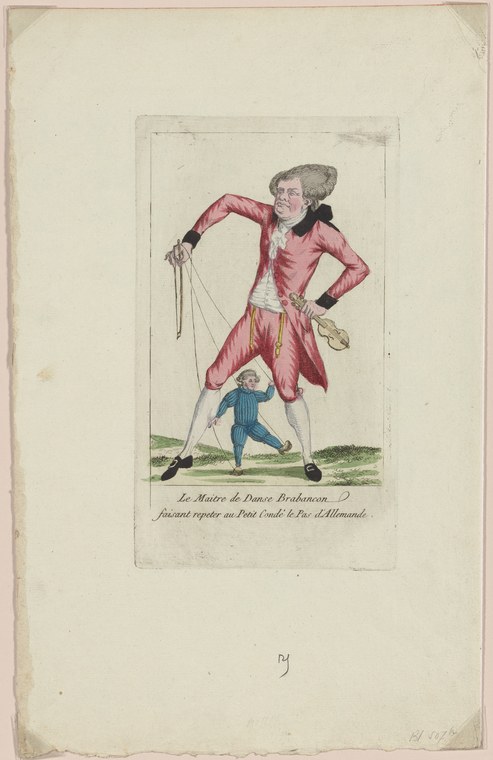
Le maitre de danse Brabancon faisant repeter au petit Condé le pas d'allemande
Unknown artist
- Collection:
- Prints depicting dance
- Source:
- New York Public Library
- Rights:
- Public domain — free to use, share and adapt.
- Recorded as:
- Public Domain
This image is a rare documentary record of how baroque court dances were actually taught. Most dance imagery from this period depicts performance or festival; teaching scenes are scarce. It also shows the allemande in its native context—not a historical reconstruction or a theatrical piece, but a working dance form, learned young by those who would practice it. For historians of dance technique, it is evidence: the master's posture, the hand-hold, the boy's alignment all tell us something about how the body was supposed to work in this dance.
What you are looking at
A hand-colored engraving shows a dancing master in a pink coat instructing a small boy in the allemande. The master stands at left, weight on his right leg, left arm extended holding the boy's hand, his right arm raised and bent to guide the movement. The boy, dressed in blue breeches and coat, steps forward under instruction, his posture already mimicking the master's upright carriage. The scene is set outdoors on a grassy ground line against a plain background, the composition spare and focused entirely on the pedagogical moment. The master's costume—pink silk coat with gold trim, dark breeches, white stockings, and buckled shoes—marks him as a professional dancer of quality; his gray hair and assured stance signal experience. The image captures instruction-in-progress: not performance, but the careful transmission of a courtly dance form from master to pupil.
The dancing
Two figures occupy the frame: a tall adult male and a young boy, connected by a right-hand hold. The master's left arm reaches out at shoulder height, his right arm raised and bent to demonstrate or correct the boy's position. The boy's body is aligned forward, his frame upright and responsive. Both figures stand in profile or three-quarter view, allowing the viewer to read the spatial relationship and the direction of the movement. The hold is hand-to-hand, light and instructional rather than the full-bodied contact of a social dance; this is the grammar of teaching.
The dance depicted
The caption explicitly names this the allemande (pas d'allemande), a court dance central to baroque dance practice. The allemande was a walking dance in duple time, often the opening movement of a suite, characterized by flowing arm movements and a walking gait rather than jumps or turns. The image shows an allemande lesson: the master demonstrates the basic hand-hold and forward step that define the dance. This is not the theatre or the grand ball, but the dance studio or courtyard where technique is acquired. The small scale of the pupil—identified in the caption as 'le petit Condé'—suggests he is learning the fundamentals that any courtly person of breeding would need to master.
How it was made
This is a hand-colored engraving, likely 18th century based on the style and technique. The line work is fine and precise, the composition cleanly framed within a rectangular border. Hand coloring with watercolor or gouache adds distinction to the master's pink silk coat and the boy's blue dress, making the figures stand out from the plain paper ground. The engraving technique allowed for multiple impressions from a single plate; this image circulated as a print, likely educational or documentary in purpose—a visual record of correct dance instruction rather than a work of fine art. The technique's precision serves the pedagogical intent: the viewer can read exactly how the body should be positioned.
About this work
This engraving documents the teaching of the allemande, a foundational court dance, in the baroque era. It records a private lesson rather than a performance, capturing the moment when technique is transmitted from master to pupil. The scene is identified by its caption as instruction in the pas d'allemande given by a master of dance (identified as Brabancon, a professional dancing master) to a young nobleman, 'le petit Condé.' This belongs in a gallery of dance art because it shows dance as pedagogy and professionalization: the dancing master as a figure of authority, the codified steps and holds that constitute a specific dance form, and the careful posture and hand-work that baroque dance required. It is not a record of performance but of training—the unglamorous, essential work of learning to move correctly in a courtly society.
How to look at it
Attend to the hands: the master's left hand holds the boy's right hand at the point where the allemande begins. Notice the master's right arm, raised and bent, which guides or demonstrates the arm carriage the boy must adopt. Look at the alignment of the torso—upright, not collapsed—in both figures, and the forward weight on the stepping leg. The artist has frozen a moment mid-instruction, with the master looking down at his pupil, ready to correct. The sparse background and outdoor setting emphasize that this is not theatrical display but genuine pedagogical work.
The artist
The artist is not recorded. The print was likely made in France or the Low Countries in the early 18th century, a period when illustrated books and prints on dance instruction were common. The image belongs to a genre of dance pedagogy prints, many anonymous, that documented the proper execution of court dances.
The period
The allemande was the preeminent social dance of the baroque aristocracy, reaching its height in the 17th and early 18th centuries. By the early 18th century, when this print was likely made, it was established protocol for young nobility to receive instruction in dance, often from specialized masters who held official positions at court. The dancing master was an established profession, with their own guild and standards. The print format allowed dance instruction to circulate beyond the master's studio, reaching a broader educated public. This image is part of a larger corpus of dance instruction prints and manuals—including those by Thoinot Arbeau, Pierre Rameau, and others—that systematized and recorded baroque dance technique in an era before dance notation became widespread.
Where it lives
Held in the New York Public Library as part of a collection of prints depicting dance. The image is catalogued as 'Le Maitre de Dance Brabancon faisant repeter au petit Condé le pas d'allemande.' The collection appears to be a documentary archive of dance imagery from the 17th and 18th centuries.
Dance in this work
Questions about this work
What is an allemande?
An allemande is a court dance of the baroque period, typically in moderate duple time, characterized by a walking gait and elegant arm movements. It was often the opening dance of a suite and was essential knowledge for anyone of aristocratic standing. Unlike the more acrobatic dances of the period, the allemande emphasized grace, posture, and flowing arm work.
Who was 'le petit Condé'?
The caption identifies the boy as 'le petit Condé,' likely a young member of the Condé family, a cadet branch of the French royal house. Young aristocrats routinely received instruction from professional dancing masters to acquire the physical accomplishments expected of their rank.
Why is this a teaching scene rather than a performance?
The engraving documents pedagogy rather than spectacle. The postures are corrective and demonstrative; the setting is a courtyard or studio; the master is actively instructing. This makes it a rare historical record of how baroque dances were actually transmitted and learned, rather than how they were displayed.
What can we learn from the body positions?
The upright torso, the quality of the hand-hold, the forward weight, and the arm carriage all reveal baroque dance aesthetics and technique. The master's posture shows what 'correct' looked like; the boy's responsive frame shows a pupil internalizing instruction. Such images are primary evidence for reconstructing historical dance technique.
More dance artwork





