49 works in this view — arrow keys or swipe to move between them.
Dance in Art
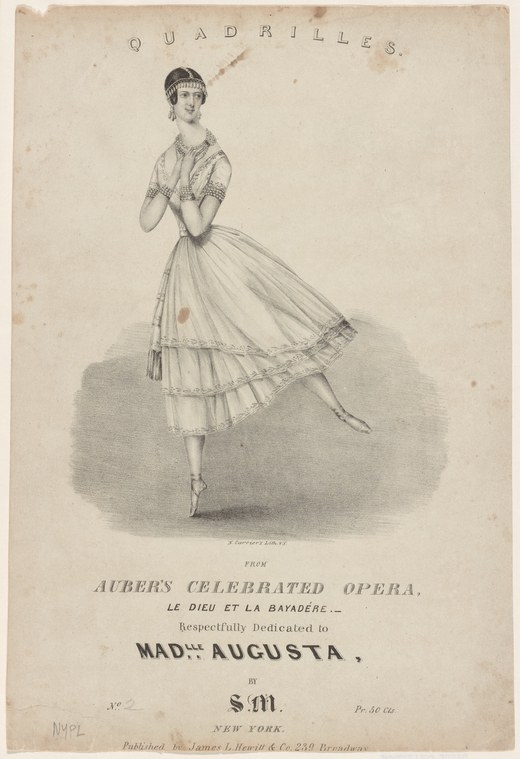
Quadrilles from Auber's celebrated opera Le dieu et la bayadère, respectfully dedicated to Madlle. Augusta, by S. M.
Unknown artist
- Collection:
- Prints depicting dance
- Source:
- New York Public Library
- Rights:
- Public domain — free to use, share and adapt.
- Recorded as:
- Public Domain
This print is direct evidence of how quadrille choreography circulated in professional theater and of the celebrity status of named performers like Mlle. Augusta. It shows that quadrilles were not merely ballroom dances but were staged as featured numbers for individual stars, a practice that has left little other trace. The image, title, and dedicatee together document a specific moment in theatrical dance history when Romantic ballet and social dance forms coexisted and cross-pollinated on the stage.
What you are looking at
A single female dancer in Romantic-era dress stands in a ballroom or stage setting against a neutral background with subtle shading. She wears a white muslin dress with a fitted bodice, short puffed sleeves, and a voluminous skirt that falls to mid-calf with horizontal pleating or gathering at the hem—characteristic of 1840s fashion. A decorative headpiece or tiara sits atop her dark hair. Her pose is balletic: she stands on one leg with the other raised, arms positioned asymmetrically, one drawn across her body and one extended. The composition is a three-quarter frontal view. The engraving style, with fine cross-hatching for shadow and the formal framing typical of 19th-century dance prints, suggests this is a published souvenir or advertisement from a theatrical production.
The dancing
A single dancer balanced on one leg in a pose suggesting movement rather than repose—the raised leg, extended arm, and forward-leaning torso suggest a moment mid-step rather than a static position. Her frame is upright and controlled, with a Romantic-era balletic carriage: shoulders back, head held high. The asymmetrical arm placement (one curved inward, one extended) is characteristic of the port de bras of classical ballet in this period. No partner is present; this is a portrait of a featured performer, not a couple or ensemble.
The dance depicted
The title identifies this as a *quadrille* choreographed for or inspired by Auber's 1830 opera *Le dieu et la bayadère*. The quadrille was the dominant social and theatrical dance of the period—a figure dance for four couples in square formation—but it also appeared in theatrical contexts, often as a solo variation or character piece for a principal dancer. The dedicatee, Mlle. Augusta, was likely a professional dancer who performed this as a solo variation within a quadrille sequence or as a standalone theatrical number. The Romantic-era costume and balletic pose suggest this was performed in a theatrical context, not as a social dance, though the title explicitly names the quadrille form.
How it was made
This is a steel or copper engraving, identified by its fine linear hatching, sharp definition, and the uniform tone typical of metal-plate processes. The technique allows for precise rendering of costume detail—the pleating of the skirt, the delicate sleeves, the headpiece—and the distribution of light across the figure. Engravings of this type were mass-produced and sold as sheet music covers, theatrical souvenirs, or topical prints; the inscription naming the choreographer and dedicatee confirms its function as a promotional or souvenir print tied to a specific theatrical production.
About this work
This is a theatrical dance souvenir: an engraved portrait of a named dancer (Mlle. Augusta) in costume for a quadrille choreographed to music from Auber's *Le dieu et la bayadère*. It documents both the social prestige of quadrille dancing in the 1840s and the celebrity of professional dancers who performed variations on the form on the theatrical stage. The print represents a moment when social ballroom dances were being elevated into theatrical spectacle, and individual dancers were being marketed to audiences by name and image. The work sits at the intersection of popular print culture, theatrical promotion, and dance documentation—showing how 19th-century audiences encountered and remembered performances.
How to look at it
The artist has chosen to freeze the moment of a running or traveling step—the raised leg and extended arm capture momentum even in stillness. Note the fine detail in the costume: the pleating of the skirt is rendered to show how the fabric would move and catch light in motion, and the short puffed sleeves are characteristic of Romantic-era ballet dress. The pose itself—neither fully extended nor fully closed—is typical of the theatrical quadrille variation, which borrowed vocabulary from ballet (the lifted leg, the arm position) while maintaining the lighter, more mobile aesthetic of social dance. The background is deliberately plain, focusing all attention on the dancer's form and costume detail.
The artist
The artist is listed as 'S.M.' but is not otherwise identified in the record. The engraver's name may appear on the plate but is not legible in the image provided. The style and quality of the work suggest it was made by a journeyman engraver working for a music publisher or theatrical print house in New York—the inscription notes the publication location as New York—rather than by an artist of major independent standing. Such prints were commercial products, often produced by workshop teams, and rarely carried prominent artist attribution.
The period
The 1840s saw the height of Romantic ballet in Europe and the United States, yet social dances like the quadrille, waltz, and polka remained central to both ballroom and theatrical entertainment. In America, theatrical dance was often presented as extracted highlights or variations on social forms, rather than as fully formed dramatic ballets. Auber's *Le dieu et la bayadère* (1830) was a hugely popular opera internationally and continued to be performed and adapted throughout the 1840s; choreographers and dancers created new numbers to its music for American audiences. This print documents the secondary afterlife of operatic music in American dance culture and the role of single performers in dramatizing and selling dance to audiences.
Where it lives
Held by the New York Public Library in its Prints collection under the classification for dance-related imagery. The print was published in New York by James H. Marx & Co., indicating circulation among American audiences in the 1840s. Such prints were commonly sold to theater-goers as souvenirs or inserted into sheet music editions of popular operatic music.
Dance in this work
Questions about this work
What is a quadrille and why would a solo dancer perform it?
A quadrille is a figure dance for four couples in square formation, performed both socially and theatrically. In theatrical contexts like this one, a famous dancer might perform a variation—a solo showpiece—to music from a quadrille, showcasing technique while retaining the lighter, less formal aesthetic of social dance. This allowed dancers to display virtuosity without the demands of full Romantic ballet.
Who was Mlle. Augusta and why is she named here?
The dedicatee's identity must be established through other historical records; the print does not identify her beyond her stage name. She was evidently a named performer with enough celebrity or contractual standing to have a dance choreographed for her and printed with her name. Such dedicatory prints served as publicity for the dancer and the company.
Is this ballet, or is it a social dance performed on stage?
It is functionally both. The costume, pose, and elevated leg are balletic; the title identifies it as a quadrille, which was a social dance form. In the 1840s, theatrical dance was a hybrid: professional dancers performed lighter, more socially rooted dances on stage alongside or as alternatives to full-length ballets. This print documents that hybrid practice.
How do we know this is an engraving and not a lithograph?
The fine linear hatching, sharp point definition, and uniform tone are characteristic of metal-plate engraving rather than the softer, more granular appearance of lithography. The technique allowed for precise costume detail and wide distribution through printing, making it ideal for theatrical souvenirs.
More dance artwork





