49 works in this view — arrow keys or swipe to move between them.
Dance in Art
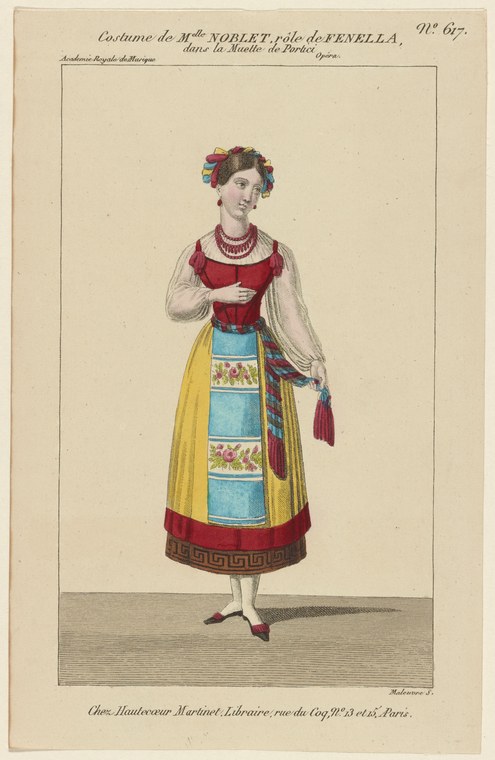
Costume de Melle. Noblet, rôle de Fenella, dans La muette de Portici, opéra, Académie royale de musique
Unknown artist
- Collection:
- Prints depicting dance
- Source:
- New York Public Library
- Rights:
- Public domain — free to use, share and adapt.
- Recorded as:
- Public Domain
This print is essential evidence for how Romantic ballet performers were trained, costumed, and marketed to the public. It documents a foundational role in the development of classical mime technique and shows the collaboration between visual costume design, theatrical spectacle, and dance virtuosity that defined early 19th-century ballet.
What you are looking at
A young woman stands alone against a pale ground in a three-quarter pose, her body angled slightly to the left with her weight on her right leg. She wears a richly decorated costume in the Italian peasant style: a short-sleeved cream linen chemise under a red bodice laced tightly at the front, and a full skirt composed of horizontal bands of yellow silk and bright blue linen separated by embroidered panels in red and gold floral patterns. A red border frames the hem. She wears a red coral necklace and coral hair ornaments, with her dark hair elaborately curled and arranged atop her head. Her right hand gestures expressively across her body; her left hand holds a small tassel or purse. Her pose is neither still nor actively dancing—it is a presentation pose, the attitude of a performer pausing mid-scene for the viewer's contemplation. The spare setting emphasizes the costume as the primary visual subject.
The dancing
The dancer's weight is settled and grounded; she is not captured mid-leap or in an unstable moment. Her arm gesture is graceful and controlled, the hand lifted with spread fingers in a manner consistent with early 19th-century theatrical pantomime. The pose suggests a character revealing herself to an audience rather than executing steps. Her body is upright and composed, the frame open and frontal. There is no evident partnering, and no other figures share the stage.
The dance depicted
This is a costume study for the role of Fenella in Auber's opera-ballet *La muette de Portici* (The Dumb Girl of Portici), one of the most celebrated works of the 1828–1830 repertory. Fenella was a silent mute role danced entirely through mime and expressive gesture, often performed as a virtuoso solo. The role became iconic in the development of Romantic ballet and was danced by many of the era's leading ballerinas. This appears to be a study of the character as costumed on stage, using Neapolitan folk dress to signal her peasant identity within the opera's dramatic narrative. The pose and presentation suggest a moment of stillness within the performed mime.
How it was made
This is a hand-colored engraving or aquatint, a common and economical format for theatrical costume documentation in the early 19th century. The technique allowed for precise linear definition of the embroidered details and the careful registration of colored inks to achieve the vivid effect of the skirt's banded decoration. Such prints circulated widely among the ballet-going public, theater subscribers, and dance professionals as a means of recording performances and publicizing dancers in celebrated roles. The soft modeling of the face and hands contrasts with the crisp architectural rendering of the costume, a typical strategy of the medium.
About this work
This is a hand-colored theatrical print documenting the costume and presentation pose of Fenella, a celebrated mute role from Auber's 1828 operatic spectacle *La muette de Portici*. The work belongs to a vast category of early 19th-century costume and character studies distributed to theater audiences and collectors; it records both the visual splendor of Romantic-era stage dress and the theatrical conventions by which silent female characters communicated through gesture and pose. The work exemplifies the intersection of theater marketing, dance documentation, and fine-art printmaking in the age of Romantic ballet.
Fenella was one of the signature roles of the Romantic period, performed internationally by stars including Marie Taglioni and Fanny Elsslér. The role required sophisticated mime technique and commanding stage presence; costume prints like this one helped establish the character's visual identity across European opera houses. The print's presence in the New York Public Library's collection testifies to the transatlantic circulation of such theatrical ephemera.
How to look at it
Attend first to the costume's construction and the precision with which its decorative logic is rendered—the horizontal banding, the floral embroidery, the careful gradation of color. Then observe the dancer's pose: note that her body is not in motion but presented, the arms arranged to show off the sleeves and the hand gesture, the weight settled so that the costume's full form can be read. This is a print designed for viewers who wished to study the character's appearance in detail, not to experience the dynamism of movement. The frontal, almost portrait-like composition reflects the theatrical convention of the 'pose plastique'—the moment when the dancer pauses to allow the audience to admire costume and bearing.
The artist
The artist is not recorded in the catalogue. The print credit line reads "Chez Hantesseur Martinot, Libraire rue Coq 23 et 25 à Paris," identifying the Parisian publisher and bookseller, not the designer or engraver. Costume and character prints of this type were often unsigned or credited only to the publisher; they were commercial products made by workshop hands following designs by stage costume designers. The style and quality suggest a professional theatrical print workshop operating for the Parisian market in the late 1820s or 1830s.
The period
The print dates to the era of Romantic ballet, when spectacle, costume, and pantomime mime were as central to a ballet's success as choreography. *La muette de Portici*, with its exotic Neapolitan setting, picturesque "folk" costumes, and dramatic mute heroine, was a defining work of the genre. The opera premiered in 1828 and became the first ballet to be transmitted internationally through both live touring and print reproduction. The hand-colored engraving was the chief medium by which European theater-goers outside Paris could visualize celebrated roles and dancers. This print is part of a vast archive of Romantic ballet ephemera that saturated European culture in the 1830s–1840s.
Where it lives
The print is held by the New York Public Library in its collection of prints depicting dance. It was acquired as part of the library's comprehensive effort to document the history of theatrical performance and dance in Europe and America.
Dance in this work
Questions about this work
Who was Fenella?
Fenella is a mute peasant girl and the protagonist of Auber's 1828 opera-ballet *La muette de Portici*. She never speaks; her entire role is performed through mime, gesture, and expressive pantomime. The role became one of the most celebrated in Romantic ballet and was performed by many of the era's greatest ballerinas, including Marie Taglioni. It was a starring role that required both technical virtuosity and dramatic sensitivity.
Why would a ballet dancer need a costume print like this?
Theatrical costume prints served multiple purposes: they were sold to theater audiences as souvenirs and advertisements; they circulated among dancers and choreographers as references for staging productions in other cities; and they were collected by dance professionals as records of celebrated performances. This print would have been valuable to any ballerina learning or rehearsing the role of Fenella, as it showed the exact cut, decoration, and color of the character's costume.
What is a hand-colored engraving?
A hand-colored engraving is a print made by incising a design into a metal plate, inking the plate, and printing it on paper—and then hand-painting each print individually with watercolor or gouache to add color and detail. This was the standard method for producing colored theatrical prints in the early 19th century. Each print was thus slightly unique, and the colors could be adjusted to match stage lighting or the painter's interpretation.
How did silent roles like Fenella work in ballet?
Mute characters relied entirely on mime technique—codified gestures, facial expression, and pantomime to convey emotion and narrative. Fenella's mime included gestures for love, grief, desperation, and joy, all performed in synchrony with the orchestra and often with other dancers. The role required an exceptional dancer-actor who could sustain dramatic presence and emotional clarity without speaking.
More dance artwork





