49 works in this view — arrow keys or swipe to move between them.
Dance in Art
Les trois graces du ballet de
Unknown artist
- Collection:
- Prints depicting dance
- Source:
- New York Public Library
- Rights:
- Public domain — free to use, share and adapt.
- Recorded as:
- Public Domain
For historians of Romantic ballet, this print preserves evidence of how a canonical allegorical subject (the Three Graces) was staged, costumed, and presented to the public in the early 19th century. The absence of a complete title makes it a useful puzzle: identifying the ballet, the choreographer, and the performers would connect this image to a specific historical moment in dance.
What you are looking at
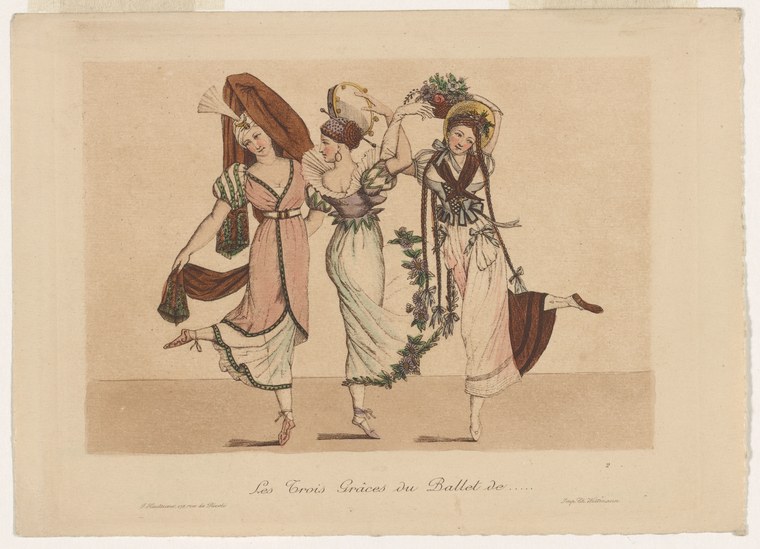
Three female dancers stand in a frontal line against a plain beige ground, posed in a moment of stylized repose rather than active movement. The figure on the left wears a coral-pink dress with a high waistline and a brown decorative head covering; she holds a large pleated fan. The center figure, dressed in white or very pale fabric with green accents, holds a substantial garland or wreath of ivy or similar vegetation aloft in both hands, her pose suggesting presentation or offering. The figure on the right wears a darker, patterned dress and bonnet. All three stand with elongated, graceful limbs in the refined posture expected of theatrical performers. The composition is shallow and frontal, arranged almost as a portrait triptych or a presentation of three character types. The title inscribed at the foot—*Les trois graces du ballet de*—remains incomplete, but it clearly identifies these as the Three Graces from ballet.
The dancing
Each dancer stands in a relaxed yet formal pose, legs straight and extended, weight evenly distributed. The arms are variously occupied: the left figure displays the fan as a prop; the center figure raises both arms to frame the vegetation; the right figure allows hers to fall at her side. There is no physical contact between them. Their bodies are rendered with neoclassical elongation and a studied lack of tension, suggesting the codified deportment of early 19th-century theatrical training rather than the dynamic muscularity of a moment in motion.
The dance depicted
This represents a theatrical tableau vivant or character study from a ballet, likely from the early 19th century. The identification as 'the Three Graces'—a classical trope—suggests these are allegorical or mythological roles rather than narrative characters. The image is more a presentation of costume and role than a depiction of choreography in action; the dancers are posed, not danced. The props (fan, wreath) and dress styles are consistent with Romantic-era ballet practice, in which such character dances were interpolated into longer works. The incomplete title frustrates precise identification, but the genre and conventions are unmistakable.
How it was made
This is a hand-colored engraving or etching, recognizable by the fine line work, the printed inscription, and the delicate hand-coloring applied to the printed base. The technique allowed rapid reproduction and circulation to a broad theatrical audience—these were commercial prints sold in foyers and print shops, not collector's objects. The hand-coloring was applied with restraint, respecting the primacy of the linear image beneath. This combination of cheap reproducibility and fineness of detail made such prints the primary visual record of 19th-century stage costume and character for those who could not attend performances.
About this work
This is a theatrical print documenting three character roles from a European ballet of the early 19th century, presented as a formal costume study rather than a moment of choreography. The work sits at the intersection of dance documentation, theatrical commerce, and neoclassical allegory—a visual record of how dancers appeared on stage, what they wore, and how they were understood to embody classical ideals. The incomplete title suggests the work was part of a larger series or publication, now fragmentary in the archive.
How to look at it
Attend to the studied, frontal presentation: this is not a candid capture but a formal show, each dancer displayed as a separate figure rather than in relationship or motion. The props—fan and wreath—are not incidental but essential to character and meaning; they signal role through object as much as through dress. The print's incomplete title is itself a cue: this work is fragmentary, part of a conversation now lost. Look at what is *not* shown: no floor, no setting, no context beyond the costume and the character type.
The artist
The artist is not recorded. The engraver's signature may be present but is not legible in the image provided. The work is typical of the commercial theatrical print production of Paris or London in the 1820s–1840s, a period when such costume and character prints were mass-produced for public sale.
The period
This dates to the era of Romantic ballet (1830s–1850s), when ballet moved away from pure technique toward narrative and emotional content, and when allegorical characters borrowed from classical mythology remained popular. The fashion visible here—high waistlines, bonnet styles, the delicate printed linework—places it in the 1820s–1840s. In this period, theatrical prints were a primary means of circulating knowledge of costume and performance across Europe; they were cheaper and faster than painted scenes and more widely available than theater attendance itself.
Where it lives
The work is held by the New York Public Library in its collection of prints depicting dance. The incomplete inscription suggests it is one sheet from a larger series or publication, now dispersed or lost.
Dance in this work
Questions about this work
What ballet is this from?
The incomplete title—*Les trois graces du ballet de*—does not name the ballet itself. This is a print, not a playbill, and surviving prints of this type often lack the full context necessary to identify the source production. Research in archives of early 19th-century ballet programs may recover the answer.
Were these characters always female?
In the classical tradition from which this derives, the Three Graces were female figures. In ballet, the Graces were typically danced by women in classical roles. Male dancers would not have been cast as the Graces in 19th-century ballet.
What are the props for?
The fan is a conventional attribute of coquetry and femininity in 18th- and 19th-century dance. The wreath or garland is the attribute of grace, beauty, and bounty—the classical symbolism of the Graces themselves. Props in character dances were essential to meaning.
Why are they not dancing?
Theatrical prints typically show dancers in repose or in a key pose from a scene, not in mid-movement. This captures how the dancers *appeared* to the audience, not how they moved. Movement was ephemeral; prints documented costume and character type instead.
More dance artwork





