49 works in this view — arrow keys or swipe to move between them.
Dance in Art
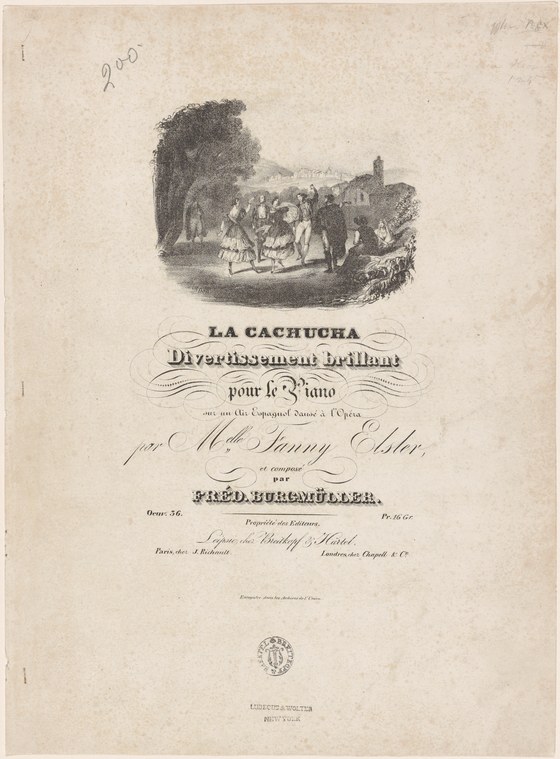
La cachucha, divertissement brillant pour le piano sur un air espagnol dansé à l'Opéra par Melle Fanny Elsler [sic], et composé par Fréd. Burgmüller
Unknown artist
- Collection:
- Prints depicting dance
- Source:
- New York Public Library
- Rights:
- Public domain — free to use, share and adapt.
- Recorded as:
- Public Domain
The cachucha represents a crucial moment in dance history: the rise of the solo female dancer as public spectacle and the internationalisation of Spanish dance forms through the Romantic ballet machine. This engraving shows both the theatrical context of the performance and the commercial apparatus that turned a stage sensation into domestic entertainment. For historians of dance and print culture, it captures how a theatrical novelty became a consumable commodity for the piano-owning middle class.
What you are looking at
This is a printed title page for a piano arrangement of La Cachucha, a Spanish dance piece. The engraving shows a theatrical scene set outdoors, with a large tree on the left framing the composition. In the middle distance, a single female dancer in a full skirt is captured mid-movement, surrounded by a group of onlookers in contemporary dress—men in coats and hats, women in bonnets—who watch from beneath the tree and to the sides. The setting suggests a public garden or estate grounds, with architectural elements (possibly a tower or building) visible in the background. The sky is rendered with atmospheric shading, creating depth and a sense of open air. The overall mood is one of theatrical spectacle: the solitary dancer commands attention while the crowd forms an informal audience around her.
The dancing
The central dancer stands in profile or three-quarter view, her body in an expressive pose with her skirt spread wide—characteristic of the whirling action of the cachucha. Her arms appear raised or extended, and her posture suggests active, rhythmic movement rather than stillness. The onlookers are variously posed: some standing, some leaning, all oriented toward the dancer, their informal grouping and relaxed stances suggesting they are witnessing a performance or spontaneous dance. The contrast between the solitary, dynamic figure of the dancer and the static, observant crowd is compositionally deliberate.
The dance depicted
The title explicitly identifies this as La Cachucha, a Spanish dance that became a sensation in European theatres in the 1830s and 1840s, most famously through the dancer Fanny Elssler (note the misspelling "Elsler" in the catalogue). The Cachucha was a solo female dance with a fast, lively tempo, executed in a social setting but also a theatrical showpiece. This piece commemorates a performance of the dance at the Paris Opéra, likely during Elssler's celebrated run there. The engraving suggests the dance was performed in a recognisable, repeatable form: the composer Frédéric Burgmüller's piano arrangement indicates it was popular enough to circulate in domestic music rooms. The image captures the cachucha as spectacle—a moment of solo virtuosity observed by an assembled crowd.
How it was made
This is a wood or steel engraving, printed from a plate, with hand-lettered or engraved text. The technique allows fine detail and tonal variation through cross-hatching and parallel lines; the artist has rendered the foliage of the tree with dense, directional shading and created atmospheric perspective through lighter work in the distance. As a printed page, this object was produced for mass distribution—it is the cover or title page of a published musical score. The circulation of such pages was widespread among piano-owning households in the mid-19th century, making this both a document of theatrical performance and a commercial cultural product aimed at middle-class musicians.
About this work
This is the title page of a piano arrangement of La Cachucha, a Spanish dance that became a European theatrical sensation in the 1830s–1840s. The engraving depicts a solo female dancer performing the cachucha in an open-air setting, watched by an assembled crowd. The work commemorates a performance by the celebrated dancer Fanny Elssler at the Paris Opéra and was published as a domestic music arrangement by the composer Frédéric Burgmüller. It is a valuable document of how the cachucha—one of the era's most fashionable dances—was performed, perceived, and circulated through print culture.
How to look at it
Observe the composition's emphasis on the solitary dancer as the focal point, set off by the tree and the watching crowd. The artist has chosen a moment of movement—the skirt is lifted and spread, the body is in action—rather than a static pose, giving the sense of the cachucha's speed and vivacity. Note how the crowd is arranged informally but attentively around the dancer; this spatial arrangement was a convention of Romantic-era theatrical prints, emphasising the isolation and magnetism of the central performer. The atmospheric rendering of the sky and distant buildings also reflects the theatrical conventions of the period: the outdoor setting suggests both spontaneity and spectacle.
The artist
The engraving is unsigned, and the artist is not recorded. The musical composition was by Frédéric Burgmüller (1806–1874), a prolific and successful composer for piano and dance, based in Paris. Burgmüller was known for creating arrangements and original compositions inspired by theatrical spectacles of the day; his works circulated widely in printed form. The engraver is unknown, but the quality and style of the work suggests it was produced by a professional workshop associated with a major Parisian publisher.
The period
The 1830s–1840s were the height of Romanticism in European dance and visual art. Fanny Elssler's rise to fame coincided with—and in part was enabled by—the craze for exotic and national dances, particularly Spanish forms. The cachucha arrived in Europe via the Spanish dancer Dolores Serral but was popularised by Elssler's performances across Europe and America. Simultaneously, the printing industry was experiencing rapid growth and technical refinement; lithography and engraving allowed theatrical images and musical scores to reach a mass audience. The title page combines two aspects of this moment: the cult of the Romantic soloist (here, the female dancer as the centre of attention) and the mechanisation of cultural distribution.
Where it lives
This is a printed title page from the New York Public Library's collection of prints depicting dance. It is a primary document of music publishing and theatrical performance in the 1830s–1840s and serves as evidence of how European audiences encountered and consumed dance through print.
Dance in this work
Questions about this work
Who was Fanny Elssler and why does this title page commemorate her?
Fanny Elssler (1810–1884) was an Austrian dancer who became an international star in the 1830s–1840s, second in fame only to Marie Taglioni. She was celebrated for her technical skill, her charisma, and her specialisation in character dances, particularly Spanish and folk forms. Her performances of the Cachucha at the Paris Opéra in 1836 were a sensation and triggered a wider European and American tour. This title page documents one of those performances.
What is the Cachucha and how was it danced?
The Cachucha is a lively Spanish solo dance in triple time, typically performed by a woman. It was known for its rapid footwork, sharp turns, and expressive arm movements, often executed with castanets. In the theatrical context (as opposed to folk practice), it was choreographed as a virtuosic solo for a principal dancer, allowing for display of technical skill and dramatic presence. Elssler's version became the canonical form in European theatres.
Why was this dance piece published as a piano arrangement?
The cachucha's popularity in theatres created a demand for piano arrangements that amateur musicians could play at home. Publishing such arrangements was a profitable business; music publishers would issue arrangements of successful operatic and ballet pieces immediately after their premiere. This allowed wealthy households to recreate or evoke the theatrical spectacle in their drawing rooms, extending the life and reach of a theatrical hit.
What does this engraving tell us about how the Cachucha was performed?
The image shows the dancer in a dynamic, upright pose with a spread skirt, suggesting the spinning and rapid movement associated with the dance. The theatrical setting and the assembled crowd imply this was a showcase solo, not a social dance, and that it was performed as a spectacle for an audience. The formal dress of the onlookers and the carefully composed scene suggest a theatrical or semi-theatrical context rather than a folk or social event.
More dance artwork





