49 works in this view — arrow keys or swipe to move between them.
Dance in Art
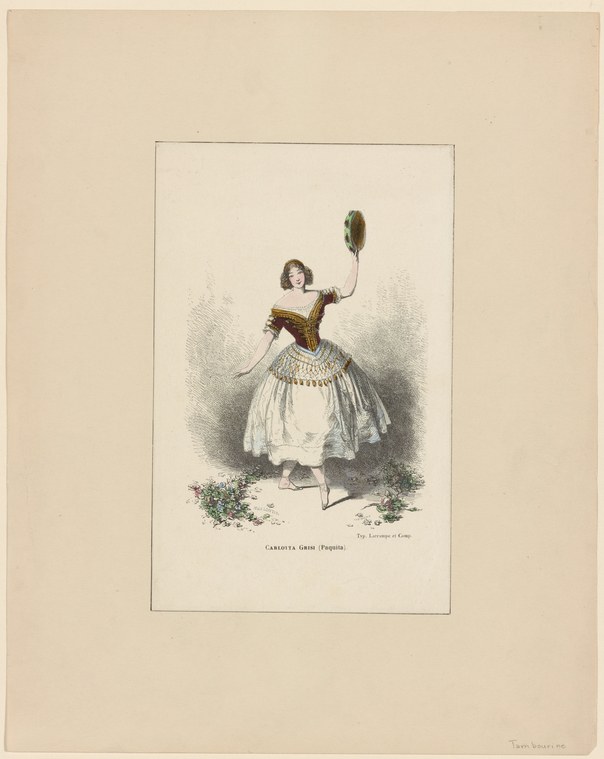
Carlotta Grisi (Paquita)
Unknown artist
- Collection:
- Prints depicting dance
- Source:
- New York Public Library
- Rights:
- Public domain — free to use, share and adapt.
- Recorded as:
- Public Domain
Carlotta Grisi was a foundational figure in Romantic ballet, and Paquita was one of her signature roles; this print documents both a celebrated performer and a beloved ballet of the era. The print's style and circulation tell us how dance was experienced and remembered by audiences who engaged with it through images rather than attendance.
What you are looking at
A young woman in mid-nineteenth-century dress stands alone against a plain background, her body caught in a moment of theatrical display. She wears a white cotton or muslin skirt with a deep gold or bronze corset-like bodice, and her dark hair is styled close to her head. Her right arm is raised in a graceful arc, holding what appears to be a feathered fan or plume aloft; her left arm extends across her body. Her weight appears to rest primarily on her left leg, which is nearly straight, while her right leg is flexed beneath her. At her feet, scattered flowers—tiny blooms in pink and green—suggest a stage property or theatrical flourish. The composition is intimate and frontal, framing the figure within a simple rectangular border. The delicate stippled shading and hand-coloring give the figure volume and presence against the pale ground.
The dancing
The dancer presents a single, poised figure in a pose of arrest rather than motion. Her elevated arm and extended torso suggest a moment of presentation or display rather than locomotion through space. The slight S-curve of her torso, the lift of the raised arm, and the delicate arch of her neck are characteristic of Romantic-era ballet vocabulary—the body is elongated, ethereal, and composed for the eye of an audience. The stance is stable rather than dynamic; this is portraiture of a dancer, not a representation of dancing movement.
The dance depicted
This is a portrait of Carlotta Grisi in the role of Paquita, a ballet created in 1846 by Joseph Mazilier with music by Édouard Deldevez. Paquita is a Spanish-themed Romantic ballet, and the costume and iconography—the Spanish bodice, the raised arm with feathered accessory, the scattered flowers—align with the role's aesthetic. Grisi was one of the greatest ballerinas of the Romantic period, and this print likely documents a celebrated performance. The pose itself is not one that captures a particular step or sequence but rather a moment of artistic presentation, a portrait mode common in lithographed dance imagery of the 1840s–1850s.
How it was made
The work is a hand-colored lithograph, identifiable from the gentle stippling and the technique of applied color over a printed stone base. The signature in the bottom right, though partially legible, may credit the lithographer rather than the original artist or designer. The medium allowed for rapid circulation of images of celebrated performers to audiences who could not attend live performances, making it a form of theatrical publicity and popular entertainment. The delicate hand-coloring and relatively small scale suggest this was a commercial print intended for domestic consumption, sold in theaters or by print dealers.
About this work
This hand-colored lithograph documents Carlotta Grisi as Paquita, a starring role in one of the great Romantic ballets. It is a portrait rather than a narrative scene, freezing the dancer in a moment of theatrical presentation rather than capturing the flow of movement. The image is part of the vast mid-nineteenth-century trade in theatrical prints that brought famous dancers into middle-class homes. Such prints served multiple purposes: they commemorated celebrated performances, disseminated the image of star performers, and provided material for fans to collect and display. In the broader history of dance imagery, they represent a crucial phase in which theater became visual commodity and the dancer became a recognizable public figure.
How to look at it
The viewer should attend to the tension between stillness and suggestion of movement. Although the dancer is not shown in active motion, the raised arm, the slight turn of the torso, and the flexed leg all communicate an idiom of movement and grace. The scattered flowers at the base and the Spanish-inflected costume create a fantasy world; this is not a portrait of Grisi in everyday dress but of Grisi *as* the character Paquita. The simplicity of the composition—plain ground, no scenery, no other figures—places all emphasis on the dancer's body and presence, which is the entire point: to sell the image of the star.
The artist
The artist is not recorded in the catalogue. The signature in the lower right corner is partially legible but cannot be definitively attributed from the image alone. The work is clearly a professional commercial lithograph, produced by a skilled theater-print maker, likely a Paris-based firm given the prominence of Carlotta Grisi in the French ballet world and the style of the print.
The period
This print dates to the height of Romantic ballet in Europe, a period (roughly 1830–1860) when ballet became the dominant theatrical dance form and when star dancers achieved celebrity comparable to opera singers. Lithographic portraiture of dancers was a thriving commercial practice; prints like this were sold in editions and consumed by a growing middle-class audience with disposable income and leisure time. The aesthetic of the Romantic ballet—ethereal women in white, pointe work, otherworldly narratives—is fully present in the costume and pose. At the same time, the practice of issuing single-figure portraits of star dancers in their roles was a form of image merchandising that anticipated modern celebrity culture.
Where it lives
The work is held in the New York Public Library's collection of prints depicting dance, a broad and historically important assemblage of theatrical imagery from the eighteenth through twentieth centuries. Such prints were typically issued in numbered or unnumbered editions by commercial lithography firms and distributed through theaters, print sellers, and the emerging market in theatrical merchandise.
Dance in this work
Questions about this work
Who was Carlotta Grisi?
Carlotta Grisi (1819–1899) was an Italian prima ballerina of the Romantic era and one of the most celebrated dancers of the nineteenth century. She performed extensively in Paris, London, and Milan, and created or premiered several major Romantic ballets, including *Giselle* (1841) with Jules Perrot. She was known for her technical brilliance, dramatic expressiveness, and ability to master both classical and demi-caractère (character) roles.
What is Paquita?
*Paquita* is a one-act ballet created in 1846 by the French choreographer Joseph Mazilier. Set in Spain, it tells a romantic story of a young Spanish girl (the titular Paquita) and features a mixture of classical ballet vocabulary and Spanish dance characteristics. The ballet remained popular throughout the nineteenth century and is still performed; later versions and fragments survive in the repertoire of major companies.
Why did dancers have their portraits printed?
Lithographed portraits of famous dancers served as theatrical publicity and as collectibles for fans, much like modern celebrity photographs or trading cards. They were sold in theater lobbies, by print dealers, and through mail order, allowing audiences to own images of performers they admired. These prints also extended a dancer's fame and income beyond the theater and helped establish a public persona.
What is a lithograph?
A lithograph is a print made by drawing an image on a stone (or later, a metal plate) with a greasy crayon or ink, then chemically treating the stone so that oil-based ink adheres to the drawn image but not to the surrounding stone. The stone is then dampened and inked, and paper is pressed against it to make a print. Because the image is created on stone rather than carved into it (as in engraving), lithography allowed for greater tonal range and more fluid, painterly effects, and it was ideal for producing multiple copies of theatrical imagery cheaply.
More dance artwork





