49 works in this view — arrow keys or swipe to move between them.
Dance in Art
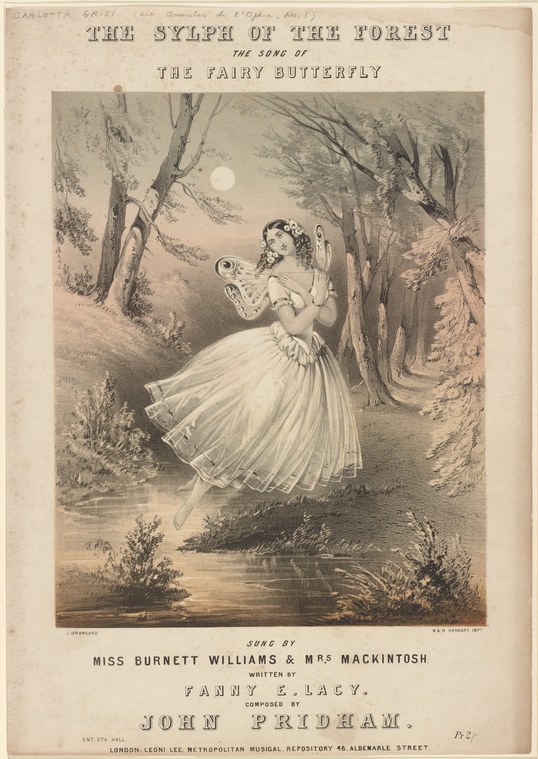
The sylph of the forest, the song of the fairy butterfly
Unknown artist
- Collection:
- Prints depicting dance
- Source:
- New York Public Library
- Rights:
- Public domain — free to use, share and adapt.
- Recorded as:
- Public Domain
The sylph is foundational to the grammar of Western ballet: she established the visual vocabulary of the Romantic prima ballerina—the tulle skirt, the uplifted gaze, the arched spine, the supernatural fragility—that ballet still invokes. This print captures that image at the moment of its cultural apotheosis, showing how thoroughly it had entered public imagination and commercial culture. For dancers, it remains the reference image for understanding what the Romantic era valued in the female body and movement.
What you are looking at
A sylph-like female figure in a flowing white tulle skirt materializes in a moonlit forest clearing beside a still pond. She floats in profile, her back arched gracefully, one arm extended upward in a gesture of wonder or enchantment, while the other curves across her body. Her hair is crowned with flowers. The forest encloses her in tall, dark tree trunks that frame the composition, while the moon hangs pale in the upper distance. The water below reflects the silvery light. The woman's posture suggests she has just alighted or is suspended mid-movement, neither fully grounded nor entirely weightless. The scene is rendered in soft greyscale tones that enhance the dreamlike, supernatural atmosphere—this is a vision rather than a quotidian moment.
The dancing
A single dancer, posed in three-quarter profile, leans far back from a high, arched spine with both arms raised asymmetrically: one hand lifted skyward, the other drawn inward at the chest. Her weight appears to rest on one leg, though the exact position of the feet is obscured by her voluminous skirt. The pose suggests a moment of rapture or transport rather than a traveling step—the body is open, expansive, and turned away from the viewer. There is no closed hold, no partnering, no group formation.
The dance depicted
This is almost certainly a Romantic ballet tableau, depicting the supernatural creature central to the ballet *La Sylphide* (1832), which premiered in Paris with Maria Taglioni. The image captures the defining icon of Romantic ballet: a weightless, ethereal female spirit materializing in a mortal realm. The context—moonlit forest, solitary sylph in tulle, the rapturous pose—all align with the ballet's narrative and visual conventions. The very title and the inscription naming Miss Burnett Williams as performer confirm this is theatrical ballet imagery, likely from a 19th-century production or imitation of the original.
How it was made
This is a lithograph or engraving (possibly tinted by hand or hand-colored lithography), rendered in greyscale with selective areas of pale wash to suggest moonlight and depth. The technique allowed for soft modeling of the figure's form and delicate rendering of the tulle fabric, while the forest backdrop is suggested through gestural linework that recedes into shadow. The medium and style of execution—the careful attention to the dancer's physical presence, the romantic landscape detail, the hand-coloring in the original print—indicate this was a commercial theatrical print, likely distributed to audiences and collectors as a souvenir of a celebrated performance.
About this work
This is a hand-colored theatrical print documenting Romantic ballet in the mid-19th century. It records a performance (or recreation) of the most iconic image in ballet history: the sylph suspended in her supernatural domain. The print was issued as commercial merchandise tied to a specific performer and production, capturing both the ballet's visual grammar—the weightless female body, the tulle skirt, the moonlit forest—and the theatrical technologies that made Romantic ballet possible (gas lighting, the illusion of flight, the ethereal body). For historians, it is evidence of how the sylph became not just a character but an archetype of ideal womanhood and female dancing in the Victorian imagination.
How to look at it
Attend to the stillness of the pose: this is not a moment of traveling or turning, but of arrival or levitation. The arched back and asymmetrical arm lift suggest effort and grace simultaneously—the body appears both to float and to strain upward. Notice how the tulle skirt dominates the visual space: the technique of rendering its transparency and volume became a marker of skill in theatrical lithography and a fetishized object in its own right. The forest setting is not naturalistic detail but a screen or backdrop; the real subject is the dancer's body framed against it.
The artist
The credits identify the writer as Fanny E. Lacy and the composer as John Pridham, but the artist of the lithograph is not named. The inscription notes publication by Leoni & Co, Metropolitan Musical Repository, suggesting this was one of dozens of theatrical prints produced in London in the mid-19th century as commercial merchandise. The absence of a named visual artist was common in theatrical prints of this period; the labor of image-making was often distributed and unsigned.
The period
The sylph emerged from European Romanticism in the late 1820s and 1830s—a period when ballet was remaking itself around the figure of the weightless, supernatural, virginal female body. *La Sylphide* (1832) and *Giselle* (1841) codified this aesthetic. By mid-century, when this print was made, the sylph had become the dominant image of ballet in popular culture and theatrical merchandise. The print predates photography as a medium for capturing dance, so lithography and engraving were the primary tools for distributing images of celebrated dancers to the public. This was the age of the prima ballerina as international celebrity—Taglioni, Cerrito, Grisi—and theatrical prints were a key mechanism of their fame.
Where it lives
The print is held by the New York Public Library in its collection of prints depicting dance. The inscription gives the date as June 1847 and credits Leoni & Co as publisher. It is one of many theatrical prints in the NYPL collection documenting 19th-century performance.
Dance in this work
Questions about this work
Is this *La Sylphide*?
Yes, almost certainly. The title, the moonlit forest, the solitary ethereal female figure in tulle, and the inscription naming a performer all point to this ballet or a direct imitation of it. The sylph became such an iconic image that prints of other ballets or generic 'fairy' scenes sometimes mimicked its composition. But the evidence is strong here.
Who was Miss Burnett Williams?
The print credits her as the performer depicted, but little is documented about her career. In the 19th century, many dancers performed the sylph role without achieving the lasting fame of Taglioni or the other international prima ballerinas. She may have been a London-based dancer or a provincial touring performer.
How was this print made?
It is a lithograph or engraving, likely drawn on stone or copper plate and printed in greyscale, then hand-colored with watercolor or hand-tinted during printing. The soft, atmospheric quality comes from the lithographic process, which allowed for tonal gradation. Mass-produced colored prints were cheaper than paintings but more expensive than plain engravings.
What does the pose tell us about Romantic ballet technique?
The arched back, the lifted arms, the sense of weightlessness and rapture—these became the visual signature of Romantic ballet. But the pose itself is not a step or a traveling movement; it is a held position meant to convey emotion and the supernatural. This reflects how Romantic ballet valued the body's ability to express interior states and transcend earthly gravity.
More dance artwork





