49 works in this view — arrow keys or swipe to move between them.
Dance in Art
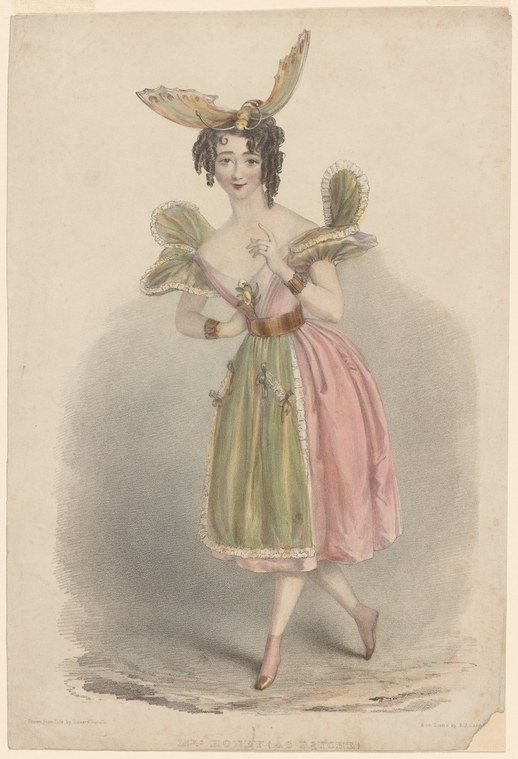
Mrs. Honey (as Psyche)
Unknown artist
- Collection:
- Prints depicting dance
- Source:
- New York Public Library
- Rights:
- Public domain — free to use, share and adapt.
- Recorded as:
- Public Domain
This work documents the visual and material culture of theatrical performance in an era before photography reliably captured movement on stage. It preserves not only the likeness of a specific performer but also the elaborate costume engineering and visual spectacle that made Romantic ballet an art of illusion. The image shows us how wings, headdresses, and carefully composed poses created the illusion of supernatural presence—techniques as important to the art as footwork.
What you are looking at
A young woman in theatrical costume stands in a classical contrapposto pose against a neutral background. She wears a pale pink skirt with green underskirt, a white corseted bodice, and an elaborate headdress topped with a large curled plume. Most strikingly, she holds enormous iridescent fairy wings—detailed with delicate veining—extended from both her shoulders. The figure is barefoot, and her dark curled hair frames a serene, upward-gazing face. The whole composition suggests a moment of ethereal suspension: she appears weightless, caught in an attitude of divine or supernatural reverie rather than in active movement. The hand-colored or watercolor technique gives the figure a translucent, dreamlike quality, with soft shadows pooling beneath her feet to anchor her in space.
The dancing
The dancer's weight rests on one leg in a classical ballet attitude, with the opposing leg relaxed beneath her. Her arms are positioned to cradle or display the wings rather than to frame her own body—a compositional choice that subordinates the dancer's line to the costume element. Her torso is upright and composed, her gaze elevated and introspective. The pose suggests a moment of stillness or suspension rather than active choreography, and there is no sense of momentum or rotation through the spine.
The dance depicted
This is likely a representation of a character dance or pantomime role from 19th-century theatrical ballet, most probably the character of a fairy, sylph, or sprite—roles that proliferated in the Romantic ballet era. The enormous prosthetic wings, the ethereal costume, and the serene, otherworldly pose all align with the visual language of supernatural or aerial characters in ballets such as La Sylphide or A Midsummer Night's Dream. The title "Mrs. Honey (as Psyche)" identifies the performer and her character: Psyche, the figure from Apuleian myth who acquired butterfly-wings after her apotheosis. The pose and presentation suggest this is a costume study or character portrait from performance, not a depiction of active dancing.
How it was made
This appears to be a hand-colored lithograph or engraving, a reproductive medium that allowed mass distribution of theatrical imagery to audiences who wished to remember or collect images of celebrated performances and performers. The soft modeling of form, the subtle gradations in the fabric, and the delicate rendering of the wings are consistent with hand-finishing—likely watercolor or gouache applied over a lithographic base. The technique is refined and labor-intensive, suggesting this was a commercial product aimed at an educated, theater-going public willing to pay for quality theatrical memorabilia. The print's size and format suggest it was part of a theatrical character portfolio or collected series.
About this work
This is a character portrait of a named actress, Mrs. Honey, costumed as Psyche in a 19th-century theatrical production. It documents both the performer and the visual language of fairy and supernatural roles in Romantic-era ballet and pantomime—genres in which actresses, often with less rigorous ballet training than their European counterparts, performed character roles alongside or within full-length ballets. The image is not a record of choreography but of costume, bearing, and the theatrical fantasy of transformation. It belongs in a dance archive because it shows how dance, theater, and the visual arts converged in the creation of supernatural female characters on stage—a genre that drove aesthetic and technical innovation in 19th-century theater.
How to look at it
Note the artist's choice to present the figure in a moment of stillness and reverie rather than in active movement—a compositional decision that emphasizes the supernatural and the costume over the technical feat. The enormous wings are rendered with scientific precision (delicate venation is visible), a contrast with the ethereal, dreamy quality of the figure herself. Look at how the pose, while referencing ballet's classical vocabulary, is actually quite static—the weight is settled, not suspended. The composition asks you to admire a costume and a performer's bearing, not to witness a movement phrase.
The artist
The artist is not recorded in the catalogue. The print's quality and finish suggest a commercial theatrical printmaker, likely working in London or a major European theater center in the mid-to-late 19th century. The attribution line at bottom—partly obscured in this image—may bear the name of a printmaker or publishing house; hand-colored theatrical character prints were a significant commercial sector, with specialized workshops producing them for sale to theater patrons and collectors.
The period
This print dates from the height of the Romantic ballet era (1830s–1860s), when ethereal female characters—sylphs, fairies, spirits—dominated the theatrical stage. The cult of the ballerina as an otherworldly being was at its peak; these roles were performed by dancers of varying levels of classical training, many of them actresses or pantomimes who specialized in character and grotesque roles. The costume of Psyche with wings references both classical mythology and the contemporary visual language of fairy illustration and pantomime spectacle. Hand-colored theatrical prints served as souvenirs and publicity for performances, much as photographic postcards would later do.
Where it lives
The print is held in the New York Public Library's collection of prints depicting dance. It is a commercial theatrical souvenir product, likely sold in the lobby or through theatrical print sellers of the era.
Dance in this work
Questions about this work
Who was Mrs. Honey?
The catalogue does not identify her further. She was likely a professional actress and dancer working in the mid-19th-century theater, known for character and pantomime roles. Without additional research in theater records and playbills of the period, we cannot establish more detail.
What is Psyche doing in this image?
She appears to be in a moment of posed stillness, not actively dancing. The upward gaze and composed posture suggest a moment of transformation or divine revelation—appropriate to the myth of Psyche, who was elevated to godhood and granted wings. This is likely a costume portrait capturing a specific moment or attitude from the theatrical performance rather than documenting choreography.
Why are the wings so enormous?
Theatrical spectacle and visual fantasy were primary. Giant prosthetic wings created the illusion of supernatural transformation and aerial presence, a key element of fairy and sylph roles in 19th-century ballet and pantomime. They were also eye-catching on stage and made for striking imagery in prints and promotional materials.
Is this from a famous ballet?
The character may come from a known ballet (La Sylphide, A Midsummer Night's Dream, or another Romantic-era work), or it may be from a pantomime or theatrical spectacle featuring original music and choreography. The catalogue provides no production information, so we cannot establish this with certainty.
More dance artwork





