49 works in this view — arrow keys or swipe to move between them.
Dance in Art
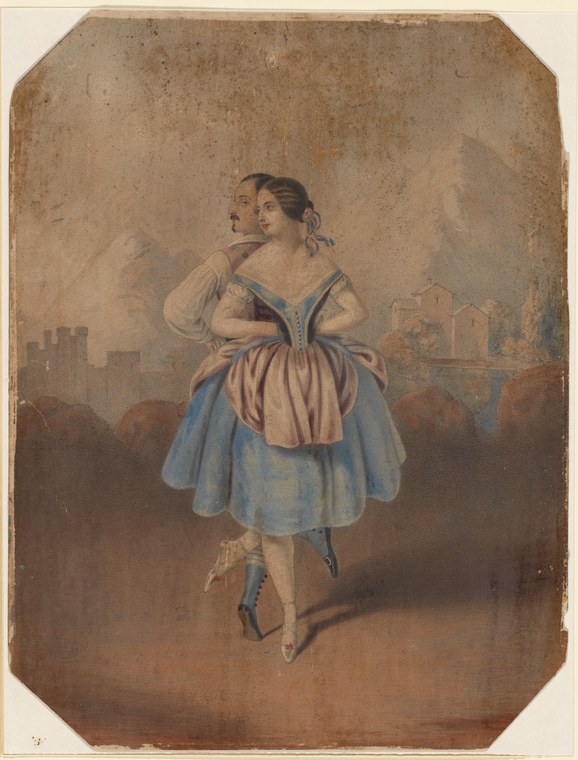
Fanny Cerrito and Arthur St. Léon in La vivandière
Unknown artist
- Collection:
- Prints depicting dance
- Source:
- New York Public Library
- Rights:
- Public domain — free to use, share and adapt.
- Recorded as:
- Public Domain
This image documents the aesthetic and emotional register of romantic ballet at its height, preserving how dancers performed the genre's signature blend of technical virtuosity and theatrical pathos. It is one of the few visual records we have of celebrated dancers in their signature roles, offering evidence of costume, movement quality, and the narrative context that gave shape to the ballet tradition.
What you are looking at
A young woman in mid-19th-century theatrical costume stands alone in a landscape of soft brown tonality, her body caught mid-movement in a pose of theatrical grace. She wears a white short-sleeved tunic-style bodice with what appears to be a blue skirt gathered at the waist, her pale legs and pink ballet slippers visible below. A pale pink shawl or fabric drapes from her shoulders and across her left arm. Her head is turned slightly to one side in a pose of modest reflection or expectation, with her dark hair arranged in the period style. Behind her, a misty landscape suggests a military encampment or fortified town in the distance—architectural elements and smoke hinting at the narrative context. The overall composition is intimate despite the theatrical scale: the figure is rendered with soft, careful attention to the fall of fabric and the modeling of limbs, creating a sense of immediacy and presence.
The dancing
A single female dancer stands with her weight distributed evenly, her body upright but softly curved. Her right arm is raised and bent, hand near her face in a gesture suggesting either distress, thoughtfulness, or the fixed positions of romantic ballet vocabulary. Her left arm is extended at her side, supporting the draped fabric. The posture is characteristic of the mid-19th-century romantic idiom—neither fully turned out nor in the extreme positions of later technique, but with the gentle line and graceful port de bras that defined the era. The figure projects both stillness and implied motion, as if paused between movements.
The dance depicted
This is a portrait of romantic ballet, most likely from a narrative military spectacle such as *La vivandière* (The Sutler's Daughter), a vehicle for virtuosic female dancers that premiered in Paris in 1848. The costume—a light tunic and short skirt combined with ballet slippers—and the theatrical setting with military encampment align with the vivandière tradition, in which a young woman of the camp follows an army and becomes entangled in the narrative or action. The pose and gesture suggest the emotional register of romantic ballet: pensive, tender, caught between duty and feeling. The artist has chosen to show the dancer not in technical display but in a moment of introspection, which was the hallmark of romantic ballet's emotional intensity.
How it was made
This is a hand-colored print, likely a lithograph or engraving hand-tinted with watercolor or gouache. The soft, subtle modeling of the figure and the luminous treatment of the white fabric suggest the work of a skilled colorist responding to a prepared stone or plate. The technique allowed for relatively rapid reproduction and wide circulation, making such prints important documents of celebrated dancers and roles in an era before photography could capture movement. The soft palette and careful gradations suggest this was a commercial or semi-commercial product, created to commemorate a celebrated performance and to be sold to theaters, admirers, and collectors.
About this work
This is a print documenting a celebrated moment in mid-19th-century romantic ballet, capturing the emotional and visual language of the era through the figure of a dancer in the role of a vivandière—a camp follower in a military narrative. The print records both the choreographic and scenic elements of a theatrical tradition that dominated European ballet stages from the 1830s through the 1860s. The work belongs to the archive of theatrical portraiture and dance documentation, a visual tradition through which audiences and historians have understood the aesthetic of romantic ballet.
How to look at it
Attend to the artist's choice of moment: not a leap or turn, but a pause—the dancer caught between movements or between actions within the narrative. Notice the careful rendering of the costume and the way the fabric reads as real and weighted despite the romantic softness of the overall image. The landscape behind her is barely suggested, kept distant and smoky, so that the viewer's attention remains on the figure and her emotional state. This is characteristic of romantic-era portraiture: the dancer is shown as a character with inner life, not as a technician.
The artist
The artist is not recorded. The work appears to be a theatrical print in the commercial tradition of the 1850s, when lithographs and hand-colored prints of celebrated dancers were produced in large numbers and sold in theaters and print shops across Europe. Such works were often unsigned or credited only to the lithographer or publisher rather than to the artist who created the original drawing.
The period
The romantic ballet era, roughly 1830–1870, was defined by ethereal female dancers, supernatural narratives, and an aesthetic of melancholy and longing. Ballets set in exotic or historical locations—among them military camps, forests, and distant lands—offered dancers like Fanny Cerrito opportunities to move between technical display and emotional drama. The vivandière figure became a popular character type after the success of *La vivandière*, allowing choreographers to explore themes of loyalty, displacement, and romantic attachment while grounding the narrative in a recognizable social type. Prints such as this were the primary means by which images of celebrated dancers and roles circulated beyond the theater, shaping how the ballet was remembered and imagined.
Where it lives
This work is held in the New York Public Library's collection of prints depicting dance, a collection that preserves commercial and documentary images from theater history.
Dance in this work
Questions about this work
Who were Fanny Cerrito and Arthur St. Léon?
Fanny Cerrito was one of the greatest Italian ballet dancers of the mid-19th century, celebrated for her technical brilliance and expressive power. Arthur St. Léon was a French dancer and choreographer who frequently performed alongside and created roles for Cerrito. Their partnership was artistically significant and personally complicated, involving both professional collaboration and romantic attachment.
What is a vivandière?
A vivandière was a woman who followed an army in the field, selling provisions and supplies to soldiers. In 19th-century ballet, the vivandière became a dramatic character type—young, loyal, often caught in the conflicts and passions of soldiers and officers. The role allowed dancers to perform in a semi-realistic narrative context while still displaying technical skill.
How do we know what this ballet looked like?
We know through prints like this, which documented celebrated dancers in their roles; through written reviews and descriptions in theater journals; and through choreographic notation and reconstructions. No video records exist, so prints remain essential primary documents for understanding how romantic ballet actually looked and what excited audiences about it.
Why does she look so pensive?
Romantic ballet valued emotional depth and psychological realism alongside technical display. Dancers were expected to inhabit their characters and to show feeling through gesture and facial expression. The pensive quality here reflects both the narrative context of the vivandière role—a woman displaced and vulnerable—and the broader aesthetic of the romantic era, which prized introspection and yearning.
More dance artwork





