49 works in this view — arrow keys or swipe to move between them.
Dance in Art
French spy
Unknown artist
- Collection:
- Prints depicting dance
- Source:
- New York Public Library
- Rights:
- Public domain — free to use, share and adapt.
- Recorded as:
- Public Domain
This print is valuable evidence of how 19th-century theatrical dance characters were posed and marketed to audiences. It shows the body in trained, purposeful movement within a narrative context, revealing the physical vocabulary of stage action in an era when dance and dramatic movement were closely interwoven. For historians of theatre and dance, it documents both the aesthetics of the period and the commercial circulation of dance imagery.
What you are looking at
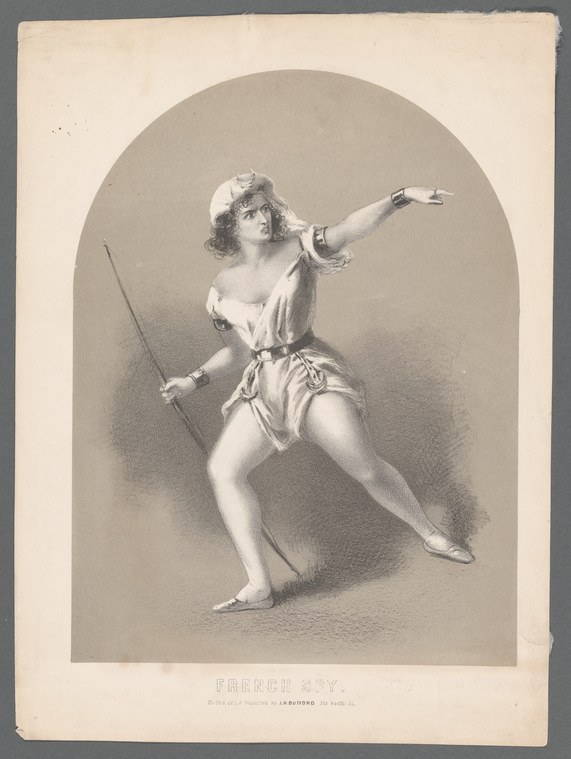
A single female figure dominates a vignette composition against a neutral ground. She is caught mid-movement in a dynamic lunging pose, her weight shifted forward onto her left leg with the right leg extended behind in a long line. Her body twists with theatrical energy—her torso turns toward the viewer while her right arm extends outward in a sweeping gesture, palm open as if pointing or indicating something beyond the frame. Her left arm holds a long thin stick or sword, angled diagonally. She wears a draped tunic or classical garment that falls short of the knees, with a soft cap or headpiece visible. The fabric clings and moves with the figure's momentum. The print is executed in fine grayscale tones with careful modeling of the flesh and subtle shading that creates volume and movement. The composition is oval in format, a common framing device of the 19th century.
The dancing
The figure stands alone in a fully extended lunge with considerable depth—the forward leg bears weight while the rear leg stretches behind for balance and extension. The arm gestures are emphatic and directional: the extended right arm reads as a pointing or commanding movement, while the left maintains a weapon or staff. The torso rotates against the legs, creating a spiral energy typical of stage movement. The weight distribution and limb extension suggest trained theatrical movement rather than social or folk dance.
The dance depicted
The image depicts a stage figure in classical or mythological costume, likely representing a historical theatrical dance or pantomime rather than a recognizable ballroom or folk form. The combination of the tunic, the weapon, the commanding gesture, and the title 'French spy' suggests this may be a character from 19th-century theatrical repertoire—possibly a female spy or soldier character from an operatic or pantomimic work. The dynamic lunge and extended arm positioning indicate stage combat or martial movement training, common in theatrical dance and movement of the Romantic era. Without more documentary evidence, the specific dance style cannot be definitively named, but the execution shows academic training in theatrical movement.
How it was made
This is a fine engraving or lithograph, executed in grayscale with careful tonal gradation. The technique allows the artist to capture the play of light across the figure's musculature and the fabric of the costume, and to create atmospheric depth through subtle grading. The oval vignette format, typical of 19th-century reproductive prints, suggests this was a published or widely distributed work intended for a general audience. The fine detail and careful modeling indicate a skilled professional printmaker, likely working from a drawing or painting.
About this work
This print documents a theatrical character—likely from a French stage work of the 19th century—frozen in a moment of dramatic action. The figure embodies the Romantic era's fascination with dynamic stage movement, elaborate costume, and the theatrical female form in motion. The work sits at the intersection of dance history, theatrical practice, and printmaking, capturing how movement was understood, taught, and circulated as a visual commodity in the 19th century. As a record of stage practice, it preserves a specific moment in the history of theatrical movement that would otherwise be lost to time.
How to look at it
Notice the moment captured: not a stable pose but a transient lunge, with weight visibly transferring and limbs extended in space. The artist has frozen the figure at maximum extension and twist, when the dramatic intention is clearest. Observe how the costume drapes with the movement—the fabric reads the body's weight and momentum. The pointing gesture and weapon together tell a story of agency and action, rather than passive display. The oval framing draws your eye to the figure's center and creates an almost portrait-like intimacy despite the violent movement.
The period
This print dates to the 19th century, a period of flourishing theatrical dance in Europe. The Romantic era (particularly 1830–1860) saw a revolution in ballet and stage movement, with increasing emphasis on the female dancer as a central spectacle. Theatrical prints became a major commercial product, circulating images of celebrated dancers and dramatic characters to a broad public. France was a center of this print production, and images of stage figures were sold as souvenirs, reference materials, and art objects in their own right. The figure of the 'spy' character reflects the Romantic era's interest in dramatic narrative, historical costume, and physical action as entertainment.
Where it lives
This engraving is held in the NYPL's collection of prints depicting dance. The catalogue record preserves the title 'French spy' and notes only that it is undated and of unknown attribution, typical of 19th-century theatrical prints that were produced rapidly and often unsigned.
Dance in this work
Questions about this work
Who was this character and what work was she from?
The catalogue does not identify the specific theatrical source. The title 'French spy' suggests a dramatic character, possibly from a French opera, ballet, or pantomime of the 19th century, but without documentation we cannot say which work or which performer this represents.
How do I know this is dance rather than just dramatic movement?
In the 19th-century theatre, the boundaries between dance and drama were fluid. This figure exhibits trained, stylized movement—the extended lines, the turned-out positions, the coordination of torso and limbs—that shows balletic training even if the moment itself is narrative rather than purely balletic. It belongs to theatrical dance broadly understood.
What is she holding?
The object in her left hand is a thin stick or sword, consistent with a martial or military character. The right arm's pointing gesture suggests command or direction, fitting the spy or soldier character suggested by the title.
What does the oval frame mean?
The oval vignette was a standard 19th-century print format that created a portrait-like presentation. It isolated the figure from context and emphasized the individual character, making the print suitable both as a souvenir of a theatrical performance and as a standalone art object.
More dance artwork





