49 works in this view — arrow keys or swipe to move between them.
Dance in Art
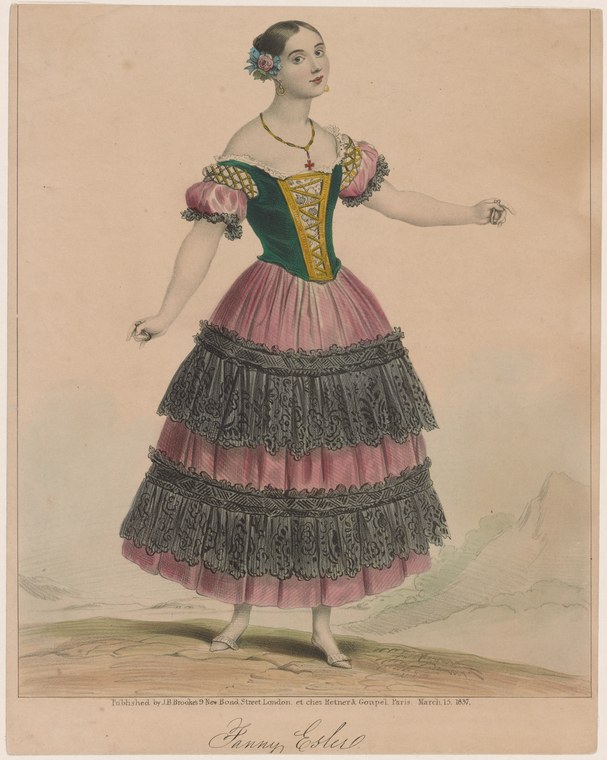
Fanny Esler [sic]
Unknown artist
- Collection:
- Prints depicting dance
- Source:
- New York Public Library
- Rights:
- Public domain — free to use, share and adapt.
- Recorded as:
- Public Domain
Fanny Elssler was one of the defining figures of Romantic ballet and a dancer of genuine historical significance: technically brilliant, dramatically powerful, and a cultural phenomenon in her own right. This portrait is one of countless prints made of her during her lifetime, testifying to her extraordinary fame and to the nineteenth-century appetite for dancer celebrity imagery. For dance historians and artists, the print is a valuable primary document of Romantic-era costume construction, performance convention, and the visual language dancers and audiences used to understand their art.
What you are looking at
A single female dancer is depicted in a three-quarter standing pose against a plain beige ground. She wears an elaborate Romantic-era costume: a fitted bodice in dark green with gold brocade detail and puffed sleeves trimmed in pink silk and black lace, beneath which falls a voluminous skirt composed of alternating bands of pink tulle and black lace, extending to mid-calf. The skirt's construction—with its layered tiers and deep lace flounces—is characteristic of the 1830s–1840s ballet aesthetic. Her dark hair is styled in a center part with a small floral wreath or tiara visible on one side. She wears a simple dark choker at her neck and delicate jewelry at her wrists. Her posture is upright and formal, with one arm extended to her side in a graceful line and the other relaxed. Her feet are bare or in soft ballet slippers, positioned in a relaxed stance rather than a demanding technical pose. The overall presentation is that of a professional dancer in stage costume, rendered as a portrait.
The dancing
The dancer stands alone in a composed, presentational pose. Her frame is upright and dignified; the extended arm describes a gentle, open line typical of Romantic ballet vocabulary. The weight appears evenly distributed, without the elevation or tension of an active step—this is a posed moment rather than a captured movement. Her expression is serene and her gaze directed upward and away, following the convention of the period in which the dancer's interiority and noble bearing were as important as technical display. No visible footwork is engaged; the bare or slippered feet rest naturally on the ground.
The dance depicted
This is a portrait of Fanny Elssler, the renowned Romantic-era ballet dancer, in a stage costume typical of the 1830s–1840s. Elssler was one of the two leading ballerinas of the Romantic period (the other being Marie Taglioni), famous for her dramatic presence, earthy sensuality, and commanding technique. Her signature roles emphasized character and personality over pure ethereal abstraction. The costume here—with its detailed construction and the emphasis on the layered skirt and decorative sleeves—aligns with the aesthetic demands of Romantic ballet: a balance between ethereal grace and material richness, the skirt's movement potential carefully designed to enhance the dancer's technique and presence.
How it was made
This is a hand-colored lithograph or engraving, a reproductive print technique that allowed mass circulation of celebrity dancer portraits in the nineteenth century. The delicate coloring of the bodice, the precise rendering of the lace tiers, and the subtle shading suggest a skilled colorist working over a printed base. The technique enabled theaters and print sellers to capitalize on the fame of celebrated dancers, making their images available to a broad public audience—fans, aspiring dancers, costume designers—beyond those who could afford original paintings. The print's careful attention to costume detail served a documentary function, recording stage fashion for posterity.
About this work
This is a hand-colored print portrait of Fanny Elssler, one of the two supreme ballet stars of the Romantic era (1830s–1840s), shown in a characteristic stage costume of the period. The work documents both the visual poetry of Romantic ballet aesthetics—the layered tulle skirt, the fitted bodice, the decorative sensibility—and the celebrity culture that surrounded the great dancers of the time. As a reproductive print, it exemplifies how nineteenth-century theater capitalised on star performers' fame, circulating their images through affordable, portable media that brought the glamour of the stage into homes and studios across Europe and beyond.
How to look at it
Attend to the costume's construction: the carefully rendered tiers of lace, the puffed sleeves, the fitted bodice—all elements that would be visible and important in stage lighting and at the distances of a theater audience. The print prioritizes these visual elements because costume was understood as integral to the dancer's art and persona. Notice also the pose: presentational rather than dynamic, the dancer addressing an implied viewer (the audience, or the purchaser of the print) rather than absorbed in movement. This follows the convention of dance portraiture in the period, where the dancer's nobility and grace were expressed through composed dignity rather than captured action.
The artist
The catalogue record identifies no artist. The print bears a publication line indicating it was printed and colored by a London print firm—likely Brougham and Co., based on the visible imprint—in March 1845. The work is one of many theatrical celebrity portraits produced during the height of the Romantic ballet craze, a genre in which skilled printmakers and colorists supplied the voracious Victorian market for images of famous performers. These works were typically based on drawings or paintings by stage designers or portraitists and adapted for mass production.
The period
The 1840s were the apex of Romantic ballet in Europe. The movement had emerged in the 1820s–1830s with a new aesthetic emphasis: pointe work, ethereal costuming (the longer skirt), supernatural narratives, and the cult of the individual dancer as artist and personality. Fanny Elssler embodied one pole of this aesthetic—the earthy, dramatic, technically assured ballerina—while Marie Taglioni embodied the other, the ethereal and weightless. Both were international superstars. The 1840s saw the rapid growth of theatrical celebrity culture, driven by improved printing technology and a new class of affluent urban audiences eager to possess images of their favorite performers. Such prints were as common in their time as photograph posters are today.
Where it lives
The print is held by the New York Public Library in its collection of prints depicting dance. The publication information visible on the print—London, March 1845, printed and colored by Brougham and Co.—indicates it was a commercial theatrical celebrity print, likely sold in print shops and theaters and distributed internationally.
Dance in this work
Questions about this work
Who was Fanny Elssler?
Fanny Elssler (1810–1884) was an Austrian-born ballet dancer and one of the two supreme stars of Romantic ballet, alongside Marie Taglioni. She was known for her dramatic intensity, technical brilliance, and earthy presence—qualities that contrasted with Taglioni's more ethereal style. She performed across Europe and the Americas and was a genuine international celebrity.
What is the costume she is wearing?
This is a typical mid-nineteenth-century Romantic ballet costume. The knee-length skirt composed of layered tulle with lace flounces was a signature element of the period, designed to showcase the dancer's footwork while maintaining an ethereal, otherworldly effect. The fitted bodice with decorative sleeves added richness and visual interest, and the costume's total silhouette was carefully engineered for stage effect.
How do we know this is Elssler and not another dancer of the period?
The print is signed with the name 'Fanny Esler' at the bottom (spelled as 'Esler' in the imprint, a common variant). The costume, hairstyle, and the documented history of Elssler's celebrity and the many prints produced of her all support the identification. Such portraits were commercial products with printed names and publication details.
What does this print tell us about how dance was understood in the 1840s?
The emphasis on costume, pose, and personality suggests that Romantic-era ballet was understood as a synthesis of visual, material, and dramatic elements, not purely technical display. The fact that such portraits were mass-produced and widely circulated shows that dancers had become celebrity figures with commercial value, and that audiences were invested in knowing what stars looked like both on stage and in the imagined space of the print.
More dance artwork





