34 works in this view — arrow keys or swipe to move between them.
Dance in Art · 2019
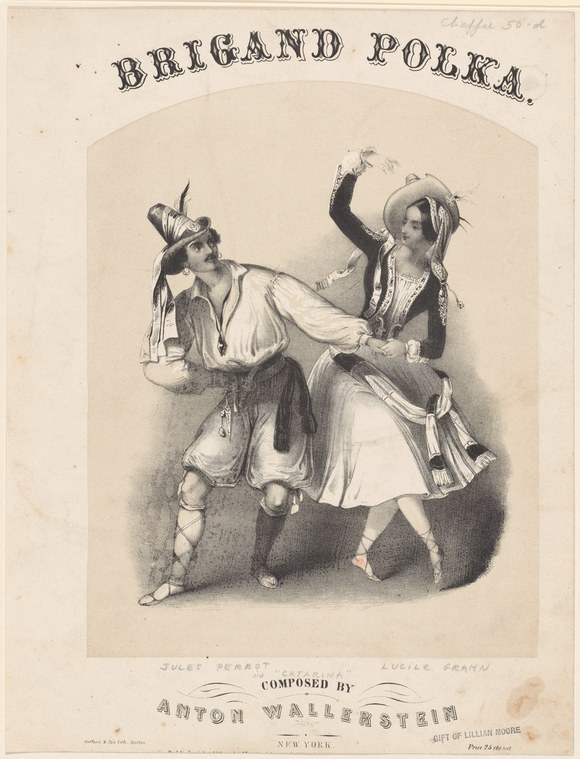
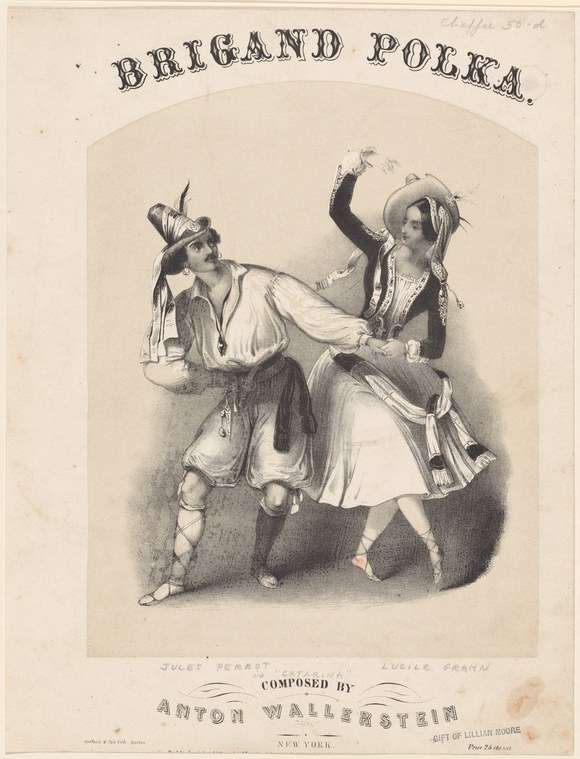
Brigand polka.
Unknown artist
- Medium:
- Lithograph
- Dance:
- Polka
- Era:
- Late 1800s (Victorian Ballroom)
- Source:
- New York Public Library
- Rights:
- Public domain — free to use, share and adapt.
- Recorded as:
- public_domain
This image documents the polka at a moment when it was the most fashionable dance in the Western ballroom—evidence of how quickly an unknown Bohemian dance became a marker of modernity and social aspiration. The brigand costume and theatrical staging reveal that 19th-century polka was not purely technical but inherently dramatic, a form that invited performers to embody character and emotion. For historians of gender and social dance, it shows how the dance floor was a space where women could enact refusal and autonomy, however playfully, within a framework of structured courtship.
What you are looking at
A lithographed title page for a polka, showing two figures in a moment of spirited courtship or flirtation captured mid-dance. The figure on the left, costumed as a brigand or romantic bandit in loose white shirt, dark vest, and striped breeches with leg wrappings, gazes adoringly upward while gesturing with one arm. The figure on the right, dressed in a white dress with dark corseting and a decorative bonnet, raises one arm in a gesture of playful refusal or coquettish retreat. The composition is set against a neutral background and rendered in the soft, tonal lithographic style typical of mid-19th-century popular prints. The energy is one of theatrical courtship—a common theme in social dance imagery of the period.
The dancing
The two dancers occupy a relatively close spatial relationship suggesting immediate social engagement. The brigand leans slightly forward with an upturned gaze and extended arm—a posture of romantic appeal or pleading. The woman stands nearly upright with her torso angled away but her raised arm and turned head keeping her engaged with her partner; her posture suggests the playful resistance typical of period flirtation choreography. Neither figure appears to be in the closed hold standard to many ballroom dances of the era; instead, the positioning suggests a moment within a figure—perhaps a turn or a phase of advance and retreat.
The dance depicted
This is a polka, as stated in the title and confirmed by the era label (late 1800s, Victorian Ballroom). The polka was a couple dance in 2/4 time with a characteristic hop-step pattern, originating in Bohemia in the 1830s and spreading rapidly through European and American ballrooms by mid-century. The theatrical costumes—particularly the brigand dress—suggest this was a themed or character variant, possibly performed at balls or in theatrical contexts where dancers adopted romantic narratives. The image captures not the technical footwork but the emotional and social drama of the dance: the interplay of desire and modest refusal that underpinned the social meanings of ballroom interaction.
How it was made
This is a lithograph, a planographic printing technique that allowed for soft tonal gradation and wide circulation at modest cost. Lithographs were the standard medium for popular dance prints, sheet-music covers, and ballroom instruction imagery throughout the 19th century. The technique's affordability and ability to reproduce detailed costume and physiognomy made it ideal for commemorating specific dances, popular melodies, and the fashions of the ballroom. This print would have been sold as a cover for the musical score or as a standalone souvenir of a fashionable dance.
About this work
This is a mid-19th-century lithographed title page for a polka, a social dance that had recently captured European and American ballroom culture. The image stages the polka not as a technical display but as a moment of romantic social theater, using costumed characters to embody the flirtation and courtship that the dance form enabled. The brigand—a figure of rakish appeal—presses his suit while the woman, dressed in fashionable ballroom attire, enacts a playful resistance. The work exemplifies how dance prints of this period sold both the music and the emotional narrative, allowing people who could not attend fashionable balls to imagine themselves within the social drama of the dance.
The print is significant as evidence of how polka was performed and understood: not as a display of virtuosity but as a vehicle for social interaction and the performance of gender roles. The theatrical costume signals that themed or character dances were part of fashionable practice, and that the polka could accommodate narrative and drama as well as technical proficiency.
How to look at it
The print freezes a single moment of social interaction rather than a technical step—a choice that privileges narrative over virtuosity. Notice the direction of gaze and the angle of the bodies: the woman's half-turned posture and the man's forward lean create a dynamic of approach and retreat, the visual grammar of courtship. The costumes are essential: the brigand's picturesque dress signals that this is a character dance or a theatrical presentation rather than plain ballroom etiquette, inviting the viewer to see the polka as a form of romantic play. The soft lithographic tonality creates intimacy and draws focus to the faces and gestures rather than to footwork or architectural setting.
The artist
The lithograph is inscribed to Jules Perrot (likely the dancer and choreographer Jules Perrot, 1810–1894) and Lucile Grahn (the Danish dancer Lucile Grahn, 1819–1907), and is credited to composer Anton Wallerstein. Perrot was a celebrated ballet master and choreographer of the Romantic era, known for dramatic and narrative choreography; Grahn was a leading Romantic ballerina. It is possible the dance or its staging was associated with these performers, or that the print used their names to market the work. The actual artist of the lithograph is not recorded.
The period
The polka emerged in Bohemia in the 1830s and by the 1840s had become a craze across Europe and America, rivaling the waltz as the defining couple dance of the era. By the time this print was made (mid-to-late 1800s), the polka was well established in ballroom repertory but retained an association with novelty and theatrical exuberance. In the visual arts, this period saw an explosion of popular prints celebrating fashionable dances, driven by the growth of lithographic printing and the commercial music industry. Dance imagery became a vehicle for marketing both music and fashionable identity, allowing middle-class consumers to participate imaginatively in elite ballroom culture.
Where it lives
The print is held by the New York Public Library and is catalogued as part of their dance and ballroom ephemera collection. It is a commercial popular print, one of thousands produced in the mid-19th century as sheet-music covers, souvenirs, and promotional materials for fashionable dances.
Dance in this work
Questions about this work
What is a polka and where did it come from?
The polka is a couple dance in 2/4 time with a characteristic hop-step pattern, originating in Bohemia in the 1830s. It spread rapidly to ballrooms across Europe and America, becoming wildly fashionable by the mid-1800s. It was faster and more energetic than the waltz and was associated with modernity and social change. The polka became a symbol of middle-class social life and was taught in dance manuals, performed in ballrooms, and celebrated in popular prints and music.
Why are the dancers dressed as a brigand and a lady?
Character or themed dances were part of fashionable ballroom practice in the 19th century. Dancers would adopt picturesque or romantic costumes to add narrative drama to social dances. The brigand was a popular romantic figure in art and literature of the period, embodying an idealized masculine freedom and appeal. This costume variant allowed the polka to be performed as a theatrical flirtation between a rakish outsider and a respectable woman, adding emotional and social layers to the dance.
How do we know this depicts a polka and not another dance?
The title of the print—'Brigand Polka'—explicitly identifies it as a polka. The era (late 1800s, Victorian Ballroom) and the couple positioning and costume all align with polka as a social dance of the period. While the image does not show the specific footwork, the moment of interaction and the overall composition are consistent with how polka was represented in contemporary dance prints and social imagery.
Who were Jules Perrot and Lucile Grahn?
Jules Perrot (1810–1894) was a celebrated French dancer and choreographer of the Romantic ballet era, known for dramatic narrative works. Lucile Grahn (1819–1907) was a Danish Romantic ballerina of considerable reputation. Their names appear on this print, though it is unclear whether they performed this specific polka or whether their names were used to lend prestige and marketability to the work. It is possible the dance was created for them or was performed in a context associated with their careers.
More Polka artwork