49 works in this view — arrow keys or swipe to move between them.
Dance in Art
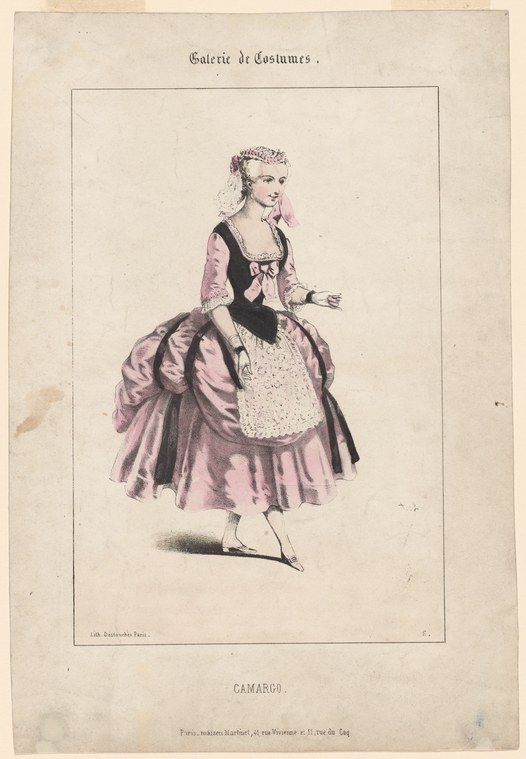
Camargo
Unknown artist
- Collection:
- Prints depicting dance
- Source:
- New York Public Library
- Rights:
- Public domain — free to use, share and adapt.
- Recorded as:
- Public Domain
Camargo was a watershed figure in ballet history: her innovations in costume and technique permanently changed what ballet dancers could do, and her celebrity set a template for the public presence and marketability of dancers that persists today. This image—a named, individual portrait rather than an allegorical or generic dance figure—is evidence of how the dancer as a celebrity had entered public consciousness by the 19th century, circulated in prints to a wide audience.
What you are looking at
A single female dancer in theatrical dress stands in a posed, three-quarter view against a plain background. She wears a voluminous pink silk skirt with deep inverted pleats or swags at the sides, gathered dramatically at the back, paired with a black velvet or satin bodice and white apron. Her bodice has short pink sleeves. She wears a white lace or gauze cap with trailing ribbons, and white stockings with heeled shoes. Her left arm is extended outward in a graceful gesture, while her right arm rests naturally. Her posture is upright and elegant, with her weight settled on both feet in a composed stance rather than mid-movement. The figure is rendered in a refined lithographic style with hand-coloring, typical of 19th-century dance portraiture. The title "Camargo" appears below the image, and a publication line credits "Chez Martinet" in Paris.
The dancing
The dancer stands in a single, frontal pose rather than captured mid-step. Her frame is upright and dignified, with the left arm extended in an open, inviting gesture while the right hangs at her side. There is no indication of balletic turnout or elevation; instead, the stance suggests a graceful, social or theatrical walk. The extended arm is characteristic of courtly or early theatrical dance gesture rather than the technical positions of later ballet.
The dance depicted
This is almost certainly a portrait of Marie-Anne Camargo (1710–1770), the famous French ballerina and one of the most celebrated dancers of the 18th century. Camargo was known for shortening her skirt to mid-calf to display her footwork—a radical innovation—and for her brilliant technique and speed, especially in entrechats (beating steps). The costume shown here follows that tradition: the shortened skirt (to just below the knee) and the emphasis on the lower leg and foot would have been her signature. The image appears to be a theatrical or promotional portrait rather than a depiction of an actual performance moment, showing the dancer as a named celebrity in her characteristic dress.
How it was made
This is a hand-colored lithograph, identifiable by the soft tonal qualities, fine linear detail, and the characteristic crayon-like marks of stone lithography. The publication credit to Martinet (a major Paris music and theater publisher of the 19th century) indicates this was a commercial print, likely produced in the 1830s–1850s. Lithography allowed for rapid, relatively inexpensive production of detailed theatrical portraits, making them affordable for collectors and theater-goers and helping to create and circulate the public image of celebrated dancers.
About this work
This is a theatrical portrait of an 18th-century dancer rendered in the 19th-century medium of hand-colored lithography. It commemorates Marie-Anne Camargo, one of the most influential figures in the history of ballet, known for technical innovation (especially beating steps), for the theatrical shortening of her skirt, and for her cultural prominence across Europe. The image shows her in her characteristic stage dress, composed and elegant, as she would have been recognized by the theater-going public of her era and remembered in popular prints long after her death. The print is an artifact of both dance history and the 19th-century culture of theatrical celebrity.
How to look at it
Note the shortened skirt and the emphasis on the leg and foot—this was the visual signature of Camargo's innovation and would have been immediately legible to a contemporary viewer as marking her as a technical virtuoso. Observe the pose: it is neither a naturalistic stance nor a balletic arabesque, but rather a refined theatrical presentation—the kind of portrait pose that presents the dancer as a named individual and celebrity rather than as a body in motion. The hand-coloring and the quality of detail in the lithography show the care taken to convey both elegance and recognizability.
The period
Marie-Anne Camargo was active from the 1720s to the 1750s, but her fame extended far beyond her lifetime. By the 19th century, when this print was made, she had become a historical figure and legend—the embodiment of early theatrical ballet innovation and elegance. The print belongs to the tradition of theatrical portraiture that flourished in Paris and Europe from the 1820s onward, when lithography made it possible to produce and distribute images of performers cheaply and rapidly. Camargo's shortened skirt and distinctive costume had become iconic and instantly recognizable, making her an ideal subject for commercial reproduction.
Where it lives
The print is held by the New York Public Library in their collection of prints depicting dance, catalogued under 'Galerie de Costumes' (Gallery of Costumes), a typological grouping for 19th-century theatrical costume studies and portraits. The publication credit indicates it was printed in Paris by or through Martinet, a major publisher of such materials.
Dance in this work
Questions about this work
Who was Camargo?
Marie-Anne Camargo (1710–1770) was a French dancer and one of the most celebrated performers of the 18th century. She was famous for her technical brilliance, especially her speed and her ability to execute beating steps (entrechats), and for shortening her skirt to mid-calf to display her feet—a radical change that became a permanent feature of ballet costume. She performed across Europe and became an international celebrity.
Why is the skirt so short?
Camargo famously shortened the long, heavy skirts worn by dancers before her, raising the hem to the knee or just below to display her feet and legs. This allowed her to show off her technical footwork and speed, which were her greatest strengths. The shortened skirt became a marker of her identity as a performer and a symbol of technical innovation in ballet.
Is this a portrait of a real performance?
No; this is a theatrical portrait or celebrity portrait—a posed studio image meant to display the dancer in her characteristic costume and elegant presentation, not a depiction of an actual moment on stage. Such portraits were made to be circulated to the public as prints, helping to build and maintain the celebrity of famous performers.
What is a hand-colored lithograph?
A lithograph is a print made from a stone or metal plate on which an image has been drawn with a greasy crayon or ink; it was a major reproductive technology of the 19th century, faster and cheaper than engraving. Hand-coloring means the colors were applied by hand, usually by teams of workers, after the image was printed. This made theatrical portraits affordable and collectable for a wide public.
More dance artwork





