49 works in this view — arrow keys or swipe to move between them.
Dance in Art
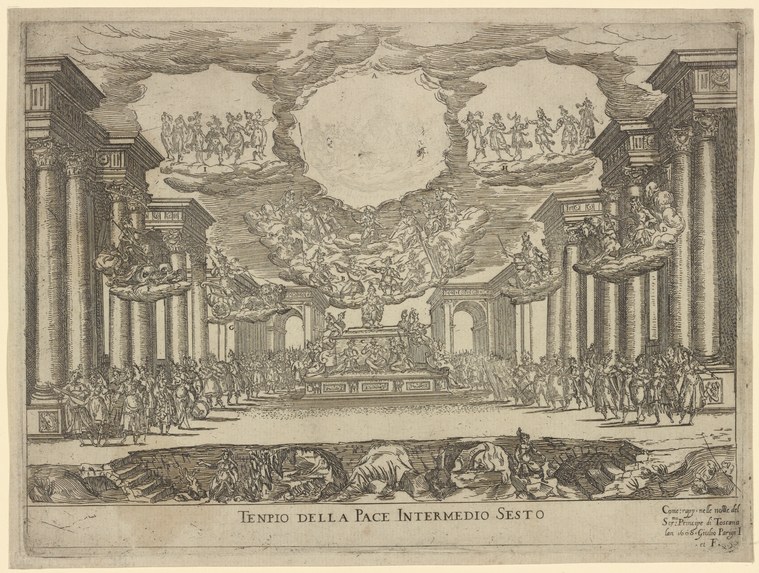
Tenpio [sic] della pace, Intermedio sesto: Come: rapp. nelle nozze del Sermo. Principe de Toscana, Jan. 1608
Unknown artist
- Collection:
- Prints depicting dance
- Source:
- New York Public Library
- Rights:
- Public domain — free to use, share and adapt.
- Recorded as:
- Public Domain
This print documents the intermedio tradition at its height and at a specific moment—the Medici court in 1608—when such spectacles were among the most elaborate and expensive artistic productions in Europe. For dance historians, it reveals how court movement was framed within architecture and pageantry, how the body was deployed ceremonially rather than athletically, and how a single event could generate commemorative images that circulated widely. It is also one of the few surviving visual records of how Renaissance courtiers actually stood, processed, and gestured in a formal public setting.
What you are looking at
This engraving depicts an elaborate court intermedio—a theatrical entertainment staged between acts of a play—performed in a vast classical hall for the 1608 Medici wedding. The space is defined by soaring Corinthian columns that recede in perspective, creating a cavernous interior lit from above by a break in the ceiling where clouds part to reveal an allegorical scene. The stage floor is crowded with richly dressed courtiers and performers: some stand in formal groupings, others process or gesture with animated arms. The composition is symmetrical, with action distributed across the full width of the space. In the foreground and background, tightly packed figures in elaborate costume create layers of social hierarchy—nobles in the center, attendants and lesser figures around them. The architectural setting itself is as much the subject as the dancers: it frames and elevates the human action through strict geometric order.
The dancing
The bodies are dressed in contemporary court costume—men in doublets and hose, women in full-skirted gowns—and the poses are decorous rather than virtuosic. Arms are raised, extended, or held in gestures of address and greeting rather than in closed dance holds. The figures are upright, frontal, or turned at three-quarter angles to the viewer; there is no sense of weight in motion or of feet executing rapid footwork. The groupings appear processional and ceremonial—figures arranged in rough lines or clusters—rather than coupled or engaged in partner dancing. The scale suggests dozens of participants across multiple spatial planes, with the image capturing a moment of formal assembly rather than the kinetic heart of any single movement phrase.
The dance depicted
This is not a record of virtuosic social or theatrical dance but rather of court ceremonial movement as it was staged in the Renaissance intermedio tradition. The intermedio was a spectacular sung and danced diversion—often mythological or allegorical in theme—inserted between the acts of a play to entertain a noble audience and display ducal patronage and wealth. Movement in such entertainments was typically processional, symbolic, and stately rather than technically demanding. The figures here suggest the formal promenade and statuary poses characteristic of court display, where the presentation of costume, architecture, and social order took precedence over dance technique. The image documents not how the intermedio was danced by trained performers but how it was staged as a total theatrical and architectural event.
How it was made
This is an engraving on paper, a reproductive print medium that allowed wide distribution among the educated elite. Engraving permitted fine linear detail—visible in the rendering of columns, drapery, and the faces of foreground figures—and enabled the artist to capture both the grandeur of the architectural setting and the crowded complexity of the assembled court. The technique required careful composition in reverse and meticulous parallel hatching to suggest volume and shadow. As a print, the work served documentary and commemorative functions: it recorded a specific state occasion for patrons and courtiers who attended or wished to have witnessed it, and it circulated the fame of the Medici court throughout educated European networks. The clarity of the engraved line made it ideal for architectural detail and social documentation.
About this work
This engraving documents the sixth intermedio (intermedio sesto) staged between acts of a play during the wedding festivities of a Medici prince in January 1608 in Florence. It records not a single dance but a multimedia court spectacle—a processional, ceremonial gathering of costumed courtiers within a classically ordered architectural space. The image is a record of Renaissance theatrical production and court ritual rather than of choreography or the technical execution of dance steps. It belongs in a gallery of dance in art because the intermedio was a major form of aristocratic performance in which movement, music, spectacle, and architecture combined to create meaning, even if the movement itself was not technically virtuosic by later standards.
How to look at it
Look first at the architecture: the engraver has used rigorous perspective to thrust the eye into a vast receding space, creating an impression of almost overwhelming scale and order. Then observe the figures: they are small against this architecture, arranged in formal groupings rather than dynamic pairs or lines. Notice that most are either frontal or turned at three-quarter angles—poses that maximize visibility rather than suggest motion. The artist has frozen not a climactic moment of dancing but rather a processional assembly, a display of social order and magnificence. The break in the ceiling (showing clouds and an allegorical scene) is as much the focus as the courtiers below—the intermedio was a total theatrical event in which heavenly and earthly orders were made visually simultaneous.
The period
The intermedio emerged as a distinct form in sixteenth-century Italian court life, particularly at Florence and Mantua, reaching its apogee in the late Renaissance and early Baroque. It was a form that blended drama, music, dance, machinery, and visual spectacle in service to dynastic power and courtly magnificence. By 1608, when this print was made, the tradition was well established and the Medici court was one of its most lavish patrons. The same period saw the rise of engraving as a medium for documenting court spectacles—prints served as both souvenirs and propaganda, extending the fame of a ruler's magnificence beyond those present. The classical architectural setting visible here reflects the Renaissance revival of antique orders and the use of perspective to suggest both grandeur and rational order—values central to court ideology.
Where it lives
This engraving is held as part of the New York Public Library's collection of prints depicting dance. It is a commemorative document of a specific 1608 wedding spectacle and is one of a number of prints that recorded Medici court entertainments and circulated their fame throughout Europe.
Dance in this work
Questions about this work
Is this a record of an actual dance that was performed?
Not of a dance in the modern sense. This is a record of the staging and assembly of the intermedio—the processional and ceremonial movement of costumed courtiers within an elaborate theatrical and architectural frame. The intermedio was a form that combined movement, music, and spectacle, but the movement was formal and processional rather than choreographed as dance steps would be. This print documents the visual composition and scale of the event rather than the technique of those who moved within it.
What is an intermedio?
An intermedio was a theatrical entertainment—typically sung, danced, and elaborately staged with machinery and special effects—performed between the acts of a drama at Renaissance and Baroque courts. It was often mythological or allegorical in theme and served to display the wealth, taste, and power of the patron (in this case, the Medici). The intermedio was one of the most elaborate and expensive forms of court entertainment and a precursor to opera.
Why are there so many people in this scene?
The intermedio was a state occasion, and the assembled courtiers served both as performers and as witnesses to ducal magnificence. The print shows the full court gathered for the spectacle, with the crowd itself part of the visual display. Social hierarchy was expressed through positioning and costume: nobles in the center, attendants and minor figures around them.
Who was the Medici prince whose wedding this was?
The catalogue record does not specify which prince's wedding is documented here, only that it took place in January 1608. The Medici family commissioned many such spectacles, and this print is one of a series documenting their entertainments.
More dance artwork





