49 works in this view — arrow keys or swipe to move between them.
Dance in Art
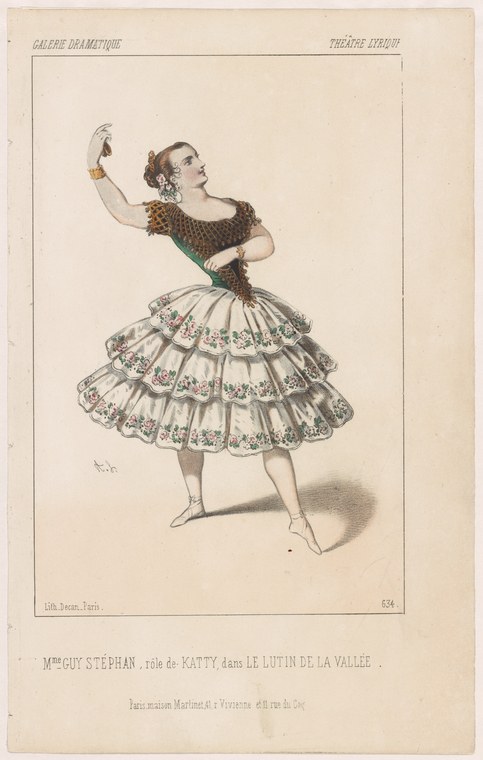
Théâtre Lyrique. Mme Guy Stephan, rôle de Katty, dans Le lutin de la vallée
Unknown artist
- Collection:
- Prints depicting dance
- Source:
- New York Public Library
- Rights:
- Public domain — free to use, share and adapt.
- Recorded as:
- Public Domain
The inscription naming performer and role is unusual in surviving dance prints and makes this a primary source for identifying how *Le lutin de la vallée* was staged and who danced its leading roles. The costume detail—the tiered decorated skirt, the fitted bodice, the length and cut—is an authentic record of mid-nineteenth-century Romantic ballet dress that can be compared with other surviving evidence. The pose and bearing of the dancer demonstrate the classical technique expected of professional ballet performers in the 1840s–50s.
What you are looking at
A young woman in theatrical costume stands in a three-quarter pose against a plain background, her body weight shifted onto her right leg in a graceful stance. She wears a fitted bodice of deep brown or bronze with short sleeves, cinched at the waist, and a spectacular skirt of multiple tiers—at least three deep flounces—each layer edged with ornamental braid or lace in cream and pale green, creating a cascading effect that falls to just below the knee. Her hair is styled up and back in the fashion of the mid-nineteenth century. Her left arm is raised to about shoulder height with the hand open and extended, as if reaching or gesturing; her right arm hangs at her side. The pose conveys both stillness and potential movement, with the body held in a classical theatrical attitude. The treatment is a hand-colored engraving or lithograph, with delicate shading that gives the figure dimension and highlights the elaborate construction of her costume.
The dancing
The dancer stands alone in a single, isolated figure. Her weight is centered and slightly forward, with the supporting leg straight and the free leg relaxed but active. The arm positions show training in classical technique—the raised left arm is extended but not fully straight, with a soft curve at the elbow and wrist, and the hand is open in a refined position. The torso is held upright with the shoulders level, and the head is turned slightly to gaze upward and away from the body, following the line of the raised arm. This pose is characteristic of trained ballet technique of the Romantic era.
The dance depicted
The costume and pose identify this as a work depicting Romantic-era ballet, likely from a French theatrical production of the 1840s or 1850s. The inscription names the performer as Mme Guy Stéphan in the role of Katty from *Le lutin de la vallée* (*The Goblin of the Valley*), a ballet-pantomime that featured supernatural and sylphide-type characters. The tiered, decorated skirt is the characteristic tutu or jupe of Romantic ballet, shorter and more voluminous than later nineteenth-century versions, designed to display footwork and create an ethereal line. The pose itself—standing on one supporting leg with the other leg free, one arm raised—is a fundamental ballet attitude or position, and suggests the dancer in a moment of repose or dramatic gesture within the narrative.
How it was made
This is a hand-colored engraving or lithograph, a commercial theatrical print from a French publisher (marked 'Galerie Dramatique' at the top and 'Théâtre Lyrique' as the heading). The technique allowed for mass distribution of images of celebrated performers to the public, circulating knowledge of current fashions, roles, and dance styles. The hand-coloring of the costume—particularly the elaborate detail of the skirt and bodice—suggests this was a higher-quality or special edition meant for collectors or fans. The fine linear work in the engraving creates definition in the figure while the colored wash establishes volume and fabric weight.
About this work
This is a commercial theatrical print documenting a performer in a specific named role in a mid-nineteenth-century French ballet. It is one of thousands of such prints produced during the Romantic ballet era, when lithographed and engraved images of dancers in costume were circulated as popular ephemera—equivalent to modern theatrical photography or postcards. The work serves both as a record of how Romantic ballet costumes were constructed and decorated, and as evidence of how dance and dancers were commodified and consumed by the urban public. The precise identification of the dancer and role, rare in surviving prints, makes this a valuable documentary source for theater history.
How to look at it
Focus on the costume construction: the way the tiers of the skirt overlap and are individually trimmed, the fitted torso, and the overall proportions show how Romantic ballet dress was engineered to create a specific silhouette. Notice the pose—the dancer is shown in a moment of arrested motion or dramatic gesture, not mid-leap or in rapid movement, which was typical of how performers were portrayed in prints (movement is harder to depict convincingly in still images). The upward gaze and the extended arm create a narrative moment, suggesting the character's emotional or dramatic state. The empty background focuses attention entirely on the figure and costume, as in all theatrical prints of the period.
The artist
The print is marked as coming from 'Galerie Dramatique' and a Parisian publisher (Bénard), indicating it was one of a series of theatrical prints. The artist of the original design is not recorded, which was common for commercial theatrical prints of this period, where the focus was on documenting the star performer and role rather than crediting the printmaker. The work belongs to a large genre of Parisian theatrical ephemera produced for public consumption.
The period
This print dates from the height of French Romantic ballet, a period (roughly 1830–1860) when ballet became a dominant form of popular theater, especially in Paris. The supernatural and fantasy narratives typical of Romantic ballet—like *Le lutin de la vallée*—drove demand for illustrated programs, lithographs, and engravings of celebrated performers. Female dancers, especially those who danced the sylphide-type roles in gossamer skirts, became celebrities whose images were widely collected. The tiered tutu shown here was the defining costume innovation of the era, replacing the longer, heavier skirts of the early nineteenth century. Theatrical prints were a major form of commercial art and a primary way audiences could own images of their favorite performers.
Where it lives
This print is held in the New York Public Library's collection of prints depicting dance. The collection contains similar commercial theatrical prints from French and European publishers, primarily from the nineteenth century. The print is part of a broader visual archive of theater history, gathered as documentary evidence of performance, costume, and celebrity.
Dance in this work
Questions about this work
What is *Le lutin de la vallée*?
*The Goblin of the Valley* was a ballet-pantomime performed at the Théâtre Lyrique in Paris, likely in the mid-nineteenth century. It featured supernatural characters in the Romantic ballet style, with narratives of magic, love, and otherworldly creatures. The surviving print is one of the few records of the work's existence and the identities of its performers.
Was this a famous dancer?
Mme Guy Stéphan is not widely documented in modern ballet histories, but the fact that she had a print commissioned and circulated of her in a leading role indicates she was a professional, likely celebrated performer at the Théâtre Lyrique in her time. Commercial prints were expensive and were made for stars who could sell them to fans.
Why is the skirt so different from later ballet costumes?
The Romantic ballet tutu of the 1840s–50s was shorter and more heavily decorated with lace, braid, and trim than the later Classical or Imperial ballet tutu. As ballet evolved in the late nineteenth century, skirts became shorter and simpler, designed to show the legs and footwork more clearly. These earlier tutus emphasized volume, movement, and theatrical fantasy.
How do we know what Romantic ballets looked like?
Prints like this are among our primary visual sources. Surviving prints, playbills, and a small number of photographs from the later nineteenth century are the main evidence we have for how these dances appeared. Written accounts and reviews are also important, but images of actual performers in costume are invaluable for understanding the aesthetics and technique of the era.
More dance artwork





