49 works in this view — arrow keys or swipe to move between them.
Dance in Art
La bayadère
Unknown artist
- Collection:
- Prints depicting dance
- Source:
- New York Public Library
- Rights:
- Public domain — free to use, share and adapt.
- Recorded as:
- Public Domain
This print is a primary document of Romantic ballet's aesthetic and its relationship to orientalism. For dancers and historians, it reveals the visual standards and fantasy worlds that shaped 19th-century performance and training. It is also evidence of how widely theatrical dance imagery circulated in print form, shaping public understanding of what ballet was and whom it celebrated.
What you are looking at
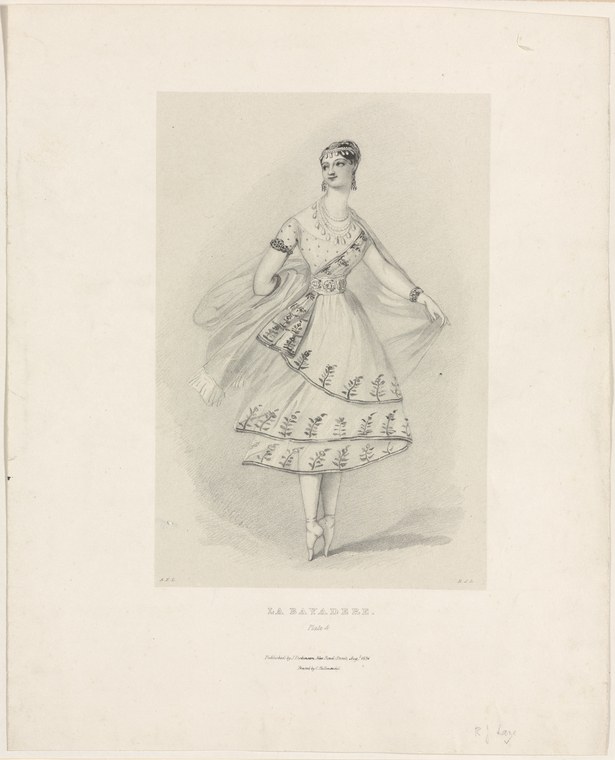
A single female dancer stands in an elegant contrapposto pose against a plain background, her weight resting on one leg in a classical stance. She wears a Romantic-era ballet costume: a fitted bodice with short puffed sleeves and a deep neckline, adorned with what appears to be jeweled or embroidered decoration at the corsage, paired with a full skirt reaching to mid-calf and decorated with a repeating leaf or floral pattern around the hem. A diaphanous shawl or scarf drapes from her shoulders and flows across one arm. Her hair is dressed up and styled with what may be a tiara or ornamental headdress. She gazes slightly upward and away, adopting an ethereal, absorbed expression characteristic of Romantic ballet imagery. The drawing is rendered in graphite with careful attention to the play of light and shadow across the figure, creating volume in the drapery and subtle modeling of the limbs.
The dancing
The dancer stands in a single-leg stance with the supporting leg straight and the free leg extended or raised slightly behind her, a fundamental classical ballet position. Her arms are positioned with one raised gracefully and the other extended, neither fully extended nor held close—a pose suggesting a moment between movements. The upper body is elongated and upright, the neck extended, the head turned in profile or three-quarter view. The overall frame is that of a soloist moment, emphasizing line and verticality rather than interaction.
The dance depicted
This is a Romantic ballet figure, identifiable by the costume, the ethereal styling, and the theatrical pose. The title *La bayadère* refers to the famous ballet by Marius Petipa (premiered 1877), whose subject is an Indian temple dancer, though this engraving may predate that production or represent an earlier related work or lithograph. The costume here blends European Romantic ballet convention (fitted bodice, full skirt, pointe-work-ready silhouette) with orientalist touches (the leaf-patterned hem, the flowing shawl) appropriate to a work about an Indian dancer. The pose is a study in the Romantic ideal: solitary, graceful, gazing inward, emphasizing the dancer's extension and emotional presence rather than technical virtuosity.
How it was made
This is a lithographic or engraved print, rendered in black ink on paper. The technique allows for precise draftsmanship and a range of tonal values achieved through careful line work and light shading. The print appears to be a theatrical costume study or promotional image, likely made for circulation among audiences, dancers, or theatre patrons. The relatively high finish and the presence of what appears to be a publication line at the base (though partly illegible in reproduction) suggest this was a commercial theatrical print, part of the visual apparatus by which Romantic ballet was consumed and celebrated in the 19th century.
About this work
This is a 19th-century theatrical print depicting a Romantic ballet dancer in costume, identified by the title as connected to *La bayadère*. It is a study in the aesthetic values of Romantic ballet: verticality, ethereality, emotional restraint, and the fusion of European classical technique with orientalist fantasy. The work belongs in a dance archive because it documents both the visual language by which Romantic ballet was marketed and the idealized body that technique was meant to produce. It is also a historical record of how European audiences imagined Indian dance, mediated entirely through ballet's vocabulary and values.
How to look at it
Attend first to the pose: notice how the artist has chosen a moment of stillness rather than dynamic movement, emphasizing the line of the body and the extension of the limbs. The upward gaze and the absorbed expression belong to the Romantic convention of the dancer as remote, ethereal, and emotionally present to an inner world. Look at the costume as a hybrid: the bodice and structure are pure European ballet, but the decorative patterning at the hem and the flowing shawl gesture toward an imagined India. This blending is the work's core claim—it asks the viewer to accept that ballet technique and Romantic sensibility can tell the story of an Indian dancer.
The artist
The artist is unrecorded in the catalogue, but the print's style and execution suggest a professional theatrical illustrator or lithographer working in the 19th century, likely in France or another major European dance centre. The quality of draftsmanship and the commercial finish indicate someone accustomed to translating stage performance into portable image.
The period
This work belongs to the height of the Romantic ballet era, roughly 1830–1880, when works like *La Sylphide*, *Giselle*, and eventually *La bayadère* captivated European audiences. In the 1870s, when Petipa's *La bayadère* premiered in St. Petersburg, it represented both the persistence of Romantic aesthetic values and the Russian Imperial Ballet's dominance in ballet production. In visual culture, theatrical prints and lithographs were a primary means by which ballet imagery reached the public; dancers' likenesses and costume studies were collected, traded, and pasted into albums. The orientalist framing of the work—the 'bayadère' or Indian temple dancer—reflects the 19th-century fascination with the exotic, mediated entirely through European aesthetic and technical systems.
Where it lives
The print is held in the New York Public Library's collection of dance-related prints and theatrical images. It appears to have been a commercial print, likely part of a larger set of Romantic ballet costume studies available to theatre patrons and collectors.
Dance in this work
Questions about this work
Is this an image of a real dancer or a generic costume study?
It is most likely a costume study—a theatrical print made to circulate the design and the role rather than to document a specific performance or performer. The unrecorded artist and the generic title suggest this was a widely distributed image rather than a portrait. However, it may have been modeled on or inspired by a famous dancer of the era; without more information, we cannot say.
When was this made?
The catalogue record gives the date as unknown. However, the style of the costume, the printing technique, and the Romantic aesthetic place it most likely between 1830 and 1880, with the 1870s as a strong possibility if this image is indeed connected to Petipa's 1877 production of *La bayadère*.
What is a bayadère?
In 19th-century European usage, a bayadère was a temple dancer from India, often represented in orientalist art and literature as seductive, exotic, and tragic. In ballet, the role allowed European companies to celebrate their own technical mastery while indulging in fantasy about non-European cultures. The actual history and practice of Indian dance was largely irrelevant to these representations.
How was this print made?
It appears to be a lithograph or engraving—a technique that allowed multiple copies to be produced and sold. This made theatrical imagery accessible to a broad audience and turned the bodies of dancers into widely circulated commodities. The quality of line and the subtle shading suggest a skilled hand and a commercial production.
More dance artwork





