49 works in this view — arrow keys or swipe to move between them.
Dance in Art
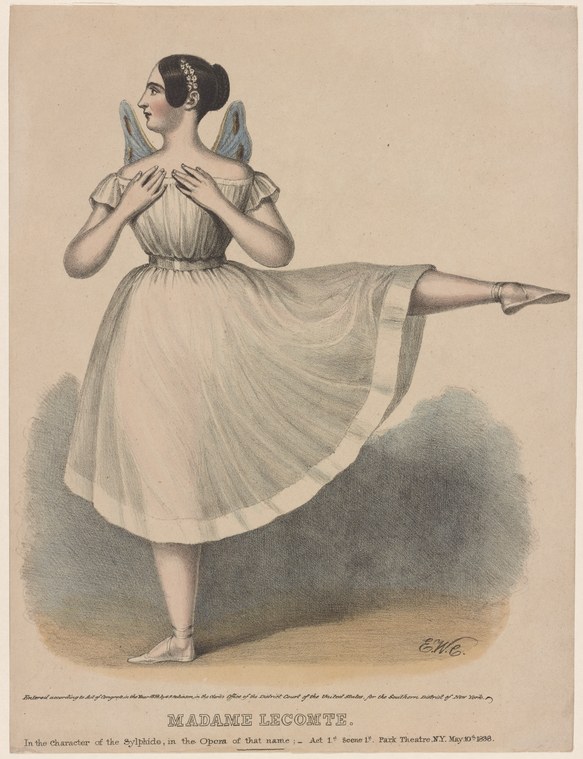
Madame Lecomte in the character of the Sylphide, in the opera of that name, act 1st scene 1st, Park Theatre, N.Y. May 10th 1838
Unknown artist
- Collection:
- Prints depicting dance
- Source:
- New York Public Library
- Rights:
- Public domain — free to use, share and adapt.
- Recorded as:
- Public Domain
This print documents the arrival of Romantic ballet—one of the most influential dance movements in history—in New York, and it names a female dancer (Lecomte) whose work is otherwise almost entirely undocumented. The Sylphide defined the aesthetic and technical parameters of ballet for over a century, and this image captures the role's visual essence at a crucial moment of transatlantic dissemination.
What you are looking at
A single female dancer is shown in a three-quarter profile stance against a plain beige background, her body angled to the right while her head turns further to face the viewer. She wears a pale, high-waisted empire-line dress of gauze or muslin with short puffed sleeves, the skirt gathered and reaching mid-calf over white stockings and pale pointe shoes. Her dark hair is pinned close to her head in the Regency fashion, adorned with what appears to be a jeweled ornament. Most strikingly, she has large, delicate wings attached to her shoulders—the signature costume element of the sylph in Romantic-era ballet. Her arms are raised and crossed at the wrists at chest height, with her hands positioned near her neck in a gesture of surprise or modest reserve. The composition emphasizes the verticality of her body and the ethereal quality of her costume; the subtle shading of the background and the figure's own shadow anchor her in space while maintaining the otherworldly impression. This is a portrait of a single moment of performance, not a narrative scene.
The dancing
The dancer stands in a nearly upright posture with her weight centered, suggesting a moment of stillness rather than dynamic movement. Her arms are raised symmetrically, bent at the elbows with forearms crossing at the wrists, a pose that conveys modest femininity and emotional restraint—neither an open port de bras nor an extended line. Her head is turned sharply toward the viewer in the classical épaulement of ballet, creating a three-quarter compositional view. The positioning of her feet suggests she may be en relevé (on the balls of the feet), a characteristic stance of Romantic ballet, though the print's resolution does not allow certain confirmation of exact footwork.
The dance depicted
This is unequivocally a depiction of the Sylphide, the role danced by Madame Lecomte at the Park Theatre in New York on 10 May 1838. The Sylphide was the paradigmatic Romantic ballet, choreographed by Filippo Taglioni to music by Jean Schneitzhoeffer and premiered in Paris in 1832; the role became the defining vehicle for the ethereal, otherworldly ballerina of the Romantic era. Lecomte's performance in New York was part of the work's rapid international dissemination in the 1830s. The image captures the character's essential visual identity: the wings, the pale dress, the pointe work, and the restrained but expressive arm gesture. The pose chosen—a moment of quiet presence rather than virtuosic display—reflects how the character was typically represented in the contemporary imagination, emphasizing her supernatural beauty and emotional delicacy over technical fireworks.
How it was made
This is a hand-colored engraving or lithograph, executed in the refined theatrical print style of the 1830s–1840s. The technique combines engraved line work (visible in the precise rendering of the dress pleats and facial features) with tinted washes for color, a standard method for mass-producing portraits of celebrated performers for commercial sale. The signature 'ENC' appears in the lower right corner. This production method allowed wide circulation among theater audiences and collectors, making the image a document of star power and the commodification of the Romantic ballet dancer. The print is a souvenir portrait, emphasizing the performer's fame and the role's visual memorability; it would have been sold in print shops near the theater and through the theatrical trade.
About this work
This is a hand-colored theatrical portrait engraving from 1838 commemorating Madame Lecomte's performance of the Sylphide at the Park Theatre in New York, one of the earliest documented stagings of this canonical Romantic ballet in America. The Sylphide was already central to European ballet culture by this date, and its rapid appearance in New York testifies to transatlantic theatrical commerce and the international appetite for Romantic dance aesthetics. The print is both a historical record—naming the dancer, role, theater, date, and even act and scene—and an artifact of how Romantic ballet was visually commodified and circulated to audiences. For dance history, it provides rare documentary evidence of an early American performance of this foundational work, and for art history, it exemplifies the theatrical print culture that made opera and ballet public spectacles beyond the theater walls.
How to look at it
Observe how the artist has frozen a moment of apparent stillness and quiet presence rather than a virtuosic arabesque or grand jeté. The crossed arms and modest gaze create an impression of supernatural delicacy and emotional interiority—core qualities of the Sylphide character. Notice the wings: they are rendered with anatomical care and scale proportional to the human body, signaling that they are stage properties designed to be worn, not metaphorical. The pale, high-waisted dress and pointe shoes are historically specific costume elements of the 1830s Romantic ballet aesthetic. The composition's emphasis on the vertical line and the isolation of the figure against an empty background—a convention of celebrity portraiture—elevates the performer and her role.
The artist
The artist is identified only by the initials 'ENC.' The style and execution are consistent with the workshops of theatrical print producers active in New York in the 1830s–1840s, a period of rapid growth in commercial theatrical portraiture. Without further documentation, the individual artist cannot be identified, but the work exemplifies the professional theatrical print trade that served American audiences eager for images of celebrated performers from Europe and America.
The period
The 1830s saw the consolidation of Romantic ballet as a dominant theatrical form in Europe, following the success of works like La Sylphide (1832), La Bayadère (1830), and Giselle (1841). These ballets emphasized ethereal femininity, pointe work, pantomime, and otherworldly narratives. In America, European ballet companies and stars began touring major cities like New York, and American dancers and companies emerged to meet public demand. The theatrical print industry boomed during this period, producing and selling portraits of celebrated performers to middle-class audiences. This 1838 staging of the Sylphide in New York reflects the rapid internationalization of Romantic ballet and the appetite for European cultural prestige in American cities.
Where it lives
This print is held in the New York Public Library's collection of prints depicting dance. It is a theatrical souvenir portrait, part of a large commercial category of such prints produced during the 1830s–1840s for sale to theater audiences.
Dance in this work
Questions about this work
Who was Madame Lecomte?
Very little is documented about her beyond this performance and a handful of similar theatrical prints. She was a professional dancer performing in New York in 1838, and she was cast in the leading role of the Sylphide, one of the most prestigious roles in Romantic ballet. This print is one of the few records of her artistry to survive.
Why were these prints made and sold?
Theatrical prints were mass-produced souvenirs sold to audiences after performances, similar to modern celebrity photography. They commemorated celebrated performers and roles, served as mementos for fans, and functioned as advertisements for the theater and the stars. They were inexpensive enough for middle-class buyers and remained popular keepsakes.
What is the Sylphide and why does it matter?
The Sylphide (1832) was a groundbreaking Romantic ballet that defined the aesthetic of ethereal, otherworldly femininity that dominated ballet for over a century. The role became the vehicle through which ballerinas displayed both technical mastery and emotional expressivity. Its rapid dissemination to America by 1838 shows how quickly European cultural innovations crossed the Atlantic.
What do the wings signify?
The wings are the visual trademark of the Sylphide character—a supernatural being. They were actual stage properties worn by the dancer, not metaphorical. Their presence in the print signals the specific identity of the role and the importance of costume in Romantic ballet's creation of otherworldly characters.
More dance artwork





