49 works in this view — arrow keys or swipe to move between them.
Dance in Art
Lucille Grahn
Unknown artist
- Collection:
- Prints depicting dance
- Source:
- New York Public Library
- Rights:
- Public domain — free to use, share and adapt.
- Recorded as:
- Public Domain
This work is essential visual evidence of how Romantic ballet dancers were publicly represented and understood: not as athletes or technicians, but as ethereal, otherworldly presences. For historians of dance, it documents the gap between the physical demands of classical technique and the cultural mythology surrounding the art form in its most commercially influential period.
What you are looking at
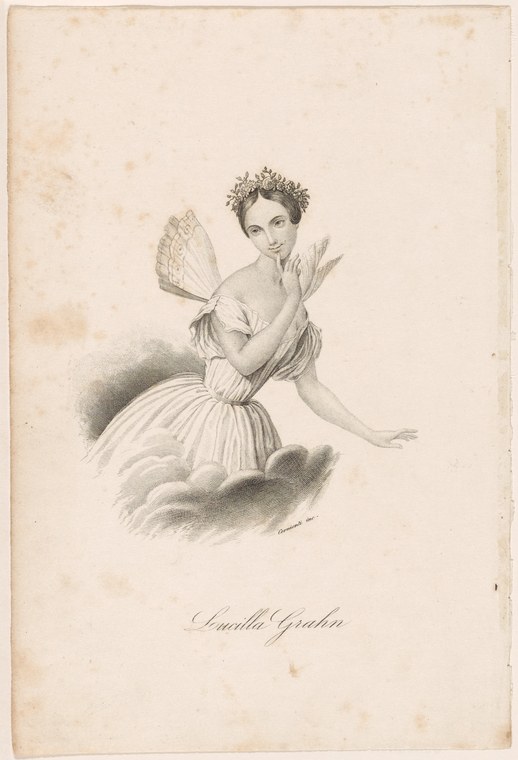
A young woman in classical dress is suspended in mid-leap or flight against a plain background. Her body is captured in an attitude of weightless grace, one leg bent beneath her, the other extended, her torso twisted with arms raised and curved. She wears a simple draped white garment fastened at the shoulder, and her dark hair is crowned with a wreath of flowers or leaves. Behind her floats a large, delicate fan—its pleated surface rendered in fine shading—and beneath her a billowing cloud formation suggests she is airborne or dancing among the heavens. The composition is intimate and focused entirely on the single figure; there is no surrounding narrative, no stage, no orchestra pit. The work is rendered in fine line engraving or etching with skilled use of shading to model the fabric and create atmospheric depth.
The dancing
The dancer's posture shows the trained carriage of classical dance: an upright torso, elongated limbs, and an attitude of controlled ease despite the dramatic suspension. Her weight appears to be on the bent supporting leg, with the extended leg straight and pointed. Her arms curve gracefully around her body, one raised near her head, the other extended at waist level—a composition that suggests both lift and stability. The positioning of her head (tilted, eyes gazing away) conveys a sense of ethereal reverie rather than effort.
The dance depicted
This appears to be a portrait of a romantic-era ballet dancer, almost certainly depicting classical ballet as it was performed in the early-to-mid 19th century. The inscription reads 'Lucille Grahn', identifying the subject as the Danish ballerina Lucille Grahn (1819–1907), one of the principal dancers of the Romantic ballet period. The imagery—the ethereal pose, the floral crown, the weightless floating—embodies the Romantic ballet aesthetic of the 1830s–1840s, when female dancers were increasingly portrayed as otherworldly and spirit-like beings. The fan and cloud support this fantastical register rather than depicting a specific choreography.
How it was made
This is a fine engraving or etching, identifiable by the precise parallel line work used to build tone and shadow, particularly visible in the rendering of the fan, drapery, and cloud. The technique allowed for wide circulation as prints—this example comes from a collection of dance prints held by the New York Public Library, suggesting this was a commercial or semi-commercial publication aimed at a broad audience of dance enthusiasts, collectors, and the fashionable public. The quality of execution indicates a skilled engraver working from a drawn original, likely produced in the 1840s–1850s.
About this work
This is a commemorative engraved portrait of Lucille Grahn, a celebrated ballerina of the Romantic era, rendered in the ethereal visual language that defined how female ballet dancers were marketed and imagined during this period. The work captures not a specific moment of choreography but rather an idealized image of the dancer as a weightless, celestial being—a fantasy fully consonant with the narrative ballets of the time in which Romantic heroines were often supernatural or tragic figures. The print circulated widely among the urban middle and upper classes who patronized ballet, making it a document of both artistic practice and popular culture.
How to look at it
Look first at the suspended pose: notice how the artist has frozen the moment not at the peak of a jump, but in a floating, hovering state that defies gravity. The fan and cloud are not decorative afterthoughts—they are essential to the meaning, signaling that this is not a document of the stage but a fantasy image. Observe how the drapery clings and falls, how the line of the leg extends, how the torso remains vertical and composed even as the limbs move: this is the classical technique of the era, rendered with anatomical understanding. The floral crown and the gentle, abstracted gaze confirm that this is an image not of a woman performing, but of an ideal.
The artist
The artist is not recorded in the catalogue, but the technical quality and circulation suggest this was produced by a skilled commercial engraver working in a major European printing center, most likely Paris or London, during the height of Romantic ballet's popularity. Prints of celebrated dancers were a significant market; many were created by anonymous or semi-documented craftsmen and sold as sheet prints or in collected albums.
The period
This engraving dates to the Romantic era in ballet, roughly 1830–1850, when the art form had transformed dramatically from the courtly classical style. Female dancers became the focus of fascination and desire in ways they had not been before; the introduction of the pointe shoe, the lengthening and whitening of skirts (eventually the tutu), and the shift in narrative content toward supernatural and tragic heroines all reinforced a visual and conceptual ideal of weightlessness and otherworldliness. Lucille Grahn was one of the four 'immortal' ballerinas of the period, and prints of celebrated dancers like her were collected avidly. The medium of engraving was still the dominant form of image reproduction before photography became widespread, making prints like this the primary way most people encountered images of dancers.
Where it lives
Held by the New York Public Library as part of its collection of prints depicting dance. The work is catalogued as part of the Library's visual arts collection but lacks detailed provenance or cataloguing beyond subject and general date range, which is typical for 19th-century commercial prints that were produced in quantity.
Dance in this work
Questions about this work
Was Lucille Grahn a real dancer?
Yes. Lucille Grahn (1819–1907) was a Danish prima ballerina and one of the most celebrated dancers of the Romantic era. She performed across Europe and was particularly admired for her technical facility and dramatic presence. She danced in the famous 1845 Paris Pas de Quatre alongside Marie Taglioni, Fanny Cerrito, and Carlotta Grisi—a historical moment that became legendary in ballet.
Why does she appear to be floating in the air?
This is the visual language of Romantic ballet. Rather than depicting a specific moment of choreography, the print idealizes the dancer as a weightless, ethereal being. This fantasy image matched the content and aesthetics of Romantic ballets, in which female dancers often portrayed sylphs, spirits, and doomed heroines. The floating pose and floral crown signal that this is imaginative rather than documentary.
What is the fan for?
In some Romantic ballets, fans and other hand properties were used, but here the fan primarily serves to reinforce the fantastical, decorative register of the image. It also showcases the engraver's technical skill in rendering the delicate pleated surface. The object helps establish this as an idealized portrait rather than a naturalistic one.
How many copies of this print were made?
The catalogue does not record an edition number, but prints like this were typically produced in hundreds or thousands of impressions. They were sold individually as popular souvenirs and collected in albums. The fact that this example survives in a public collection suggests it was successful enough to circulate widely and be preserved.
More dance artwork





