49 works in this view — arrow keys or swipe to move between them.
Dance in Art
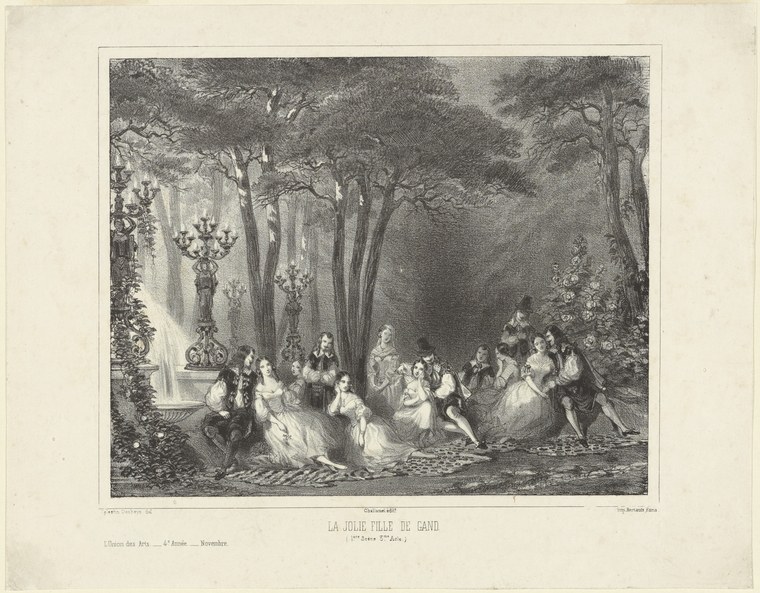
La jolie fille de Gand (1ière scène, 3me acte)
Unknown artist
- Collection:
- Prints depicting dance
- Source:
- New York Public Library
- Rights:
- Public domain — free to use, share and adapt.
- Recorded as:
- Public Domain
The print preserves visual evidence of a real production at a moment when photography of dance was not yet standard. It shows how Romantic ballet was staged, costumed, and lit in Brussels and elsewhere, and what the experience of spectacle and femininity meant to mid-nineteenth-century audiences. For dancers and choreographers studying Romantic ballet history, it offers concrete detail about ensemble work, grouping, and the relationship between narrative and movement.
What you are looking at
A wooded glade at twilight or moonlight serves as the stage for an aristocratic gathering. Tall trees with thin trunks rise vertically through the composition, their foliage creating a dense canopy overhead. In the foreground, a group of elegantly dressed figures moves across a forest floor. Women in voluminous white gowns dominate the scene—their skirts billowing, their poses suggesting graceful, floating movement. Men in dark coats and breeches attend them. Tall ornamental candelabra or sculptural monuments frame the clearing, their classical form suggesting a formal garden overlaid with natural woodland. The scene is rendered in soft gray tones with skillful use of light and shadow; moonlight or filtered light seems to pour from above, catching the women's gowns and creating an ethereal, almost dreamlike atmosphere. The composition draws the eye toward the clustered figures at the center, whose animated poses suggest active dancing or promenading.
The dancing
The dancers are arranged in loose groups rather than formal couples. Several women in wide skirts are captured mid-turn or in postures of weightlessness—their bodies upright, their skirts flared outward as if caught by a spinning motion. Their arms are raised or extended; at least one woman appears to have her arms aloft in a gesture of abandon or joy. The men stand attending, supporting, or gesturing toward the women, their postures more restrained. The overall impression is of women as the focus of movement and display, with men as partners or spectators. No rigid hold or ballroom frame is visible; instead, the spacing and arm positions suggest the freer, more theatrical movement characteristic of Romantic-era choreography.
The dance depicted
This is almost certainly a scene from a Romantic ballet of the 1840s–1860s, most likely "La Jolie Fille de Gand" (The Pretty Girl from Ghent), a Belgian ballet choreographed by Albert and first performed in Brussels in 1842. The title identifies this as Act 3, Scene 1. The work was popular across Europe and depicts a festive village celebration. The woodland setting, the emphasis on female dancers in gossamer skirts, the theatrical grouping, and the nocturnal atmosphere all align with Romantic ballet convention. The movement vocabulary appears to be pantomime and theatrical dance rather than academic ballet technique, suggesting a dramaturgy in which gesture and theatrical effect matter as much as virtuosity.
How it was made
This is a steel engraving or similar print technique, characteristic of theatrical illustration and dance documentation in the mid-nineteenth century. The tonal range—from deep black to pale gray—shows the capability of engraving to render complex atmospheric effects and fabric texture. The technique allowed for detailed reproduction of costume and setting and made the image affordable to circulate among the theatrical public, opera-goers, and dance enthusiasts. Such prints were often published as souvenirs of celebrated performances or included in theatrical journals, making them key evidence of how specific productions were staged and costumed.
About this work
This engraved illustration documents a moment from Act 3 of "La Jolie Fille de Gand," a Romantic-era ballet. It captures the theatrical and social dance world of the 1840s–1860s, showing not technical virtuosity but the choreographic and visual spectacle through which Romantic ballet conveyed narrative and emotion. The forest setting, the play of light, the billowing white skirts, and the clustering of figures around a festive action all serve the Romantic aesthetic: nature, femininity, and the transcendence of the everyday through dance. For historians of dance and theater, the image is a primary document of staging practice, costume design, and the visual culture of Romantic ballet outside Paris—a glimpse of how European regional opera houses mounted the era's most fashionable works.
How to look at it
Notice the asymmetry and fluidity of the grouping: this is not a corps de ballet in formation, but figures arranged to create a sense of spontaneous, joyful movement. The artist has frozen a moment of high energy—skirts mid-flare, arms raised—that conveys motion through stillness. The play of light on the women's gowns and the depth created by the towering trees suggest a theatrical space designed for visual drama rather than pure dancing. The male figures, though present, are secondary; the eye is drawn to the women's bodies and the spectacle of their dress and movement. The composition uses the Romantic love of nature—the forest, the moonlight—as both setting and metaphor for the transcendence of everyday social constraint.
The artist
The artist is unknown, as is typical for theatrical engravings of the period, which were often collaborative works involving a choreographer's design, a theater's scenic and costume team, and a reproductive engraver. Such prints were published by theatrical presses and sold to audiences as souvenirs. The anonymity reflects the hierarchy of the theater world at the time: designers and engravers served the production rather than claiming authorship.
The period
The 1840s–1860s were the height of Romantic ballet in Europe. The aesthetic celebrated the ethereal, the supernatural, and the feminine; ballets were set in forests, at court, in exotic or magical places. Female dancers, increasingly en pointe, became the focus of spectacle. "La Jolie Fille de Gand" was part of a wave of locally produced Romantic works that traveled across European opera houses, competing with and supplementing the Paris-centered repertory. Engraved illustrations were a primary form of theatrical publicity and archival documentation before photography became standard. The image shows how the Romantic ballet aesthetic—light, femininity, nature, spectacle—was realized in production.
Where it lives
This engraving is held in the New York Public Library's collection of prints depicting dance. It represents the kind of theatrical illustration and souvenir that documented and publicized nineteenth-century ballet productions for audiences across Europe and North America.
Dance in this work
Questions about this work
What is 'La Jolie Fille de Gand' and why is this from Act 3?
It is a Belgian Romantic ballet choreographed by Albert and premiered in Brussels in 1842. The story concerns a village festival and romantic entanglements. Act 3, Scene 1 depicts a festive gathering, which matches the scene shown here. The ballet was widely performed across Europe and was considered one of the important regional Romantic works outside Paris.
How do I know this is actually from a real performance and not an imaginative scene?
The title on the print—with the act and scene number, the ballet's name, and the date (1842 or shortly after)—anchors it to a specific production. Theatrical engravings of this kind were either made from designs before a premiere, from sketches during performances, or from memory and description by the theater's design team. They were published and sold as souvenirs and documentation, not as pure fantasy.
Why are the women's dresses so important to this image?
In Romantic ballet, the tutu and the body beneath it were the primary vehicles of spectacle and expression. The billowing skirt caught in motion, the raised arm, the line of the leg—these conveyed both the ethereal femininity central to the era's aesthetic and the technical achievement of the dancer. The engraver has lavished detail on fabric, shadow, and silhouette because that is what audiences came to see.
Is this a real engraving or a later reproduction?
The catalogue record does not specify the date of the print or its printing history. Based on style and technique, it appears to be a mid-nineteenth-century engraving, likely produced within a few years of the ballet's 1842 premiere or during the 1850s–1860s when the work was widely performed. It could be a later reissue, but it is a period or near-period artifact, not a modern reproduction.
More dance artwork





