49 works in this view — arrow keys or swipe to move between them.
Dance in Art
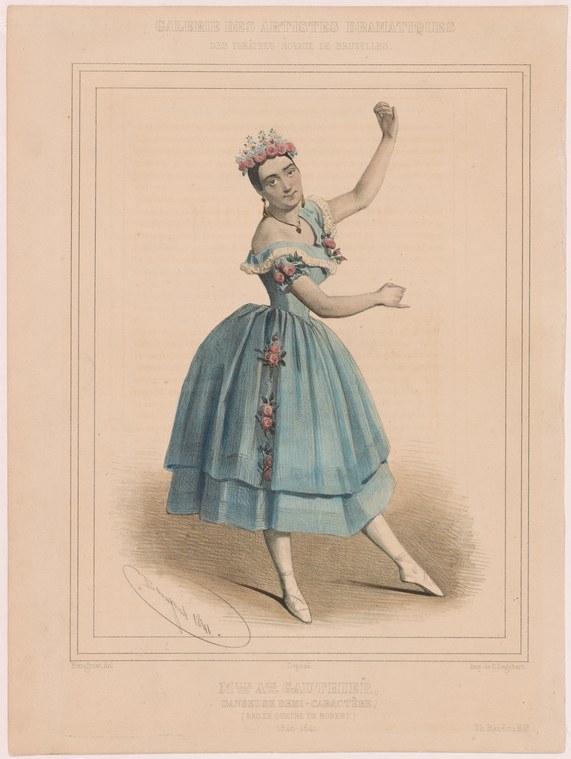
M'elle A'sie Gauthier, danseuse demi-caractère (Pas de quatre de Robert), 1840-1841
Unknown artist
- Collection:
- Prints depicting dance
- Source:
- New York Public Library
- Rights:
- Public domain — free to use, share and adapt.
- Recorded as:
- Public Domain
This print is evidence of the commercial cult of the individual ballet dancer in the 1840s, and of how demi-caractère roles—a now-defunct category of classical ballet—were costumed, taught, and publicly imagined. The specificity of the portrait (a named dancer in a named work) and the care of the execution show that Gauthier was known and marketable, making this a rare document of a performer whose work otherwise survives only in fleeting references in theatre journals.
What you are looking at
A single female dancer in three-quarter view, posed mid-performance against a neutral background. She wears a pale blue tulle skirt with multiple layers, the hem reaching mid-calf, decorated with pink floral garlands that cascade down the front. Her bodice is off-shoulder with short puffed sleeves trimmed in matching flowers. A floral headdress sits atop her dark hair. Her left arm is raised and extended, the right arm lowered, and her body twists in a balletic contrapposto. She stands en pointe or near-pointe on her right leg, with her left leg bent and raised behind. The figure is rendered in hand-colored lithography or engraving, with delicate shading to suggest the volume and movement of the skirt and the form of the body. The whole composition sits within a ruled double-line border.
The dancing
The dancer's frame shows the upright, épaulement-conscious posture of Romantic-era ballet. Her raised left arm curves gracefully at the elbow, palm inward, while the right hangs naturally at her side with a slight curve. Her torso rotates away from her supporting leg, creating a spiral line. The lifted left leg, bent at the knee and held behind and to the side, suggests a penché or arabesque-like position, though the exact foot placement is not sharp in the print. Her weight appears centred and controlled, not pitched forward—this is a moment of suspended equilibrium rather than rapid movement.
The dance depicted
This is a theatrical-ballet dancer, almost certainly performing a demi-caractère role—a hybrid style that combined elements of classical technique with character dance. The catalogue identifies her as performing in the *Pas de quatre de Robert*, a group work that was part of the mid-nineteenth-century ballet repertory. The costume—a bell-shaped romantic tutu, pointe work, and lifted arms—places this squarely in the Romantic ballet tradition of the 1840s. Demi-caractère roles, such as this, occupied a middle ground between the ethereal, ethereal corps de ballet and more grotesque or comedic character parts; they allowed dancers to display technical brilliance within a less purely classical frame.
How it was made
This is a hand-colored lithograph or engraved print, likely produced for theatre publicity or as a commercial souvenir for the ballet-going public. The printing base is stone or metal plate; the artist then applied watercolor or oil pigments by hand to each impression. The technique allowed rapid circulation of theatre imagery without the labour of oil painting, making it the standard medium for mid-nineteenth-century dance publicity. The delicate, even application of colour and the fine line work suggest this was a high-quality commercial production, not a rough sketch—the kind of print that would have been sold in the lobby or through print sellers to patrons who had seen the performance.
About this work
This is a portrait of a named dancer, *Mlle A'sie Gauthier*, frozen in the moment of a demi-caractère solo from a ballet that was fashionable enough to be documented in commercial print form. It belongs to the rich visual archive of mid-nineteenth-century Romantic ballet, when dancers were celebrated as individual performers and their costume and poses were standardized and circulated to a wide public. The print records not just a person but a professional type—the demi-caractère dancer, a technical and stylistic category that is now largely lost from ballet practice. For dancers and historians, it is an example of how the ballet world documented itself before photography: through lithographs and hand-colored prints that reached beyond the theatre to a literate audience of dance enthusiasts.
How to look at it
Look at the moment the artist has chosen: not a leap or a dramatic fall, but a posed equilibrium, the dancer's body arranged to display line and poise. The raised arm, the turned-out supporting leg, the lifted back leg, and the slight twist of the torso are all calculated to be read from the front—this is a dancer shown to best advantage, flattering and legible. Notice the care taken with the floral decoration of the costume; the garlands are not ornament only, but part of the character she is dancing (likely a peasant or sylvan figure, given the flowers and the pale blue). The background is deliberately empty, forcing attention entirely on the body and the line it makes.
The period
The 1840s were the height of the Romantic era in ballet, a decade after *La Sylphide* (1832) had established the pointe shoe and ethereal costume as central to ballet aesthetics. However, alongside the airy sylphs and nymphs, there existed a parallel tradition of earthier, more virtuosic roles: the demi-caractère dancer, who performed in pastorales, folk-inspired ballets, and comic scenes. These dancers were often less celebrated than the ballerinas of the corps de ballet, but they were valued for their speed, precision, and ability to combine classical technique with more naturalistic gesture. The printing and circulation of individual dancer portraits was by this time an established industry in Paris and other major ballet centres; these images served both as souvenirs for patrons and as marketing for the dancers themselves.
Where it lives
The print is held in the New York Public Library's collection of prints depicting dance, suggesting it came to the Library as part of a broader acquisition of theatre ephemera or dance documentation. It is the kind of souvenir print that was produced in quantity and sold cheaply, so while the printing quality is high, the object itself was once abundant and is now scattered across institutional and private collections.
Dance in this work
Questions about this work
What is demi-caractère ballet?
Demi-caractère ("half character") is a style of nineteenth-century ballet that sat between pure classical technique and fully stylized character dancing. The dancer performs on pointe and maintains classical posture and arm positions, but the roles are typically peasant girls, coquettes, or comic figures—less ethereal than the romantic sylph, more technical than the grotesque character dancer. The category is now rarely used in ballet training and choreography.
Who was Mlle A'sie Gauthier?
The catalogue record identifies her as a demi-caractère dancer performing in the *Pas de quatre de Robert* around 1840–1841. Beyond this print and any references in contemporary theatre notices, her biography is not currently known. The existence of this commercially produced portrait suggests she was a recognized performer in Paris ballet circles of the era.
What is a Pas de quatre?
A pas de quatre is a ballet variation for four dancers, typically women, dancing together in a symmetrical or coordinated group. The most famous is the *Pas de quatre* choreographed by Jules Perrot in 1845, which featured four of the greatest ballerinas of the age. This *Pas de quatre de Robert* (attributed to a choreographer surnamed Robert) would have been a similar showpiece, and Gauthier's role in it marked her as a soloist of sufficient status to be individually documented.
Is this dancer shown en pointe?
The print shows the dancer standing on or very near pointe on her supporting leg, which was standard for Romantic-era classical ballet by the 1840s. Pointe work was by then fully established, though the toe shoes and the strengthening required were far less developed than in modern ballet. The exact position of the raised foot is harder to discern in the print, but the overall line suggests classical ballet training and technique.
More dance artwork





