49 works in this view — arrow keys or swipe to move between them.
Dance in Art
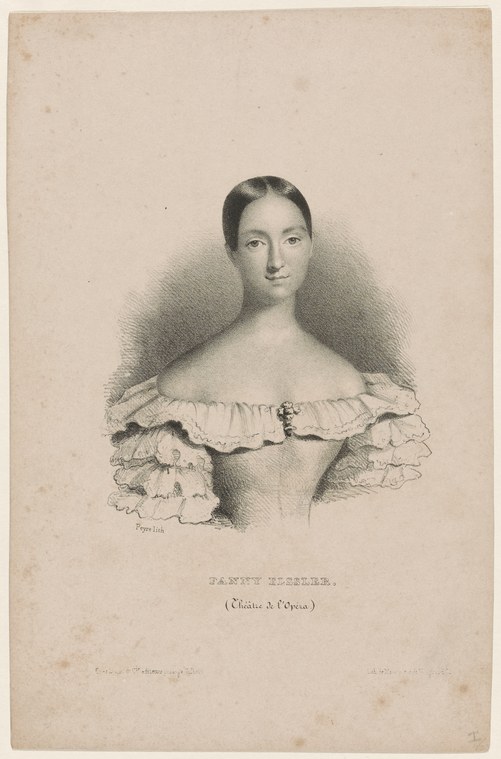
Fanny Elssler.: (Théâtre de l'Opéra)
Unknown artist
- Collection:
- Prints depicting dance
- Source:
- New York Public Library
- Rights:
- Public domain — free to use, share and adapt.
- Recorded as:
- Public Domain
Fanny Elssler was arguably the most celebrated dancer of the 1830s–40s, rivaled only by Marie Taglioni. Her career spanned classical ballet, character dance, and dramatic mime, and she was known for her technical command and expressive power. This portrait print is a primary document of how star dancers were constructed and circulated as cultural icons in the Romantic era.
What you are looking at
A three-quarter-length portrait of a young woman in mid-19th-century theatrical dress, set against a plain, subtly shaded background. She wears a white off-shoulder gown with voluminous ruffled sleeves that fall away from her arms, exposing her shoulders and upper chest in the Romantic-era fashion. Her dark hair is parted and smoothed close to her head, with a simple, elegant styling. Her posture is upright and composed, with one arm resting across her body and the other at her side. The soft modeling of the face and the delicate rendering of the fabric suggest this is a portrait of a professional dancer—the name inscribed below identifies her as Fanny Elssler, and the subtitle references the Théâtre de l'Opéra, the Paris Opera. The work captures the idealized beauty and refined grace expected of a prima ballerina of the period.
The dancing
A single standing figure in a frontal or near-frontal pose, captured in a moment of stillness rather than active dancing. The shoulders are drawn back, the posture is upright and dignified. One arm is positioned across the body, the other hangs naturally at her side—a classical pose of repose and elegance. The off-shoulder neckline and the careful draping of the ruffled sleeves emphasize the neck and shoulders, drawing attention to the line and carriage of the upper body. No active footwork is visible; this is a portrait of presence and bearing rather than movement.
The dance depicted
Fanny Elssler was the leading Romantic-era ballerina of the 1830s–1840s, famous for both classical ballet and for her performances of character dances such as the Spanish Cachucha and Neapolitan Tarantella. This print is a theatrical portrait rather than a scene of dancing, but it documents her as a professional dancer of the Romantic Ballet period. The off-shoulder Romantic-era costume—the white muslin gown with voluminous sleeves—is characteristic of the aesthetic she embodied on stage. Her fame rested on her technical brilliance and dramatic expressiveness across a wide range of styles, from the ethereal classical roles to fiery character performances.
How it was made
This is an engraving or possibly a lithograph, evident from the tonal modeling achieved through fine parallel lines and the characteristic handling of light and shadow. The technique allows for the soft gradations of tone in the face and the careful delineation of the fabric's drape and texture. The medium suggests this is a commercially produced print, likely circulated widely as a portrait of a celebrated performer—a common practice for promoting star dancers to the theatre-going public. The quality and finish indicate this was an expensive, professional production.
About this work
This is a professional portrait print of Fanny Elssler, the pre-eminent Romantic-era ballerina, published during or shortly after her performances at the Paris Opera. It documents her at the height of her fame in the 1830s–1840s, when she was known across Europe for her interpretations of both classical and character roles. The work belongs in a dance collection not as a record of a specific choreography or moment of performance, but as a crucial artifact of how the greatest dancers of the Romantic era were marketed, celebrated, and memorialized. Elssler's image was among the most widely reproduced of any 19th-century performer, and prints like this shaped public memory of the Romantic Ballet.
How to look at it
Attend to the off-shoulder gown and the handling of the fabric—the ruffled sleeves are rendered with careful attention to their weight and drape, showing the artist's understanding of how Romantic-era costume actually sat on the body. The pose itself is idealized and static, but the upright carriage, the line of the shoulders, and the exposed neck all emphasize the physical discipline and bodily control of the classical dancer. Notice also the face: the soft modeling and the direct gaze create an effect of intimate appeal while maintaining formal distance—this is how 19th-century theatrical portraiture created both accessibility and untouchability.
The artist
The artist is not recorded in the catalogue. The inscription at the lower left appears to carry a signature or maker's mark, but it is not clearly legible in this reproduction. The print is professionally executed and likely by a specialist in theatrical portraiture—a common practice in 19th-century Paris, where printmakers produced and sold portraits of celebrated performers as commercial products for the theatre-going public.
The period
This portrait dates to the height of the Romantic Ballet era, when dancers like Elssler and Marie Taglioni dominated European stages and became the first performers to achieve international celebrity through reproduced images. The white Romantic-era tutu and the aesthetic of ethereal beauty were standard iconography of the period. Simultaneously, lithography and engraving were enabling the mass production of celebrity portraits, turning dancers into recognizable public figures across the continent. Elssler was particularly notable for her integration of character dance—especially Spanish and Italian national dances—into her classical repertory, expanding the range of what ballet audiences expected to see.
Where it lives
The work is held in the New York Public Library's collection of prints depicting dance. It is a commercial theatrical portrait, part of the mass-produced image-culture that surrounded celebrated performers in the 19th century.
Dance in this work
Questions about this work
Who was Fanny Elssler?
Fanny Elssler (1810–1884) was an Austrian dancer who became one of the most celebrated ballerinas of the Romantic era. She was known for her technical brilliance in classical ballet and for her fiery interpretations of character dances, especially the Spanish Cachucha and Neapolitan Tarantella. She performed across Europe and traveled to the United States, where she was celebrated as a major star. She rivaled Marie Taglioni as the leading dancer of her generation.
What is the off-shoulder costume she is wearing?
This is the characteristic Romantic-era ballet costume: a white muslin or silk gown with off-shoulder neckline and voluminous ruffled sleeves. It became the standard costume for classical ballet in the 1830s–40s, replacing the earlier, more heavily structured costumes. The style emphasized the dancer's neck, shoulders, and upper body, and allowed greater freedom of movement in the arms and upper torso.
Why is this a print rather than a painting?
Prints were the primary medium for circulating images of celebrities in the 19th century. They were cheaper to produce and easier to distribute than paintings, allowing portrait images to reach a much wider audience—theatre-goers, fans, and the general public. A single engraved plate could produce hundreds or thousands of copies, making the dancer's image widely available and recognizable.
Is she shown dancing?
No—this is a formal standing portrait, not a scene of performance. She is posed in a moment of repose, with her weight balanced and her posture dignified. The portrait documents her appearance and bearing as a stage celebrity rather than capturing her in the act of dancing.
More dance artwork





