49 works in this view — arrow keys or swipe to move between them.
Dance in Art
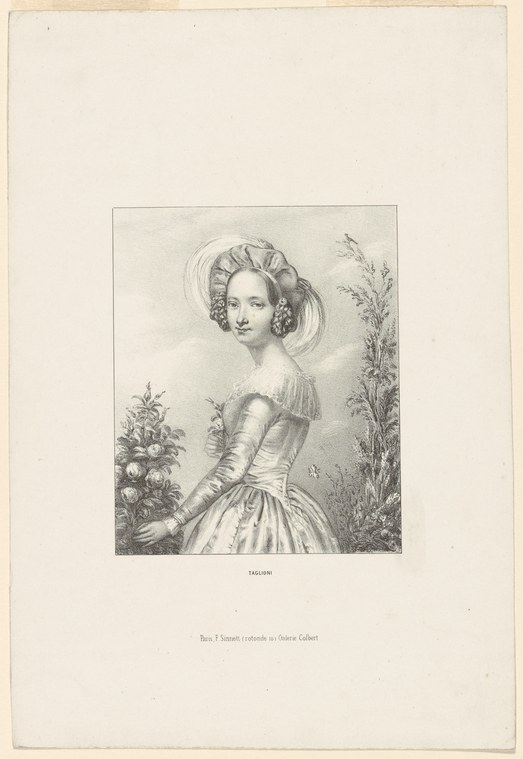
Taglioni
Unknown artist
- Collection:
- Prints depicting dance
- Source:
- New York Public Library
- Rights:
- Public domain — free to use, share and adapt.
- Recorded as:
- Public Domain
Taglioni was the defining figure of Romantic ballet and a global celebrity; prints like this shaped her public image and influenced how ballet was understood and valued across Europe and North America. The print documents both the visual culture surrounding dance stardom in the nineteenth century and the specific aesthetic values—feminine elegance, refinement, otherworldliness—that Romantic ballet embodied. For historians, it is evidence of how performance and celebrity were mediated through reproductive media before photography.
What you are looking at
A young woman in Romantic-era dress stands in an outdoor garden setting, holding a small bouquet of flowers in her left hand. She wears a white off-shoulder dress with short puffed sleeves and a fitted bodice, the skirt falling in soft folds to her ankles—characteristic silhouette of the 1830s–1840s. Her hair is styled in the period fashion, pulled back and adorned with what appears to be a decorative headdress or snood. She turns slightly to her right, her posture upright and graceful, with her gaze directed away from the viewer. Flowering plants and delicate foliage frame her on both sides, creating an intimate, pastoral mood. The engraving technique renders the scene in fine grayscale tones, with careful attention to the texture of fabric and the softness of the botanical elements. The overall composition suggests an idealized portrait of feminine beauty and elegance rather than a narrative moment.
The dancing
The single figure is captured mid-turn in a standing pose, with her weight evenly distributed and her body held in an upright, balletic carriage. Her left arm is extended slightly forward at waist level, cradling the bouquet; her right arm hangs at her side. The posture conveys a sense of poised, restrained movement—the kind of refined deportment expected of a lady of the period. There is no active dancing visible, but the graceful stance and the fluidity suggested by the fabric folds indicate an understanding of how trained movement governs the body.
The dance depicted
This is not a depiction of active dancing but rather of the idealized physical presence and carriage cultivated in Romantic-era dance training and courtly behavior. The figure's posture and comportment reflect the aesthetic ideals of Romantic ballet—verticality, grace, and an ethereal quality—though she is not captured in a dance step or formal position. The title 'Taglioni' strongly suggests this is either a portrait of the famous dancer Marie Taglioni or an image created to circulate her likeness during the height of her fame in the 1830s–1840s. Taglioni was the supreme representative of Romantic ballet and the originator of the role of the Sylphide; such prints were widely distributed as a form of celebrity portraiture and were consumed by an enthusiastic public.
How it was made
This is a steel or copper engraving, executed in fine linear work with delicate cross-hatching to create tonal gradations. The technique allows for precise detail in the rendering of lace, fabric, and botanical elements, and produces an image suitable for serial reproduction and wide circulation. The fineness of the engraving suggests a work of some expense and careful execution, consistent with the high cultural status of the subject. Such prints were a primary means of disseminating images of celebrated performers in the nineteenth century, reaching audiences far beyond the theater.
About this work
This is a celebrity portrait engraving of or after Marie Taglioni, the legendary Romantic ballet dancer, produced during or shortly after the peak of her fame in the 1830s–1840s. Rather than capturing her in performance, it presents her as an idealized figure of feminine grace and beauty, embodying the aesthetic values of Romantic ballet through her posture and dress. The print is an artifact of the cult of the dancer that flourished in this period—a mass-produced object that allowed admirers to possess an image of their idol and that shaped how the public understood and remembered Taglioni's significance.
Within the history of dance imagery, this work exemplifies a specific genre: the celebrity portrait print circulated for fan consumption. It differs from narrative scenes or stage designs by offering a static, idealized likeness rather than a moment of choreographic action. Yet it conveys profound information about how Romantic dancers were perceived and marketed, and about the physical ideals—verticality, delicacy, ethereal grace—that defined the era's most prestigious art form.
How to look at it
The viewer should attend to the studied simplicity of the pose—no ornate gesture, no theatrical histrionics, but instead a quiet, upright stance that conveys authority and poise through restraint. Notice how the engraver has rendered the fabric to suggest movement and delicacy even in stillness: the soft folds of the skirt, the translucency suggested in the sleeves. The positioning of the flowers and foliage creates a frame that isolates and elevates the figure. This is not a snapshot but a carefully composed image designed to present the subject as both ideally beautiful and fundamentally graceful—the visual equivalent of how Romantic ballet audiences experienced their greatest dancer.
The period
This engraving was produced during the height of the Romantic ballet era, roughly 1832–1850. Marie Taglioni dominated this period; her debut as the Sylphide in 1832 at the Paris Opéra established the aesthetic template for Romantic ballet—ethereal female dancers in white tutus, pointe work, supernatural themes, and the elevation of the ballerina to the status of prima donna. During this era, lithographic and engraved celebrity portraits circulated widely, feeding a public hunger for images of celebrated dancers. The mid-nineteenth century saw the industrialization of print culture and the emergence of the modern celebrity image; Taglioni was among the first performers to achieve truly international fame mediated through mass reproduction.
Where it lives
The work is held in the New York Public Library's Prints collection, which documents theater and dance through reproductive imagery. The catalogue record identifies it as a print depicting dance but offers no information on artist, publisher, date, or engraving technique; all of these have been inferred from the image itself.
Dance in this work
Questions about this work
Who was Marie Taglioni?
Marie Taglioni (1804–1884) was a Swedish-born dancer trained in the Italian school who became the defining figure of Romantic ballet in Europe. She created the role of the Sylphide in 1832, performing the ballet on pointe in a white tutu—a look and style that became the template for Romantic ballet. She was a global celebrity, danced across Europe and Russia, and retired in 1847. She is widely regarded as the greatest ballerina of the nineteenth century.
Why are there so many prints of ballet dancers from this era?
The 1830s–1850s saw the emergence of celebrity culture and the industrialization of print. Lithographed and engraved portraits of celebrated performers—especially ballerinas—were mass-produced and sold to admirers as affordable souvenirs. They were hung in homes, collected in albums, and traded among fans. These prints were a primary way that audiences beyond those who could attend the theater experienced and remembered great dancers.
Is this a portrait of Marie Taglioni herself?
The title strongly suggests so, but without artist attribution or archival documentation in the record, this cannot be confirmed with certainty. It may be a portrait taken from life, a posthumous idealization, or a generic representation of a Romantic-era dancer meant to evoke Taglioni's aesthetic. The physical features are not distinctive enough to permit comparison with other known likenesses.
What is the dance significance of the pose?
The upright, poised stance reflects the Romantic ballet ideal of verticality and ethereal grace. Though not a step, the posture embodies values central to the dance form: refinement, elevation (literally and figuratively), and a kind of restrained, dignified movement. It demonstrates how Romantic ballet training shaped not just dancers' movement on stage, but their entire deportment and physical presence.
More dance artwork





