49 works in this view — arrow keys or swipe to move between them.
Dance in Art
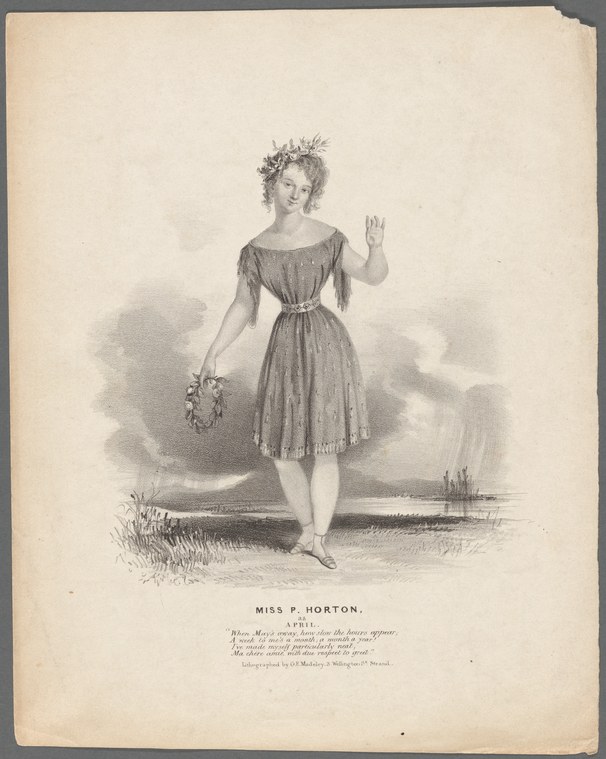
Miss P. Horton as April
Unknown artist
- Collection:
- Prints depicting dance
- Source:
- New York Public Library
- Rights:
- Public domain — free to use, share and adapt.
- Recorded as:
- Public Domain
This print preserves a specific historical performance and the physical presence of a professional dancer within the conventions of 1830s–1840s theatrical ballet. For dance historians, it provides concrete visual evidence of costuming, bearing, and the aestheticization of the female body on stage during the Romantic period. For anyone studying 19th-century theatrical culture, it demonstrates how dance imagery was mass-produced and consumed as cultural merchandise.
What you are looking at
A young woman in classical dress stands in an elegant contrapposto pose against a soft, atmospheric landscape background. She wears a short, high-waisted chiton-style dress with short sleeves, a wreath of flowers in her hair, and holds a small posy of flowers in her lowered left hand. Her right arm is raised in a graceful gesture at about shoulder height, palm open, suggesting greeting or benediction. Her weight rests on her left leg while her right leg is extended and relaxed. The setting is rural and dreamlike—a distant water body, reedy grasses, and soft clouds create a romantic, timeless atmosphere. The composition is frontal and symmetrical, with the figure centered against the luminous background. The engraving technique creates delicate tonal gradations through parallel lines, giving the scene an ethereal quality.
The dancing
The dancer stands in a classical contrapposto position, her body weight shifted to her supporting left leg while her right leg extends slightly forward in a relaxed, natural line. Her right arm rises to approximately shoulder height with fingers gently extended, a gesture familiar from classical ballet and neoclassical dance. Her left arm hangs naturally, holding flowers. The pose suggests a moment of stillness rather than active movement, though the raised arm and open palm convey elegance and lyrical quality. There is no partner or other figures; she is entirely alone in the composition.
The dance depicted
The image depicts a classical or allegorical female figure—identified as 'April' from the title—in a pose consistent with Romantic-era ballet conventions. The raised arm, bare feet (suggested by the sandal-like footwear), floral crown, and pastoral setting are all attributes of the sylphide aesthetic that dominated theatrical ballet in the 1830s–1840s. The gentle, open hand gesture and the overall sense of ethereal grace point toward theatrical ballet, likely from the Romantic period when such allegorical and nature-themed works were common. The costume is deliberately antique and classical rather than contemporary, a signature of ballet's engagement with idealized beauty.
How it was made
This is a steel engraving, a reproductive technique that allowed high-quality mass circulation of theatrical images in the 19th century. The delicate parallel lines and careful tonal modeling are characteristic of steel plate engraving, which permitted longer press runs than copper and finer detail than lithography. The technique was ideal for theater prints and souvenir portraits of performers, distributed to audiences and collected as ephemera. The soft atmospheric effects—the graded sky, the misty landscape—are skillfully achieved through varied line density, demonstrating technical sophistication.
About this work
This engraved portrait of Miss P. Horton as April is a theatrical character print from the Romantic era of ballet, when allegorical and seasonal figures were stock characters in ballet divertissements and pantomimes. The work captures the aesthetic ideals of the period: classical costume, idealized beauty, graceful arm positions, and a sense of poetic stillness. Such prints were distributed as souvenirs to theatergoers and served as records of celebrated performances and performers. The image is a valuable document of early 19th-century ballet aesthetics and female performance on the stage.
Within the genre of dance documentation, this print exemplifies how theatrical dance was commodified and circulated through visual culture. The emphasis on the individual female performer, the romantic landscape setting, and the classical allegorical figure all reflect the values of the Romantic ballet movement and the emerging cult of the prima ballerina.
How to look at it
Notice the careful positioning of the raised arm and open hand—a foundational gesture in classical ballet, derived from pantomime and courtly dance. The artist has frozen a moment of stillness, not action, which conveys the lyrical, sustained quality prized in Romantic ballet. Observe how the soft, atmospheric engraving technique—the hazy sky and misty landscape—works in concert with the classical pose to create an effect of timelessness and ideality. The frontal presentation and centered composition emphasize the figure as an object of aesthetic contemplation rather than as a moving body in space.
The artist
The artist is not recorded. The print is a high-quality reproductive engraving, likely made by a professional theater print engraver based on a drawing or painting by another artist—a common division of labor in 19th-century theatrical portraiture. Such prints were often published by theater print houses and distributed through print sellers and at the theater itself.
The period
This print dates stylistically to the 1830s–1840s, the height of the Romantic era in ballet. This was the period of Marie Taglioni, the sylphide, and the apotheosis of the ballerina as an ethereal, otherworldly figure. Classical themes—seasons, nymphs, woodland sprites—were popular subjects for ballet divertissements, and allegorical female characters were standard roles. In visual culture, theater prints enjoyed enormous popularity; they were affordable, widely distributed, and served both as advertisement and as keepsakes. The soft, romantic engraving style reflects contemporary taste for sentiment and idealization in both art and performance.
Where it lives
This engraving is held in the New York Public Library's Prints collection, part of a broader archive of dance-related prints and theatrical ephemera. Such prints were typical products of commercial theater and print publishing and survive in libraries and museums as records of 19th-century performance culture.
Dance in this work
Questions about this work
Who was Miss P. Horton?
The record does not provide biographical information beyond her name and this performance. Professional dancers of the Romantic era are often poorly documented outside of major prima ballerinas. Miss Horton was clearly a working performer in the 1830s–1840s who danced in theatrical roles including allegorical characters. The print's existence suggests she was well-known enough to have souvenir portraits circulated.
What does 'April' mean in this context?
April is a personification of the spring month, likely part of a ballet or pantomime scene depicting the seasons. Allegorical figures representing months and seasons were stock roles in theatrical dance throughout the 18th and 19th centuries. The floral crown and pastoral setting are visual attributes of the season itself, conflated with the figure.
Is this a record of an actual performance?
Yes. Theater prints of this type were made to commemorate and publicize specific roles and performances. This engraving documents Miss Horton in a particular role and costume, making it a historical record of how that character was presented on stage. The print likely dates to the period during or shortly after her performance in this role.
Why is she barefoot?
The classical aesthetic of Romantic ballet often included bare feet or minimal footwear to evoke ancient Greece and Rome and to emphasize the dancer's physical control and elegance. Bare or nearly bare feet also suggested the otherworldly, ethereal quality associated with sylphides and nymphs.
More dance artwork





