49 works in this view — arrow keys or swipe to move between them.
Dance in Art
Le sucre aux raves, opera pour 1808
Unknown artist
- Collection:
- Prints depicting dance
- Source:
- New York Public Library
- Rights:
- Public domain — free to use, share and adapt.
- Recorded as:
- Public Domain
This work is one of the few surviving visual documents of the actual social and performative texture of early 19th-century French theatrical dance, showing dancers in costume and in relation to musicians, audiences, and theatrical machinery rather than in isolated formal poses. It demonstrates that theatrical dance was understood as a collaborative, mixed-media art form embedded in the life of the theater, not as a separate discipline. For researchers of opera-comique, ballet d'action, and the social history of performance, such images are invaluable evidence of period practice and cultural ideology.
What you are looking at
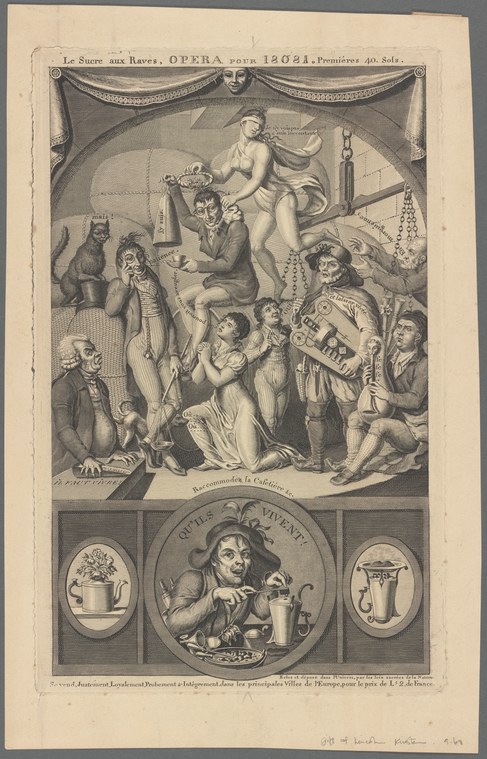
This is an allegorical engraving celebrating opera and theatrical dance, likely created as a frontispiece or title page illustration. The upper register depicts a grand celestial scene: a semi-nude winged figure (Cupid or a muse) presides from above, scattering bounty or blessings, while below a diverse cast of theatrical and operatic characters congregates in an ornate interior space hung with swags of drapery. Among them are figures in 18th-century dress (gentlemen in coats and tricorn hats, women in gowns), musicians with instruments, and dancers in various attitudes of performance or repose. A large banner or coat of arms is held aloft by one figure. The composition is dense with narrative incident, treating the stage as a microcosm of artistic and social life. The lower register contains three separate roundel frames: the central one shows a figure (possibly a composer or impresario) amid theatrical props and masks, flanked by two smaller ovals containing emblems or heraldic devices. The entire composition is framed within an architectural cartouche typical of 18th-century French print design.
The dancing
The figures are rendered in the refined manner of 18th-century theatrical illustration: upright postures, graceful arm gestures, and a mingling of static and dynamic poses. Several figures are caught in mid-movement—a woman appears to be turning or curtseying with one arm extended, while others stand in conversational groups. The dancers, where identifiable, adopt the light, lifted carriage and turned-out legs characteristic of early theatrical dance and court convention. The emphasis is on elegance and the social ease of the theatrical world rather than on the virtuosity or athleticism of specific technique.
The dance depicted
The image celebrates opera and theatrical spectacle of the early 19th century (or possibly late 18th, depending on dress dating). The title *Le sucre aux raves* (the sugar with the turnips) suggests a farcical or satirical opera-comique or vaudeville piece—perhaps a comedy of social mix-up involving performers of different ranks or backgrounds. The scattered theatrical characters, the prominence of musicians, and the allegorical apparatus all point to a work documenting or promoting a specific theatrical production or genre. No single codified dance style is depicted; rather, the image captures the social and performative milieu of theatre dance as practiced in fashionable salon and stage settings of the period, where refined balletic carriage and courtly gesture were the norm.
How it was made
This is an engraving, likely copper engraving or possibly etching with engraved finish, executed in black and white line with tonal modulation achieved through cross-hatching and parallel lines. The technique allowed for wide circulation as a print, and the fine detail suggests this was designed for educated viewers familiar with theatrical culture—likely a Paris or French provincial audience. The print's function as a title page or promotional illustration indicates it was bound into a published score or libretto, making it a document of both artistic and commercial theatrical practice. The quality of the line work and the sophistication of the allegorical composition suggest a professional printmaker of some standing, though the artist is not recorded in the catalogue.
About this work
This engraving documents the world of French theatrical dance and opera in the early 19th century, capturing a moment of cultural efflorescence when opera-comique and pantomime were thriving popular genres. The image is simultaneously a practical record—a frontispiece identifying a specific production—and an idealized portrait of theatrical life as contemporaries wished to see it: witty, elegant, multi-talented, and socially elevated. For dance historians, it reveals how theatrical performers of the period inhabited space together, how gesture and dress coded their roles, and how the world of dance was integrated into a larger ecosystem of music, comedy, and visual spectacle. The dense composition and allegorical framing suggest that theatrical dance, however popular, was understood as part of a philosophical and social order—not merely entertainment but a reflection of refinement, wit, and civilized values.
How to look at it
Look first at the lower register: the three roundels provide iconographic keys to the print's meaning—the central figure among theatrical props may identify the work or its creator. Then scan the upper scene from left to right, identifying the different types of figures and their interactions: observe how costume and posture distinguish dancers, musicians, audience members, and perhaps patrons or directors. Notice the framing devices—the swags, the cartouche, the architectural setting—which signal that this is a conscious composition, not a documentary snapshot. The figure of Cupid or the muse overhead suggests the print's allegorical claim: that theatrical dance belongs to a celestial order of beauty and grace.
The period
The early 19th century, particularly the decade around 1808, was a moment of ferment in French theatrical dance. The Romantic ballet was emerging; the popularity of opera-comique and pantomime was at its height; and the social disruptions of the Revolutionary and Napoleonic periods were reshaping theatrical institutions and audiences. Engravings of theatrical scenes were a significant genre, serving both to document specific productions and to satisfy a growing appetite for images of theatrical life among a literate, theater-going public. The allegorical and emblematic tradition visible here—the winged figures, the layered frames, the heraldic devices—belongs to a 17th- and 18th-century visual language that was being deployed to dignify and theorize theatrical practice even as popular forms like opera-comique were becoming dominant.
Where it lives
The print is held by the New York Public Library in its collection of prints depicting dance. The catalogue title suggests it was a title-page or promotional engraving for an opera or theatrical piece, likely published in Paris or France during the period indicated.
Dance in this work
Questions about this work
What is 'Le sucre aux raves' and why would it have an opera made from it?
The title translates as 'sugar and turnips,' a deliberately banal or comic juxtaposition suited to opera-comique or farce. Such works often played on social incongruity—mixing characters of different classes, occupations, or pretensions. The phrase may reference a specific plot (a confusion over provisions, a cook's mishap) or may be pure nonsense, typical of popular comic opera of the period.
How can I date this print more precisely?
The catalogue lists the date as unknown, but the dress of the figures—the cut of the coats, the style of the women's gowns, the hair—all appear consistent with the period 1800–1820. A specialist in French theatrical costume or in printmaking of the Napoleonic era might narrow the date further by examining the engraving technique and comparing the style to known works from specific printing houses or artists.
Does this show real dancing or just theatrical posturing?
Both. The figures adopt the refined, turned-out carriage of theatrical dance as taught and practiced in the early 19th century, but the print is not designed to show technique or virtuosity. It captures the social and professional context in which dancing took place—the mix of performers, musicians, audience, and management—and the ideal image performers and patrons wished to project: elegance, wit, refinement, and cultural authority.
Who is the winged figure at the top?
Most likely Cupid (Eros), the god of love and pleasure, who was a standard allegorical emblem for theatrical and operatic spectacle in the 18th and 19th centuries. His presence overhead, scattering blessings, claims that theatrical dance is a form of inspired, divinely sanctioned pleasure—not mere entertainment but an expression of higher aesthetic and social values.
More dance artwork





