49 works in this view — arrow keys or swipe to move between them.
Dance in Art
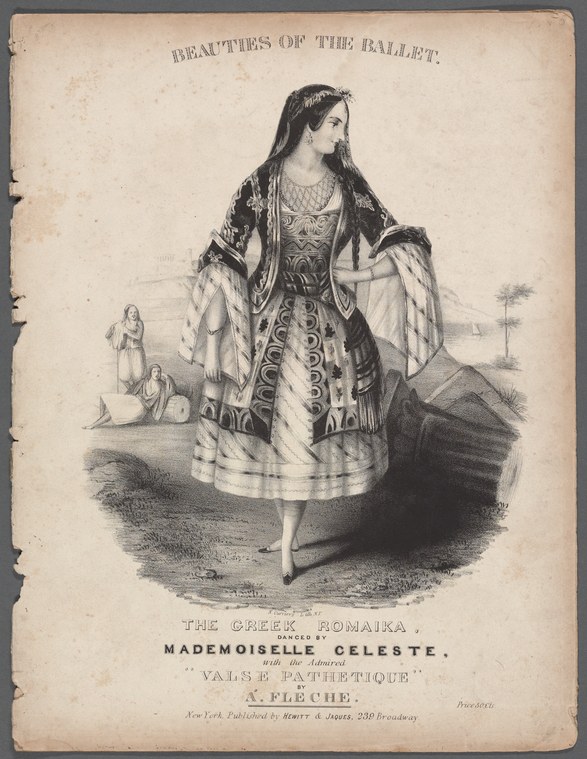
The Greek romaika, danced by Mademoiselle Celeste,: with the admired Valse pathetique by A. Fleche
Unknown artist
- Collection:
- Prints depicting dance
- Source:
- New York Public Library
- Rights:
- Public domain — free to use, share and adapt.
- Recorded as:
- Public Domain
This work illuminates the 19th-century theatrical practice of appropriating and repackaging 'foreign' dances for European and American stages, a practice that shaped how audiences experienced and imagined non-Western dance. It shows how an engraving could function as both promotional material and a kind of dance documentation—recording not how the romaika was danced in Greece, but how it was performed and consumed in New York theatres.
What you are looking at
A single female dancer dominates the composition, positioned center-stage against a pale background. She wears an ornate theatrical costume: a dark embroidered bodice with geometric patterning, a white skirt with horizontal stripes or tiers, and a flowing white cape or shawl draped over her shoulders. Her dark hair falls long and loose past her waist. The dancer stands in a composed, frontal pose with her weight settled, one leg forward, gazing toward the right in profile. Behind her, two smaller figures in similar costumes appear in the middle distance, suggesting either corps de ballet or a secondary scene. The composition is intimate and formal—this is a portrait of a performer in character rather than a scene of dynamic movement. The engraving technique renders fine detail in the costume's embroidery and the fall of fabric; the setting is minimal, suggesting a stage rather than a naturalistic location.
The dancing
The lead dancer stands upright with a slight forward lean, one foot advanced, in a stance that suggests poise and presentation rather than active dancing. Her arms hang naturally at her sides, not in a balletic frame. The pose is fundamentally a standing display—the body is still and vertical, the gaze directed into the middle distance. This is a figure shown at rest or in a moment of stillness, not mid-movement. The smaller figures behind her are similarly static, posed rather than captured mid-action.
The dance depicted
The title identifies this as 'The Greek Romaika, danced by Mademoiselle Celeste.' The romaika (or romaic or romæk) is a traditional Greek line or circular dance, typically performed by women or in mixed groups with simple, repetitive footwork and often improvised upper-body movement. However, the image shows a solo theatrical presentation in Western operatic costume rather than a documentary record of how the romaika was actually danced. This is a Romantic-era theatrical interpretation, filtered through the conventions of Parisian stage dance and the exoticizing gaze toward Greek and Mediterranean culture. The dancer presents the dance as a spectacle for an European audience, and the title references both the dance form and the celebrated performer (the 'admired Valse pathétique by A. Fleche' suggests this was a complete stage piece combining the romaika with a contrasting waltz).
How it was made
This is a steel or copper engraving, a print medium that allowed mass circulation and relatively inexpensive reproduction. The fine parallel lines (hatching and cross-hatching) visible in the background and on the fabrics are characteristic of engraving technique. The publisher 'N. Mendal, New York' with an address in Broadway and the notation 'Published' suggest this was a commercial theatrical print, likely distributed to promote the performer or the production, or sold as a souvenir of a New York performance. The technique was well-suited to rendering intricate costume detail and fine gradations of light and shadow, making this an effective advertisement for the spectacle of the stage production.
About this work
This is a 19th-century theatrical promotional engraving of a solo dance by the performer Mademoiselle Celeste, framed as a presentation of 'The Greek Romaika' on the European and American stage. It documents the Romantic era's fascination with exoticized national and ethnic dances reframed as high theatrical spectacle. The work sits at the intersection of documentary and fantasy: it records what audiences actually saw—a Western-trained dancer in ornate costume—but that spectacle bore a complex and mediated relationship to the traditional Greek dance it claimed to represent. The engraving's circulation through Broadway publishers made it an instrument of cultural performance and commercial entertainment as much as an artistic record.
How to look at it
Look at the stillness of the pose: this is not a moment of action, but of presentation. The dancer is shown as an object of beauty and spectacle, posed frontally for the viewer's gaze. The costume—the embroidered bodice, the tiered skirt, the flowing cape—is rendered in meticulous detail, suggesting that the visual appeal of the costume was as important as any dancing. Notice how the smaller figures in the background are rendered almost like statues, reinforcing the theatrical tableau quality of the scene. The composition privileges the body as an image rather than as a moving, dancing thing.
The artist
The artist is not recorded. The engraving was published commercially by N. Mendal in New York in the 19th century, suggesting this was professional theatrical ephemera produced by commercial printmakers working in the service of theatre promotion and distribution.
The period
This work dates to the height of Romantic ballet and the Romantic theatre's fascination with exoticism and national character dances. European and American stages of the 1830s–1860s frequently programmed 'ethnic' dances—Greek, Spanish, Hungarian, Swiss, Italian—often performed by celebrated soloists in elaborate costumes. These dances were understood as picturesque and emotionally expressive rather than as documentary or authentic representations of living dance traditions. Mademoiselle Celeste was a celebrated performer of the era, and dances like the romaika were vehicles for displaying virtuosity and charm within the framework of Romantic sensibility. The engraving medium allowed theatres to circulate images of celebrated performers and productions through printed ephemera, sustaining interest and advertising future performances.
Where it lives
This is a commercial theatrical engraving published by N. Mendal in New York (Broadway address). It belongs to the collection of theatrical and dance-related prints held by the New York Public Library, part of a broader documentary archive of 19th-century American and European performance.
Dance in this work
Questions about this work
Who was Mademoiselle Celeste?
Mademoiselle Celeste (1815–1882) was a celebrated French dancer and actress who performed throughout Europe and America in the 19th century. She was known for her versatility in both classical ballet and theatrical character dances, and for bringing European dramatic dancing to American audiences. She frequently performed in New York and was a star of the theatrical circuit.
What is the romaika?
The romaika (also spelled romaic or romæk) is a traditional Greek circle dance, typically performed at celebrations and festivals. It features simple, repetitive footwork and a moderate tempo, often with improvised or variable upper-body movement depending on the context and musicians. On the 19th-century European stage, it was reframed as an exotic solo spectacle with added theatrical costume and movement.
What does 'Valse pathétique by A. Fleche' mean?
This refers to a musical composition—a waltz with emotional or dramatic character—that accompanied the romaika in the stage performance. It suggests this was a complete short ballet or theatrical piece combining the Greek dance with a contrasting waltz, likely performed in a single entertainment. The composer A. Fleche (or possibly a variant spelling) is not widely documented.
Why is this engraved rather than painted or photographed?
Engraving allowed cheap, rapid reproduction of theatrical images for circulation as promotional materials, playbills, and souvenirs. It was the standard medium for theatrical publicity and fan imagery in the 19th century. Photography was expensive and slow to reproduce in quantity; oil painting was a one-off artwork. Engraving let theatres distribute images of their stars to multiple cities and audiences.
More dance artwork





