49 works in this view — arrow keys or swipe to move between them.
Dance in Art
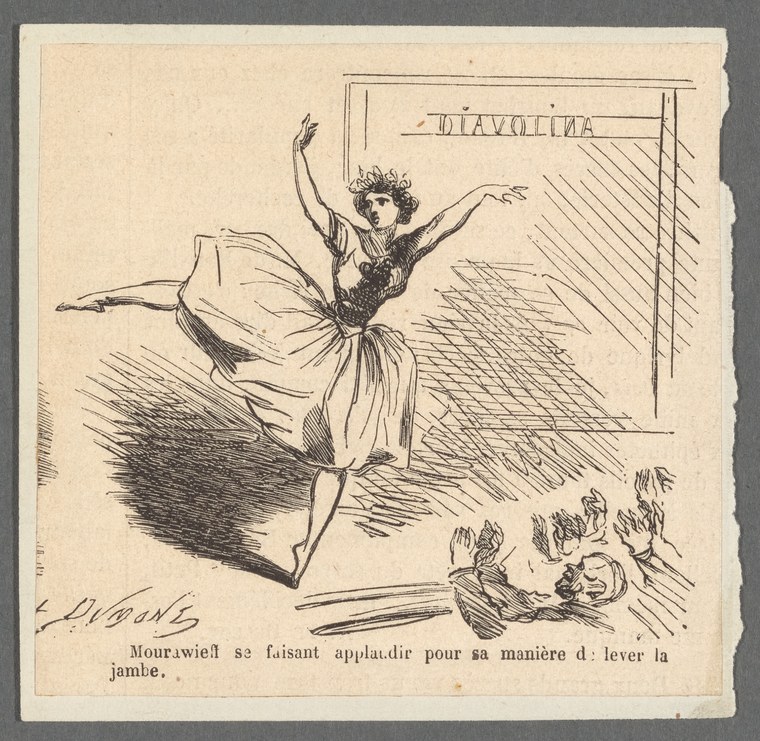
Mourawieff se faisant applaudir pour sa manière de lever la jambe [cartoon of Marfa Muravʹëva]
Unknown artist
- Collection:
- Prints depicting dance
- Source:
- New York Public Library
- Rights:
- Public domain — free to use, share and adapt.
- Recorded as:
- Public Domain
This print is valuable evidence of how dancers' technique was perceived and talked about in 19th-century theater culture. The focus on a single technical detail—the leg extension—as the identifying feature of a named performer tells us what audiences noticed, what dancers trained for, and how individual virtuosity became legible as a kind of personality or signature on stage.
What you are looking at
A female dancer in mid-leap dominates the composition, her body suspended in a striking vertical extension with one leg raised high. She wears a light, billowing skirt and fitted bodice, her crowned head tilted back, one arm reaching upward while the other gestures expressively outward. The setting is a theatrical interior with a doorway or archway visible behind her, suggested by simple linear perspective. In the lower right, a group of male spectators—rendered in much smaller scale and sketchier technique—sit or crouch, applauding. The contrast between the fully realized, elongated figure of the dancer and the hastily suggested audience creates a satirical effect, emphasizing both the dancer's prominence and the comedy of the scene. The inscription below identifies this as a caricature of Marfa Muravʹëva, mocking her particular manner of raising her leg.
The dancing
The dancer's body is drawn with elongated proportions, exaggerating the height of the leg extension and the reach of her arms. Her posture is upright but dynamic, with the raised leg extended nearly vertically past the level of her head—a striking feat of flexibility. The supporting leg appears nearly straight, suggesting she is poised on a single point. Her arms frame the composition; the upper arm reaches past vertical while the lower is extended at a wider angle. The sketchy male figures below are rendered in contrasting abbreviated style, their postures bent and informal as they react to her performance.
The dance depicted
This is a satirical print depicting a moment from theatrical ballet, likely from the mid-19th century Russian or European stage. The inscription identifies the subject as Marfa Muravʹëva (also transliterated Mourawieff), a dancer of the period, and the joke centers on her distinctive high leg extension—a technical achievement that was clearly recognizable enough to be an instant identifier. The exaggerated verticality of the leg and the affected pose suggest this is both admiring the technical feat and mocking the performer's style or the audience's amazement at it. The print captures a specific moment in a theatrical performance, with the dancer in an attitude that emphasizes technical virtuosity over narrative action.
How it was made
This is a pen-and-ink drawing, likely prepared for engraving or lithographic reproduction and distributed as a printed satirical image. The artist's confident, economical line work—especially visible in the dancer's form—suggests practice in the medium and familiarity with theatrical subjects. The sketchy treatment of the male figures and background, contrasting with the precise definition of the dancer's body, is a deliberate compositional choice that focuses attention and creates caricatural effect. The work's style and subject matter place it within the tradition of 19th-century theatrical caricature and society satire, a format that relied on rapid distribution via print and circulation in newspapers, journals, or standalone broadsheets.
About this work
This is a satirical print caricaturing the Russian dancer Marfa Muravʹëva, capturing a moment of theatrical performance and lampooning her technical signature—an extraordinarily high leg extension. The work belongs to the tradition of 19th-century theater caricature, where dancers' recognizable techniques and styles became subjects of visual wit. As a document of a specific performer's reputation and distinctive movement vocabulary, it preserves evidence of what was memorable and remarked upon in ballet performance of the era: the ability to achieve dramatic vertical extensions of the working leg, presented here with exaggeration that blurs admiration and mockery.
How to look at it
Attend to the elongation of the dancer's body and the precise angle of her raised leg—the artist has exaggerated both to comic effect, making the extension seem almost impossible. The size difference between the dancer and the applauding men is deliberate caricature, emphasizing how the audience's gaze is wholly captured by her technical feat. The simplified, sketchy rendering of the theatrical interior keeps focus on the body itself. The moment captured is the apex of the extension, the instant of maximum height and maximum display—the most photogenic moment of the movement, frozen to create wonder and satire simultaneously.
The period
The print dates to the mid-19th century, when Romantic ballet and Russian Imperial ballet were at their height of technical sophistication and international fame. Dancers from the Russian Imperial Ballet toured across Europe and were frequent subjects of caricature in Paris and other capitals. The tradition of theater caricature was well-established by this period; satirical prints offered commentary on current performers, fashions, and mannerisms. High leg extensions were increasingly central to ballet technique during the Romantic era, as dancers refined turnout and verticality; this print's mockery of Muravʹëva's extension suggests the technique was still striking enough to be instantly recognizable as a personal signature rather than a universal standard.
Where it lives
The print is held in the New York Public Library's collection of prints depicting dance. It is catalogued under the subject of theatrical dance and caricature, reflecting its dual role as both a historical record of performance and a work of visual satire.
Dance in this work
Questions about this work
Who was Marfa Muravʹëva?
Muravʹëva was a Russian dancer active in the mid-19th century, known for her technical virtuosity, particularly her high leg extensions. This print preserves her reputation as the kind of performer whose technique was distinctive enough to be instantly recognized and caricatured.
Why is the leg extension exaggerated?
The exaggeration is deliberate caricature—the artist is both celebrating and mocking Muravʹëva's signature technique. In the visual language of satirical prints, exaggeration signals both admiration and gentle ridicule, suggesting that the extension was remarkable enough to define the performer.
What does this tell us about 19th-century ballet technique?
The focus on the raised leg as the identifying feature of a named dancer suggests that high extensions were prized technical achievements in Romantic ballet, something dancers trained for and audiences applauded. The print is evidence that this specific technique was central to what made a dancer memorable and discussable.
More dance artwork





