49 works in this view — arrow keys or swipe to move between them.
Dance in Art
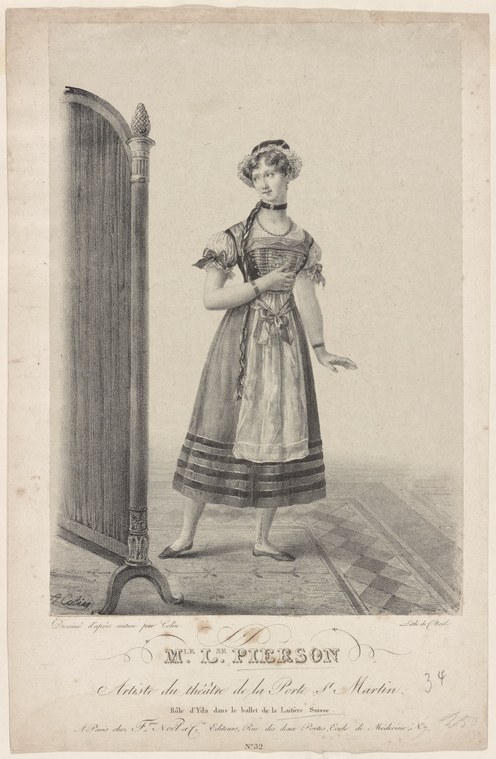
Mle. L'se Pierson, artiste du Théâtre de la Porte St. Martin, rôle d'Yda dans le ballet de La laitière suisse
Unknown artist
- Collection:
- Prints depicting dance
- Source:
- New York Public Library
- Rights:
- Public domain — free to use, share and adapt.
- Recorded as:
- Public Domain
This print is one of thousands of ephemeral theatrical portraits that documented the actual conditions of dance work in the nineteenth century: the costumes, the staging, the social reality of performers whose names and roles are now almost entirely forgotten. For historians of dance as labor, as popular entertainment, and as a practice embedded in narrative theater rather than abstract movement, such images are invaluable evidence. The work also demonstrates how dance was marketed and consumed: as a visual spectacle, often tied to narrative and character, aimed at a broad urban audience rather than an elite court or academy.
What you are looking at
A young woman stands alone in an austere interior, posed in a moment of theatrical stillness. She wears a modest but elegant dress of the 1830s–40s period: a fitted bodice with short puffed sleeves, a full skirt with horizontal trim bands at the hem, and a choker at her throat. Her hair is gathered on top of her head in the fashion of the era. She holds a small object—possibly a fan or prop—in one hand while the other rests at her side. To her left stands a tall draped curtain or door, rendered in deep shadow with vertical hatching, which anchors the composition and emphasizes the theatrical setting. The floor is indicated by perspective lines receding into depth. The entire image is rendered in fine engraving or lithographic line work, with careful attention to the fall of fabric and the delicate modeling of the figure. The pose is neither active nor relaxed: it is a presentation pose, the stance of a performer between moments of action.
The dancing
The dancer stands in a neutral, upright posture with weight evenly distributed on both feet—a pose of readiness rather than momentum. Her torso is frontal and composed; her arms are held low and unengaged, one bent slightly at the elbow. There is no visible turn-out of the feet, no elevation, no indication of the balletic vocabulary that would come to dominate theatrical dance by the mid-nineteenth century. The body is presented as a whole to the viewer, not fragmenting into a demonstrative line or frame. The overall carriage is calm and dignified, suggesting a woman of social standing rather than the acrobatic virtuosity associated with Romantic ballet.
The dance depicted
This is a portrait of a stage performer, likely a dancer or mime-actress in the Parisian theater of the 1830s–40s, printed as a promotional image. The title identifies her as Mlle. L. Pierson, performing in the role of Yda in a ballet called *La Laitière suisse* (The Swiss Milkmaid). The work appears to be a document of popular theatrical entertainment rather than a record of a specific dance technique. The pose and costume suggest a narrative or character-driven performance, possibly blending mime, dance, and spoken drama in the manner of the *pièce à spectacle*—the spectacular mixed-genre entertainment that dominated Paris's minor theaters in this period. Without access to the ballet's score or descriptions, the specific choreography cannot be reconstructed from the image alone.
How it was made
This is a finely executed engraving or possibly a lithograph, rendered in delicate parallel lines with subtle cross-hatching to create form and shadow. The technique allowed for mass reproduction and circulation as an affordable print, typical of the theatrical publicity materials distributed to build an audience for performances at smaller Paris theaters. The quality of the line work and the care taken with anatomical detail suggest this was a commercial product of some ambition—neither a crude woodcut nor a fine-art intaglio, but a mid-range reproductive print of the kind found in collections, albums, and theater lobbies. The worn and aged appearance of the paper in the image indicates it has survived as a collectible artifact for well over 150 years.
About this work
This is a promotional theatrical print from the Paris of the July Monarchy, documenting a minor performer in a small-theater production. It belongs in a dance gallery not because it depicts virtuoso dance technique, but because it is a primary document of how dance existed in lived theatrical practice: as entertainment, narrative, character work, and social spectacle. The image records not a choreographer's vision or a training method, but the moment when a woman named L. Pierson put on the costume of a Swiss milkmaid and walked onto a stage to be seen. It is a record of her labor, her visibility, and her participation in the commercial culture of Paris.
The work represents a moment in dance history when ballet was still fluid in form: before the codification of Romantic technique had fully taken hold, before pointe work became mandatory, before the rigid separation of ballet from pantomime and spectacle had been enforced. Mlle. Pierson's costume and pose place her in the tradition of character-based theatrical entertainment that would be displaced—but not entirely replaced—by the rise of Romantic ballet and the celebrity cult of the danseuse étoile.
How to look at it
Attend to the stillness of the pose: this is not a snapshot of movement, but a staged presentation, a moment of pause or greeting. The theatrical conventions visible here are those of *attitude*—the held, composed posture intended to convey character and social status—rather than the fluid, ongoing motion of later dance photography. Notice the relationship between the figure and the curtain: the curtain is not merely decoration, but marks the boundary between stage and auditorium, between the performer's world and the viewer's. The careful rendering of the fabric of her dress, the precise folds and the trim bands at the hem, tells us that costume was central to meaning in this kind of theater: she is legible as 'Swiss milkmaid' through her clothing. The neutral background and the absence of other figures or narrative context suggest this is a promotional portrait rather than a scene from the ballet—Mlle. Pierson presenting herself to the public in her role, not in the act of performing it.
The artist
The artist is not recorded in the catalogue. The print is characteristic of Parisian commercial theatrical publicity of the 1830s–40s, a period when dozens of small workshops produced these portraits in quantity. The level of technical skill suggests a trained engraver or lithographer working within a commercial print shop, possibly one associated with theatrical publishing or the sale of theatrical souvenirs. Without a signature or inscription, attribution is not possible from the image alone.
The period
This image dates to the early Romantic period in ballet, when the form was in transition between the older tradition of spectacle ballet and character dances (*ballets d'action*) and the emerging vocabulary of Romantic ballet associated with Marie Taglioni and the cult of weightlessness and pointe work. Paris in 1835–45 had multiple tiers of theatrical production: the grand state theaters (Opéra, Comédie-Française) at the top, and dozens of smaller theaters—the Porte-Saint-Martin, Gaîté, Ambigü-Comique—that specialized in mixed entertainments, vaudeville, melodrama, and spectacular dance numbers. The minor theaters often recycled plots, music, and even choreography from the major houses, adapting them for a paying public of bourgeois and working-class spectators. *La Laitière suisse* was itself a popular subject, adapted and restaged many times across Europe. Mlle. Pierson's role as Yda (possibly a variant of a Swiss or Alpine character name) suggests a narrative framework centered on national costume and folk identity.
Where it lives
The print is held in the New York Public Library's collection of prints depicting dance. It belongs to the category of theatrical publicity materials and promotional portraits that were collected, bound into albums, and preserved by fans, historians, and libraries as records of theater practice. The NYPL's collection includes thousands of such prints from across Europe and America, ranging from the early nineteenth century to the twentieth.
Dance in this work
Questions about this work
Who was Mlle. L. Pierson?
L. Pierson was a performer in the Parisian minor theaters during the 1830s–40s, where she is documented in the role of Yda in *La Laitière suisse*. Beyond what this print and similar theatrical records tell us, little is known of her life or career. She represents the vast majority of theater workers whose names appear in playbills and prints but leave no other trace in historical records.
What is 'La Laitière suisse'?
*La Laitière suisse* (The Swiss Milkmaid) was a popular theatrical work of the period, adapted and staged multiple times across European theaters. It likely combined dialogue, song, and dance, with a plot centered on Alpine or Swiss character types. Similar works proliferated in the minor theaters as affordable entertainment for urban audiences.
Is this ballet in the Romantic style?
The image predates or sits at the very beginning of the full codification of Romantic ballet technique. The dancer's posture and costume suggest a mixed theatrical entertainment—part mime, part character dance, part spectacle—rather than the virtuosic ballet technique that would come to dominate the Opéra in Paris. She is dressed and posed as a character, not as an idealized dancer.
Why is this print valuable to dance historians?
This print documents the material reality of theatrical dance as it was actually practiced and marketed: not as high art in a state theater, but as popular entertainment in a commercial context. It shows us costumes, social roles, promotional strategies, and the work of performers who are otherwise invisible in histories focused on famous dancers and choreographers.
More dance artwork





