49 works in this view — arrow keys or swipe to move between them.
Dance in Art
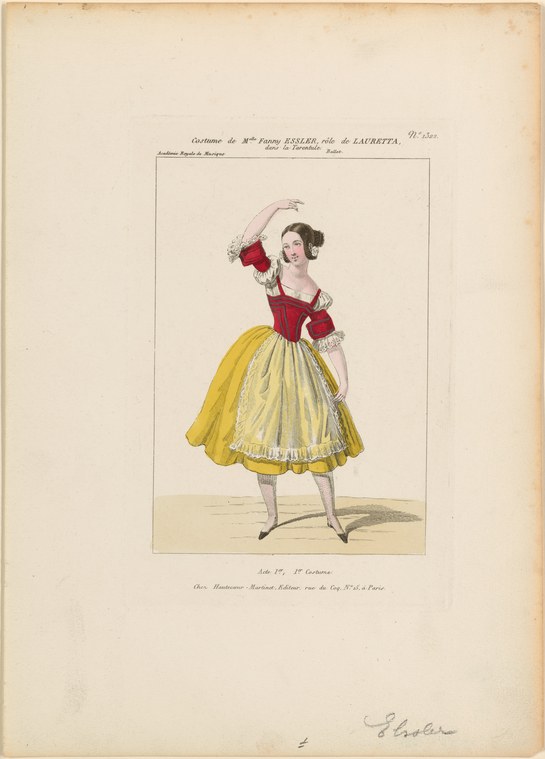
Costume de Melle. Fanny Essler [sic], rôle de Lauretta, dans La tarentule.: Ballet. Académie Royale de Musique. Act 1.er, 1.er costume
Unknown artist
- Collection:
- Prints depicting dance
- Source:
- New York Public Library
- Rights:
- Public domain — free to use, share and adapt.
- Recorded as:
- Public Domain
Fanny Elssler was a principal figure in Romantic ballet and a rival to Marie Taglioni; her Tarantelle was one of the most celebrated and widely circulated roles of the 1830s-1840s. This print is direct evidence of how Elssler looked in one of her most famous parts, offering dancers and historians a visual record of Romantic-era theatrical presentation, costume construction, and the conventions of feminine performance in the period. Elssler's nationality (she was Austrian), her rivalry with French dancers, and her later American tour made her a figure of significant cultural and political importance, and her roles are central to understanding Romantic ballet beyond the French canon.
What you are looking at
A single female dancer is depicted in a three-quarter stance against a plain beige background, wearing a striking costume of a red bodice with short puffed sleeves and a voluminous yellow skirt with white underskirts visible at the hem. She holds a small red fan or feather accessory aloft in her right hand, her left arm relaxed at her side, and her head is turned slightly upward with a bright smile. Her hair is styled in the fashion of the 1830s-1840s, dark and pulled back. The pose captures a moment of lightness and vivacity: her weight appears to rest primarily on one leg while the other extends with a slight bend, suggesting either a pause in movement or a preparatory position. The figure stands on a small tan shadow line suggesting ground, with no other setting or context—the composition focuses entirely on the dancer and her costume.
The dancing
The dancer's pose conveys a distinctly theatrical moment: upright posture with the torso lifted, one supporting leg bearing weight while the other leg remains mobile with a slight flex at the knee. The arm holding the fan is raised to approximately shoulder height with the elbow gently bent, while the other arm hangs naturally. The head is tilted back and to the side with an animated expression. The overall frame and carriage suggest trained theatrical movement—the kind of posed presentation typical of role costume documentation rather than an action photograph. There is a refined, controlled quality to the stance despite its apparent lightness.
The dance depicted
This is a costume study for a role in a Romantic-era ballet, specifically for Fanny Elssler (note the spelling variation in the title) as Lauretta in Tarantelle (La tarentule). The tarantella was a central item in Elssler's repertory during the 1830s and became her signature role. The image documents theatrical dress rather than capturing dance technique in motion. Tarantelle appears here not as an authentic Neapolitan folk dance but as a stylized theatrical vehicle showcasing the dancer's virtuosity and charm through costume, carriage, and facial expression.
How it was made
This is a hand-colored engraving or lithograph, likely produced from a print by an unrecorded artist, with selective hand-coloring applied to the bodice (red), skirt (yellow), and skin tones. The technique is typical of 1830s-1840s theatrical documentation, where performers' roles were circulated to audiences, critics, and the profession in the form of colored costume prints. The fine line work, precise anatomical rendering, and restrained use of wash suggest engraving rather than lithography. Such prints were affordable, portable documentation that circulated through theatrical networks and private collections, making the costumes and roles familiar to dancers and audiences across Europe.
About this work
This is a hand-colored engraving documenting Fanny Elssler's Romantic-era costume as Lauretta in Tarantelle, one of the defining roles of her career. The print belongs to a widespread European practice of circulating theatrical costume documentation to performers, audiences, and the profession during the 1830s-1840s. As such, it is evidence of how Romantic ballet dancers were marketed, how roles were standardized and transmitted, and how tarantella—an ostensibly folk dance—was transformed into a showcase for Romantic virtuosity and charm. The print serves both as historical documentation and as a window into the visual culture of Romantic dance.
The image is most valuable as a record of what audiences saw and how roles were understood and communicated. Unlike a photograph or sketch made during performance, a costume print like this is a formal, finished statement about the role—how the dancer was supposed to look, stand, and present herself in the character. This particular print's inclusion in the New York Public Library's dance collection signals its recognition as an important historical document of a canonical Romantic-era role.
How to look at it
The pose is neither a moment captured mid-action nor a static standing position; it is a composed presentation designed to show the character, costume, and carriage in favorable light. Attend to the uplifted head, the animated expression, and the informal but controlled stance—these communicate the character's vivacity and charm. The raised arm with the fan is a gesture of coquetry and liveliness, not a step in the dance. The skirt and bodice proportions are exaggerated and perfected compared to what would be worn in daily life, indicating idealization and theatrical convention. The plain background emphasizes the figure and costume alone, removing any context; this is portraiture of a role, not documentation of a stage setting or choreography.
The period
This print dates to the heart of the Romantic era in ballet, roughly 1835-1845, when hand-colored costume prints were the primary visual documentation of theatrical performance available to the broader public. Fanny Elssler emerged as a major rival to Marie Taglioni during this period, offering a contrasting style—more technical, more sensual, more overtly connected to folk and character dances. Tarantelle became closely associated with Elssler; she danced her own version and others created versions for her, making it a touchstone of her performance identity. The tarantella as a theatrical form drew on Neapolitan folk traditions but was transformed into a vehicle for Romantic virtuosity, featuring turns, light footwork, and vivacious character. The voluminous skirt and bodice seen here became increasingly standardized elements of Romantic costume during this decade, reflecting evolving ideals of the feminine silhouette on stage.
Where it lives
The print is held in the New York Public Library's collection of prints depicting dance, catalogued as part of their theatrical materials from the 19th century. It was likely produced and distributed in multiple copies in Europe during the 1830s-1840s and has entered an American institutional collection, as was common for significant theatrical documentation.
Dance in this work
Questions about this work
Who was Fanny Elssler?
Fanny Elssler (1810–1884) was an Austrian dancer and one of the greatest stars of Romantic ballet. She was a rival to Marie Taglioni and famous for her technical virtuosity, her interpretation of character and folk-based dances, and a celebrated 1840–1842 tour of the United States. Unlike Taglioni, who embodied ethereal, otherworldly femininity, Elssler was known for a more earthy, sensual, and technically brilliant style.
What is a tarantella?
Tarantella is a rapid, lively folk dance from southern Italy, traditionally danced in couples or groups. In Romantic ballet, it was adapted as a solo or featured role for virtuoso dancers, transformed from folk form into a display of technical skill and character portrayal. Elssler's Tarantelle became one of the most famous versions and was widely imitated.
Why was this print made?
Theatrical costume prints served multiple purposes: they documented roles for dancers learning parts from other performers or cities, they advertised and commemorated performances, and they circulated the image of celebrated dancers and roles to a broader public. Before photography, these colored engravings were the primary visual record of theatrical dress and presentation.
How does this differ from modern costume documentation?
A costume print is an idealized, hand-finished representation rather than a photograph. It shows the dancer in a composed, favorable pose designed to present the character and costume at their best. No movement or action is captured; instead, the image communicates character and theatrical presence through stillness and formal composition.
More dance artwork





