49 works in this view — arrow keys or swipe to move between them.
Dance in Art
Viva Andalucia!
Unknown artist
- Collection:
- Prints depicting dance
- Source:
- New York Public Library
- Rights:
- Public domain — free to use, share and adapt.
- Recorded as:
- Public Domain
The work documents the visual culture of late 19th-century ballet and the European fascination with Spanish and North African themes—a context in which what audiences experienced as 'Spanish dance' was actually a classical ballet interpretation. For a dancer or dance historian, this sketch reveals how character roles were conceived, taught, and recorded: not through notation, but through costume studies and posed documentation that could be reproduced for different performers and productions.
What you are looking at
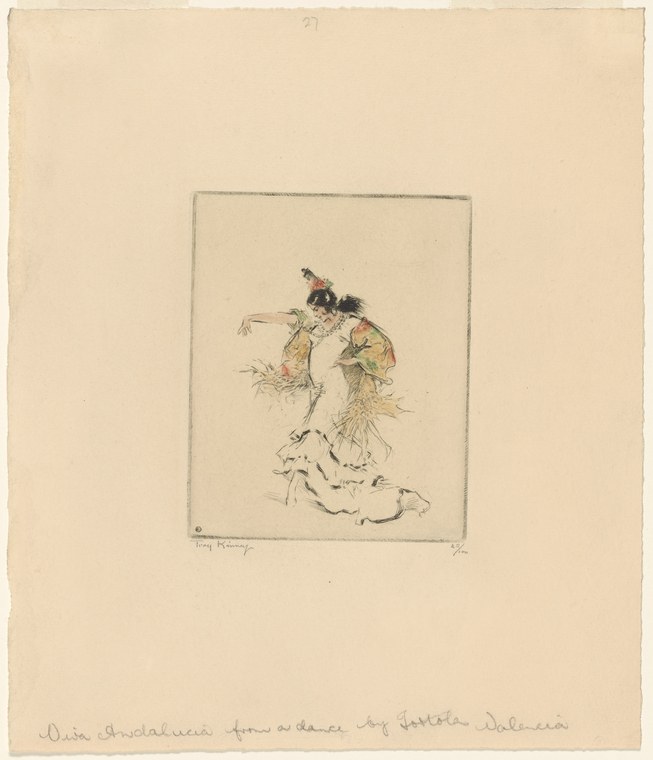
A single female dancer, depicted in a delicate watercolor or ink sketch with hand-coloring, strikes a lyrical pose against a neutral background. She wears a cream or pale yellow dress or tunic with floral embroidery or patterning at the waist and bodice, and her dark hair is crowned with a small ornamental headdress or flower arrangement. Her body curves in an arabesque-like extension, with one leg lifted behind her and arms positioned in a graceful, open frame. The sketch is spare and intimate—the artist has concentrated on the line of the body and the quality of the fabric, leaving the background minimal. A handwritten inscription in cursive script appears below the mounted work, though it is not fully legible in reproduction.
The dancing
The dancer stands in a balletic line with evident turnout, one leg extended behind in an arabesque or supported développé. The upper body leans forward slightly, with arms extended in an open, rounded position—the classical épaulement of late 19th-century academic dance. The posture shows control and refinement rather than dramatic extension; this is a moment of poise rather than explosive energy. The figure is solitary and self-contained, not engaged with a partner.
The dance depicted
This appears to document a theatrical or concert solo, likely from the late 19th or early 20th century. The pose and costume suggest a Romantic or Orientalist-inflected ballet idiom—the kind of lyrical, character-based solo that would have been performed in divertissement or one-act pieces. The title *Viva Andalucia!* implies Spanish or flamenco subject matter, but the technique and dress do not clearly declare flamenco proper: this looks more like the European theatrical interpretation of Spanish or Moorish themes that was popular in that era. The pose is pure classical ballet vocabulary applied to a character role.
How it was made
This is a watercolor and graphite sketch on paper, mounted on a larger board or mat. The artist has used spare, confident line work to establish the figure's form, then added delicate hand-coloring in flesh tones and dress ornament—a technique common in theatrical or costume studies of the period. The spontaneity of the sketch and the precision of the pose suggest this may be a rehearsal study or a design proposal for a costume or choreography, rather than a finished exhibition piece. The signature or inscription at lower left is rendered in the artist's hand, confirming this as a primary document rather than a reproduction.
About this work
This is a sketch of a single female dancer in a character role inspired by Spanish or Andalusian themes, rendered in the academic ballet idiom of the late 19th century. The work belongs to a tradition of theatrical costume studies and choreographic notation that documented dance practice for performers and producers. It sits at the intersection of dance practice (as a study for rehearsal or staging) and visual art (as a fine sketch in watercolor), and testifies to the popularity of nationalistic and Orientalist themes in European theatrical dance of this period.
How to look at it
Attend to the posture and frame of the body: the turnout, the épaulement, the relationship of the lifted leg to the upper-body line. These details encode a specific school of dance training and a specific moment in the performance—not the climax of a jump or the drama of a fall, but a moment of control and display. The costume—the embroidered dress, the headdress, the soft fabric—signals the character and setting; but the body speaks the language of classical ballet, not folk or vernacular Spanish dance. This contrast is the point: the artist is showing how European theatrical dance absorbed and reframed Spanish themes.
The period
The late 19th and early 20th centuries saw an explosion of character dances and nationalistic themes in European ballet—a response to the dominance of classical technique and narrative on the one hand, and a fascination with Orientalism and exoticism on the other. Sketches like this one circulated as design documents, rehearsal aids, and records of celebrated performances. They were made for performers and producers, not primarily for public exhibition, and survive as evidence of an ephemeral art form that depended on the transmission of movement through the body rather than through written or photographic means.
Where it lives
The work is held in the New York Public Library's collection of prints depicting dance—a holding that documents the visual and material culture of theatrical performance across centuries. The mounting and inscription suggest it was preserved as a significant document or souvenir, rather than casually filed.
Dance in this work
Questions about this work
What is the dance in this picture?
The pose and technique are classical ballet, but the costume and title suggest a character solo inspired by Spanish or Andalusian themes—likely a divertissement or one-act piece from the late 19th century. This was the era when European ballet companies were creating nationalistic and Orientalist character roles, and this sketch documents that visual culture.
Is this flamenco?
No. While the title and costume suggest Spanish subject matter, the dancer's turnout, épaulement, and arm position are academic ballet, not flamenco technique. This is a European theatrical interpretation of Spanish themes using classical ballet vocabulary.
Who was the dancer?
The catalogue record does not identify the performer or the artist. The handwritten inscription below the work may contain a name, but it is not fully legible in reproduction.
What was this sketch used for?
Sketches like this served multiple functions: as costume and design documents for producers and dressmakers; as choreographic records or rehearsal aids for performers; and as mementos of celebrated performances. This one's mounting and preservation suggest it was valued as a record of a specific role or dancer.
More dance artwork





