49 works in this view — arrow keys or swipe to move between them.
Dance in Art
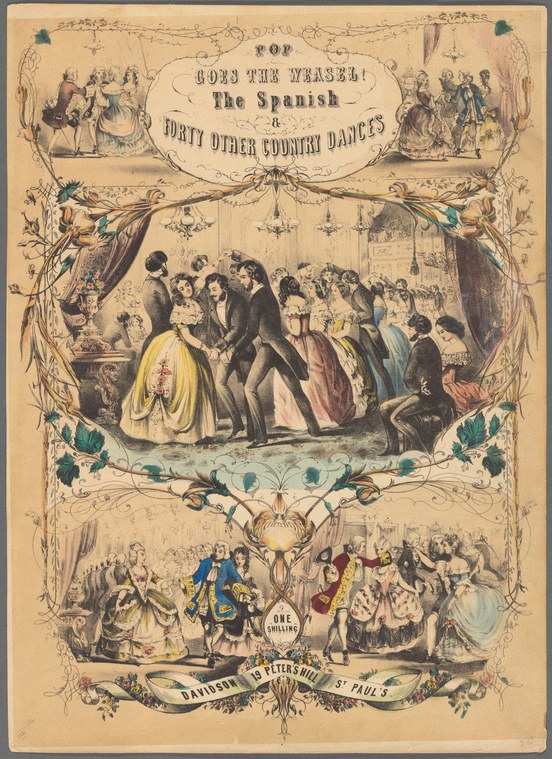
Pop goes the weasel! The Spanish & forty other country dances
Unknown artist
- Collection:
- Prints depicting dance
- Source:
- New York Public Library
- Rights:
- Public domain — free to use, share and adapt.
- Recorded as:
- Public Domain
For historians of social dance, this print is rare documentary evidence of the repertory and technique of 19th-century ballroom dance as it was actually taught, not as it appears in written choreographies. The image shows how published dance instruction reached a mass audience through cheap color printing, reshaping dance practice across the middle classes. For art historians, it is a specimen of the commercial chromolithography that flooded European homes in the mid-1800s—cheap, vivid, abundant, and often unsigned.
What you are looking at
A densely ornamented chromolithograph depicting a genteel social dance in a grand interior, likely from the mid-19th century. The central scene shows couples and groups of figures in formal dress—men in dark tailcoats and trousers, women in voluminous skirts and corseted bodices—arranged in what appears to be a ballroom or assembly room with draped curtains and hanging decorations. The composition is framed by elaborate borders featuring romantic vignettes in smaller panels: at the top, figures in profile engaged in conversation or courtship; at the bottom, a broader dancing scene with more dancers in similar formal dress, as if showing the same event from a different vantage point or at a different moment. The entire print is surrounded by ornamental scrollwork, garlands, and decorative flourishes typical of popular dance instruction or social etiquette ephemera of the period.
The dancing
The dancers in the central scene stand in conversational groupings rather than active dance positions, suggesting a moment of rest or social interaction between dances. Where figures are engaged in dancing, they appear to be in the closed frame typical of 19th-century ballroom dance—men facing partners with one hand at the waist, the other holding the partner's hand at shoulder height. The women's arms are held up to receive the frame; their voluminous skirts would require significant spatial clearance for turning. The lower vignette shows more active movement, with figures in what may be a contre-danse or quadrille formation, suggesting group choreography rather than partner improvisation.
The dance depicted
This print documents the repertory of 19th-century ballroom dance as it was taught to mixed social company. The title promises 'The Spanish & forty other country dances'—a formula that suggests this is a dance instruction or social etiquette publication aimed at teaching fashionable dances to the upper middle classes. The Spanish dance may refer to a country dance or cotillion with Spanish-themed choreography rather than an actual Spanish folk dance; such appropriations were common in English and European ballroom culture. The formal dress and interior setting indicate that these dances were performed at public assemblies or private balls, by amateurs following published choreographies rather than professional performers.
How it was made
This is a hand-colored lithograph, identifiable by the characteristic stone-printed line work overlaid with watercolor or gouache in distinct color zones—note the precisely bounded yellows, blues, greens, and flesh tones that do not blend. Lithography allowed for large print runs at modest cost, making this an affordable instruction manual or parlor decoration for the middle-class market. The ornamental engraving-style borders were likely printed separately and pasted in or printed in register, a common practice for title pages of bound dance instruction books. The technique is well-suited to rendering the play of light on fabrics and the social formality of the scene.
About this work
This mid-19th-century chromolithograph is a visual record of the social dances taught to English and European ballroom society in the Gilded Age. It belongs to a substantial genre of popular instruction ephemera—broadsheets, title pages, and parlor prints—that documented the leading dances of the period and made them available to amateur dancers through engraving and lithography. The work is neither an artist's fine art practice nor a dance notation, but rather commercial visual culture: it advertised dances, instructed amateurs, and embodied the aspirations of the classes who danced them. What makes it valuable now is precisely what made it cheap then—its unguarded record of how bodies moved, how ballrooms were decorated, what dancers wore, and what dances were fashionable enough to sell by name on the title page.
How to look at it
Look first at the formal poses in the central scene: no one is leaping or turning dramatically, but rather standing in the characteristic frame of couple-dances or the geometric arrangements of group dances. The women's skirts are voluminous and held out by crinolines—note how much space each figure occupies. The ornamental borders are not incidental: they show the print as a complete product, meant to appeal to the eye as a parlor decoration or a keepsake, not merely as instructions. The contrast between the formal stillness of the central group and the more active poses in the lower vignette suggests the print is trying to convey both the social ritual (standing, conversing, preparing) and the dance itself (turning, processing, stepping in formation).
The period
In the mid-19th century, ballroom dancing was the primary social dance of the English-speaking middle and upper classes, taught at private lessons and practiced at public assemblies and private balls. The quadrille, cotillion, country dance, and polka dominated the period; waltzes were still considered daring by some. Lithography had recently made color printing affordable, creating a vast market for instructional and decorative prints. Dance instruction manuals, which had circulated as expensive engravings in the 18th century, could now be sold cheaply as chromolithographed pamphlets or as frontispieces to bound instruction books. Publishers capitalized on the fad for exotic dances (polkas, mazurkas, Spanish dances) by issuing ever-expanding compendia of 'country dances' with fanciful national names.
Where it lives
This print is held in the New York Public Library's collection of prints depicting dance. It is a commercial ephemeral object—a broadsheet, likely folded into a pamphlet or pasted into a bound instruction book—and was never intended to be preserved as fine art; its survival depends on the institutional collecting of dance ephemera.
Dance in this work
Questions about this work
What does 'The Spanish' refer to in the title?
Likely a country dance with a Spanish-themed name rather than an actual Spanish folk dance. In 19th-century ballroom culture, dances were often given romantic or national names to enhance their appeal—'Spanish,' 'Russian,' 'Turkish' dances were fashionable novelties, usually choreographed country dances or cotillion variations performed to popular melodies.
Who danced these dances?
Amateurs from the English and European middle and upper classes, at private balls, public assemblies, and parlor gatherings. These instruction manuals were aimed at people who wanted to learn current fashions without hiring a dancing master, or who used them to teach their own families.
How does this differ from folk dances?
These are social dances taught through printed choreography and learned by reading or by instruction, not transmitted through community tradition. They are performed in formal dress in indoor ballrooms by mixed couples, whereas folk dances are typically learned by watching and participating in their own social contexts.
What is chromolithography?
A printing process that uses separate stone plates for each color, allowing color to be printed directly rather than hand-applied. It was cheaper than hand-coloring and faster than wood engraving, which made it ideal for producing colorful instructional ephemera at prices ordinary people could afford.
More dance artwork





