35 works in this view — arrow keys or swipe to move between them.
Dance in Art
The suck-in polka
Unknown artist
- Medium:
- Lithograph
- Dance:
- Polka
- Era:
- Late 1800s (Victorian Ballroom)
- Source:
- New York Public Library
- Rights:
- Public domain — free to use, share and adapt.
- Recorded as:
- public_domain
For dance historians, this print documents the polka's trajectory from fashionable ballroom dance to music-hall spectacle and the subject of popular satire. It reveals the anxieties and humor surrounding bodily display, partnering, and the physical demands of fashionable dance in the Victorian era. For visual culture scholars, it exemplifies the use of dance imagery in 19th-century satirical prints to comment on class, masculinity, and bodily propriety.
What you are looking at
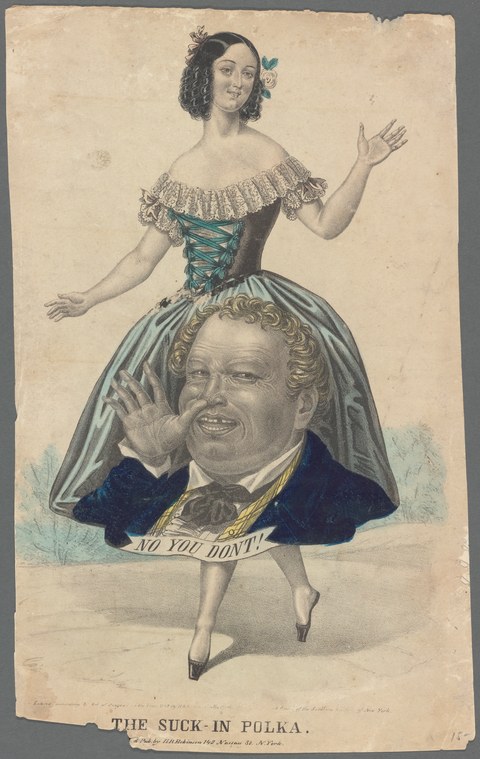
A caricatural lithograph presents a woman dancer balanced impossibly on the shoulders and head of a portly man in formal dress. The woman, dressed in a off-shoulder ball gown with a voluminous skirt of pale blue-grey silk, extends one arm in a graceful gesture while the other steadies her precarious perch. Her dark hair is adorned with flowers. The man below, whose face is grotesquely enlarged and grinning, wears a dark coat and yellow waistcoat; a banner beneath him reads 'NO YOU DON'T!' The composition is rendered in hand-colored lithograph, with careful attention to the textures of fabric—the delicate ruching of the woman's off-shoulder neckline contrasts with the solid geometry of the man's formal clothing. The background is minimal and neutral, throwing the two figures into sharp relief.
The dancing
The woman's body is held upright on the man's shoulders in an acrobatic attitude, her weight distributed across his head and neck. Her extended arm and lifted posture suggest a moment of balance or display rather than partnered dance in the conventional sense. The man's grotesquely caricatured face—bulbous, grinning, with exaggerated features—is the visual joke of the piece. There is no closed hold, no frame in the ballroom sense; instead, the relationship is one of burden and spectacle, with the woman posed as if defying gravity or the man's capacity to support her.
The dance depicted
This is a satirical commentary on the polka, likely mocking a specific novelty or performance variant. The title 'The Suck-In Polka' and the banner 'NO YOU DON'T!' suggest a wry critique—possibly of a man attempting to appear slimmer by 'sucking in' his substantial midsection while dancing, or of the increasingly acrobatic and undignified forms the polka was taking in popular entertainment. The polka itself was a lively couple dance in 2/4 time originating in Bohemia, which became a craze across Europe and America in the 1840s–60s and was frequently parodied in popular prints. The image parodies not the dance's authentic form but rather its vulgarization and the physical comedy of its performance by unsuitable dancers.
How it was made
This is a hand-colored lithograph, a print medium that allowed for rapid, inexpensive mass production and wide circulation. The artist has used lithography's capacity for expressive line work and caricature to exaggerate the man's features grotesquely while rendering the woman's costume with naturalistic detail. Hand coloring—evident in the careful application of blue and yellow pigments—elevates a cheap print process into something visually sophisticated. This technique was standard for popular satirical prints of the Victorian era, making such images accessible to the middle-class print-buying public and suitable for theatrical advertising, souvenir sale, or domestic display.
About this work
This is a satirical lithograph from the mid-to-late 19th century, likely from the 1860s–70s, that mocks the polka through absurd acrobatic staging and grotesque caricature. It belongs to the rich tradition of Victorian popular prints that used dance as a vehicle for social and bodily comedy. The work captures a specific moment in dance history when the polka, having become fashionable across Europe and North America, was entering the realm of music-hall performance and was subject to increasingly elaborate and ridiculous variations.
The image is valuable not as a record of how the polka was actually danced, but as evidence of how popular entertainment audiences understood and satirized the dance. It testifies to the polka's status as a symbol of modernity, physical exertion, and social ambition—and to the Victorian appetite for visual mockery of both the dance and the dancers who performed it.
How to look at it
The image asks you to read two competing visions of the polka at once: the woman's graceful, upright pose and extended arm gesture echo the ballroom ideal of the dance, while the man's grotesque, straining face and massive bulk beneath her ridicule that ideal utterly. The moment captured is impossible—a woman cannot actually balance thus on a man's head—which is the point. The print invites you to enjoy the visual contradiction between elegant costume and absurd staging, and to recognize in the 'NO YOU DON'T!' banner a wry comment on pretension, physical comedy, and the gap between the polka's fashionable aspiration and its vulgar reality on the popular stage.
The period
The polka originated in Bohemia in the 1830s and became a pan-European dance craze beginning in the 1840s. By the 1860s–70s, when this print was likely made, the dance had migrated from elite ballrooms to popular theaters and music halls, where it was performed by professional dancers in increasingly elaborate and acrobatic variants. Victorian popular prints frequently used dance as a subject for satire and bodily comedy; polka prints were especially common, often mocking the physical exertion and undignified postures the dance demanded of ageing or corpulent dancers. The lithographic trade in New York and London was at its height during this period, producing tens of thousands of satirical and commemorative prints for mass consumption.
Where it lives
This lithograph is held in the New York Public Library collection, suggesting it was likely published in New York in the mid-to-late 19th century. The work's appearance in an institutional collection indicates its status as a cultural artifact of interest to collectors of ephemera, popular prints, and dance history.
Dance in this work
Questions about this work
What is the 'suck-in polka'?
The title is a satirical reference to a man attempting to appear slimmer by 'sucking in' his stomach—here exaggerated to grotesque effect. It may also refer to a novelty or music-hall variant of the polka, or simply to the physical strain of the dance. The print is mocking pretension and physical comedy rather than documenting an actual named dance.
Was the polka really danced this way?
No. The polka is a lively couple dance in closed or semi-closed hold, with characteristic hopping steps in 2/4 time. This print is satirical; it exaggerates and parodies the dance and its dancers rather than depicting authentic polka technique. It comments on the gap between the polka's fashionable ballroom origins and its increasingly acrobatic, undignified forms in music-hall performance.
Why would this image be funny in the 1860s–70s?
To Victorian audiences, the image traded in multiple sources of humor: the grotesque exaggeration of the man's face and body, the physical impossibility of the pose, the contrast between the woman's elegance and her unsuitable perch, and the social mockery of a man attempting to perform fashionable dance while physically unfit to do so. It also satirizes the increasingly vulgar and acrobatic forms the polka had taken in popular entertainment.
More Polka artwork