49 works in this view — arrow keys or swipe to move between them.
Dance in Art
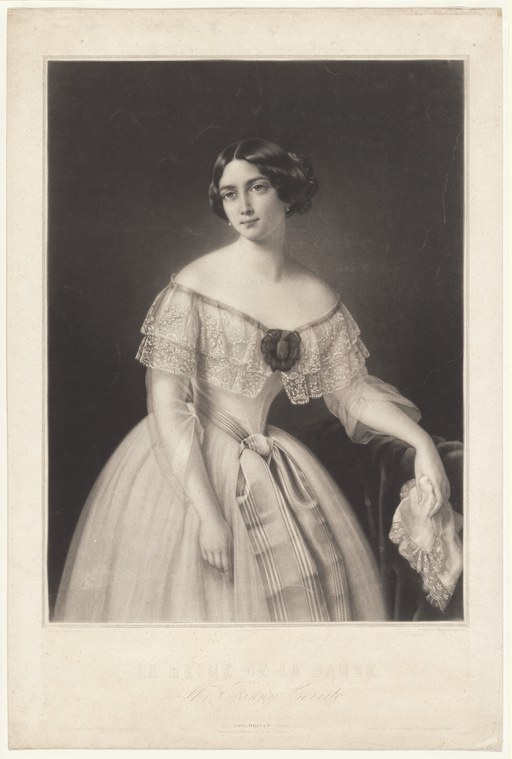
La reine de la danse, Mme. Fanny Cerrito
Unknown artist
- Collection:
- Prints depicting dance
- Source:
- New York Public Library
- Rights:
- Public domain — free to use, share and adapt.
- Recorded as:
- Public Domain
This portrait captures Fanny Cerrito at the height of her fame during the Romantic ballet period, when the female dancer became a figure of cultural fascination and artistic aspiration. It documents not the dance itself but the dancer as public persona—a shift in how performance was circulated and consumed through reproductive media. For historians of dance and theater, it is evidence of how the Romantic dancer was marketed, imaged, and remembered by audiences of the era.
What you are looking at
A three-quarter-length portrait of a woman in formal 19th-century evening dress, posed as though at a social gathering or theatrical performance. She wears a white ball gown with a notably broad, off-shoulder neckline trimmed in delicate lace, and a dark ribbon or bow at the bodice. The skirt is full and diaphanous, caught with vertical pleating or gathering down one side. Her posture is upright and composed, one arm extended gracefully downward holding what appears to be a handkerchief or small accessory; the other rests at her side. Her dark hair is arranged in the fashion of the period, parted and waved. The background is a dark, neutral tone that emphasizes the luminosity of her pale skin and white gown. The lighting is even and refined, typical of formal portraiture, with soft modeling that flatters the face and fabric. The overall effect is one of cultivated elegance and social standing.
The dancing
A single figure stands in a composed three-quarter view, weight evenly distributed, suggesting a moment of stillness or formal presentation rather than active movement. The extended arm is held with balletic grace, fingers relaxed, creating an open and refined line. The shoulders are held back and slightly dropped, the neck elongated—postural conventions associated with ballroom etiquette and courtly bearing of the period. There is no indication of weight transfer, footwork, or the dynamic energy of active dancing; the pose is that of a performer or social dancer at rest, ready.
The dance depicted
The image depicts Fanny Cerrito, a celebrated Italian ballet dancer of the Romantic era (1817–1909), though the costume and pose suggest this may represent her in a non-balletic context—possibly in character dress for a theatrical role or at a social event. The white ball gown, off-shoulder cut, and refined bearing are consistent with mid-19th-century theatrical portraiture of female performers. However, the image captures a moment of repose rather than active dancing. Cerrito was renowned for her technique and dramatic presence in Romantic ballet, particularly in works such as *Ondine* and *La Vivandière*. The portrait's elegance and restraint suggest it may document her as a public figure of the period rather than in performance.
How it was made
This is a steel or copperplate engraving, identifiable by the fine parallel lines (hatching and cross-hatching) used to render shadow, texture, and modeling, and the tonal subtlety typical of mid-19th-century portrait engraving. The technique allowed for wide distribution and reproduction, making such portraits accessible to a middle and upper-class audience interested in theatrical celebrities. The engraving's finish and quality suggest it was produced by a skilled artisan, likely for publication as a print or frontispiece, indicating Cerrito's prominence and marketability as a public figure.
About this work
This engraved portrait of Fanny Cerrito, titled *La reine de la danse* (The Queen of Dance), documents one of the most celebrated performers of the Romantic ballet era in an elegant, formal pose. Rather than depicting her in motion on stage, the image presents her as a social and theatrical celebrity of the mid-19th century, dressed in the height of fashionable evening wear. The engraving format and refined technique indicate this was intended for wide circulation among an educated, culturally engaged audience. Cerrito's status as a principal dancer of the period—known for her technical skill, dramatic presence, and international fame—is encoded in the portrait's careful elegance and the care lavished on her rendering. The work belongs in a dance gallery as a document of celebrity culture, theatrical portraiture, and the iconic status of the Romantic ballet dancer in the public imagination.
How to look at it
Look first at the posture and placement of the arms: this is a formal, composed pose drawn from social and theatrical etiquette of the period, not a moment of active dancing. The extended arm with relaxed hand shows the refined coordination and grace that was prized in both ballroom and balletic movement. Observe how the engraver has rendered the cascade of white silk and lace—the folds and pleating suggest both the weight and lightness of Romantic-era costume. The face is serene and engaging, looking slightly past the viewer, as though captured at a social event or during a moment of theatrical presence off-stage.
The artist
The artist is not recorded in the catalogue, which is typical of many reproductive engravings of the period, where the engraver's identity was sometimes secondary to the fame of the subject. The technique and quality suggest work by a skilled practitioner in the mid-to-late 19th century, when portrait engraving from photographs or drawings was a standard practice for theatrical publicity and celebrity documentation.
The period
The 1830s–1860s were the golden age of Romantic ballet in Europe, during which the female dancer achieved unprecedented prominence, celebrity status, and public fascination. The ethereal aesthetic of the era—embodied in works like *La Sylphide* (1832) and *Giselle* (1841)—elevated the ballerina as an artistic ideal. Parallel to this, reproductive engraving and lithography were crucial technologies for disseminating images of celebrated performers to a wide audience. Portrait engravings of dancers, singers, and actors were collected, framed, and sold as commercial products, making theatrical celebrities visible to people far beyond the theater itself. Cerrito's image was part of this broader culture of theatrical fame and visual celebrity.
Where it lives
The work is held in the Prints collection of the New York Public Library, part of a broader archive of dance imagery. It is catalogued simply as a portrait engraving of Fanny Cerrito, circulated as a celebrity print of the Romantic era.
Dance in this work
Questions about this work
Was Fanny Cerrito a famous dancer?
Yes. Cerrito (1817–1909) was an Italian prima ballerina of international renown during the Romantic ballet period. She performed leading roles in major works and was celebrated for her technical skill, dramatic range, and stage presence. She was one of the most famous performers of her era.
Why isn't she shown dancing?
This is a formal portrait, not a performance image. It documents Cerrito as a public figure and celebrity, dressed for a social occasion or theatrical event. Such portraits were produced for circulation among fans and the educated public—they recorded the dancer as a person, not always in the act of dancing.
How was this image made and shared?
This is a steel or copperplate engraving, a reproductive printmaking technique that allowed multiple copies to be made from a single plate. Engravings were far cheaper than paintings and could reach a much larger audience. Prints like this were sold individually, collected by fans, and sometimes published in theater programs or newspapers.
What do the clothes tell us?
The white ball gown with off-shoulder neckline and delicate lace is fashionable evening dress of the 1840s–1860s. It reflects both Cerrito's social status and theatrical prominence. Romantic-era ballet costumes often drew on contemporary evening wear, so this elegant white gown would have been recognizable to the viewer both as high fashion and as the type of costume worn in classical ballet.
More dance artwork





