49 works in this view — arrow keys or swipe to move between them.
Dance in Art
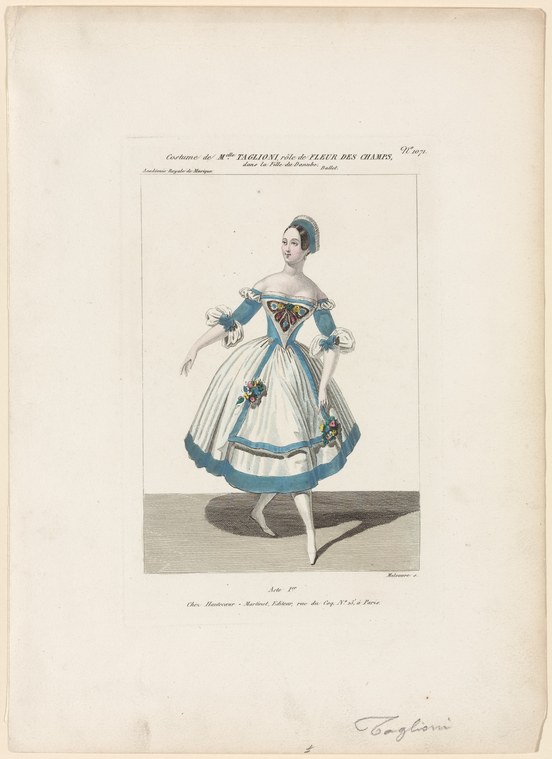
Costume de M'elle Taglioni, role de fleur des champs, dans La fille du Danube, ballet, acte 1'er, Académie royale de musique
Unknown artist
- Collection:
- Prints depicting dance
- Source:
- New York Public Library
- Rights:
- Public domain — free to use, share and adapt.
- Recorded as:
- Public Domain
Romantic ballet survives largely through costume plates and lithographs like this one; without them, we would know far less about how these roles looked, how dancers moved, or what the visual culture of the mid-19th-century Opéra actually was. The work also documents the existence of minor roles and short-lived productions that have left no other trace, expanding our understanding of the ballet repertory beyond the handful of works that survived to the 20th century.
What you are looking at
A single female dancer stands in three-quarter profile against a plain background, her body caught in a moment of graceful stillness or slow movement. She wears a Romantic-era ballet costume: a fitted corseted bodice in deep blue silk with off-shoulder sleeves, adorned with floral sprays, and a voluminous skirt of white tulle trimmed with blue silk ribbon at the hem. Her hair is arranged in dark loops over her ears in the period style. Her right arm extends forward with the hand open, while her left arm hangs at her side, both relaxed and natural. Her weight appears to rest on her right leg, with her left leg extended lightly behind, suggesting the effortless balance of trained technique. The setting is minimal—just a gray ground plane—which focuses all attention on the figure and costume.
The dancing
The dancer's stance shows the controlled elegance characteristic of Romantic ballet: weight forward on the supporting leg, the free leg extended behind in a gentle line, arms held with relaxed grace rather than dramatic tension. Her upper body is upright but not rigid, her head turned slightly as if acknowledging an audience or partner beyond the frame. The pose suggests a moment between steps, neither a dramatic leap nor a static arabesque, but rather the kind of floating stillness that defines the Romantic aesthetic. There is no partner visible; she is presented as a solo figure in what appears to be a formal portrait of the dancer in character.
The dance depicted
This is a costume plate for a Romantic ballet, specifically documenting the role of the Flower of the Fields (*Fleur des champs*) in the ballet *La Fille du Danube* (The Daughter of the Danube), Act 1. The work was created for the Académie Royale de Musique in Paris, the primary venue for ballet during the Romantic era. The costume and pose are consistent with the vocabulary of mid-19th-century Romantic ballet: the ethereal tulle skirt, the delicate arm placement, and the weightless extension all point to a style centered on an illusion of effortlessness and supernatural grace. The inscription below identifies this as a costume study, part of the documentation system used to preserve and circulate designs for major productions.
How it was made
This is a hand-colored engraving or lithograph, a reproductive print medium that allowed ballet costume designs to be distributed widely among subscribers, dancers, and theatregoers. The technique combines printed line work with careful hand coloring—note the precise blue tones of the bodice and trim, the subtle modeling of the skirt's folds, and the naturalistic flesh tones. Such prints were produced in sets or series and sold as souvenirs or reference documents. The medium's affordability and reproducibility made it the standard means of circulating knowledge about Romantic ballet across Europe; a single successful Paris production could be staged in London, St. Petersburg, or Milan with the aid of such costume plates.
About this work
This is a costume plate from the archive of Romantic ballet, documenting a minor role in a now-obscure production but representing the visual language through which 19th-century ballet was preserved and transmitted. It serves as both a historical record and a design document: evidence of what the dancer wore, how she stood, and what qualities—lightness, grace, ethereal beauty—the role embodied. The form itself is historically significant: such prints were the Instagram posts of their era, circulating images of dancers and productions to a mass audience hungry for access to the glamorous world of the Paris Opéra.
For a gallery devoted to dance in art, this plate exemplifies a crucial category of representation: the costume documentation that occupied the space between fashion plate, theatrical ephemera, and fine art print. It shows us not what the artist imagined but what the dancer actually wore and how she was taught to present herself in a specific role. The work survives because someone—whether a dancer, an admirer, or a collector—valued it enough to keep it.
How to look at it
Notice the careful balance of the pose: neither fully engaged in movement nor at rest, but suspended in a moment of transition. This was a deliberate choice by the artist, capturing not a dramatic peak of the movement but the kind of floating quality that Romantic dancers cultivated. Observe the silhouette created by the tulle skirt—how it spreads and falls, creating an illusion of weightlessness even in a static image. The costume is not generic but specific: the placement of the floral sprays, the proportions of the bodice and skirt, the choice of blue as the dominant color. These details would have been necessary for a costume maker to reproduce the role if the ballet were staged elsewhere. The plain background and frontal composition are conventions of the costume plate genre, designed to show the costume clearly without distraction.
The period
This costume plate was produced during the height of the Romantic ballet era in Paris, roughly 1835–1860, when the Opéra was the center of European dance innovation and the cult of the prima ballerina was at its peak. The production of *La Fille du Danube* is documented in the archive, confirming that such works, now forgotten, drew crowds and inspired a substantial literature of costume plates, reviews, and lithographs. The style of hand-coloring, the format, and the engraving technique place this firmly within the commercial reproductive print industry of the Paris Opéra, which supported dozens of print makers and colorists in producing these documents. The 1840s–1850s saw the widest circulation of such materials, as improvements in printing technology made colored lithographs cheaper and faster to produce.
Where it lives
This is part of a collection of prints depicting dance held by the New York Public Library, one of the largest archives of dance ephemera from the 18th and 19th centuries. Such prints were originally sold individually or in bound series; this example has survived as part of a collector's album or the library's systematic acquisition of theatre-related prints. The inscription at the top and the signature or mark at the bottom are typical of the commercial print industry of Paris.
Dance in this work
Questions about this work
What does 'Fleur des champs' mean and was this a major role?
It translates as 'Flower of the Fields,' a minor character role typical of mid-19th-century ballet. Such roles were often danced by corps members or junior soloists and allowed choreographers to create variety and spectacle. The fact that a costume plate was made for this role suggests it had some importance in the production, but it is not a principal character.
What ballet is this from and when was it performed?
*La Fille du Danube* (The Daughter of the Danube) was a Romantic ballet performed at the Académie Royale de Musique in Paris. The work is now lost to the active repertory, surviving only through prints like this one and brief mentions in contemporary reviews. Reconstructing which production or revival this costume plate documents would require archival research in Parisian theater records.
How do I know this is a real costume and not an artist's fantasy?
Costume plates were functional documents: they were used by costume makers, dancers learning roles, and theater managers coordinating productions. The specificity of detail—the exact placement of trim, the construction of the bodice, the proportions of the skirt—is evidence that this represents an actual garment. The inscription below, naming the role and work, confirms that this was made as a record of a specific, performed production.
More dance artwork





