49 works in this view — arrow keys or swipe to move between them.
Dance in Art
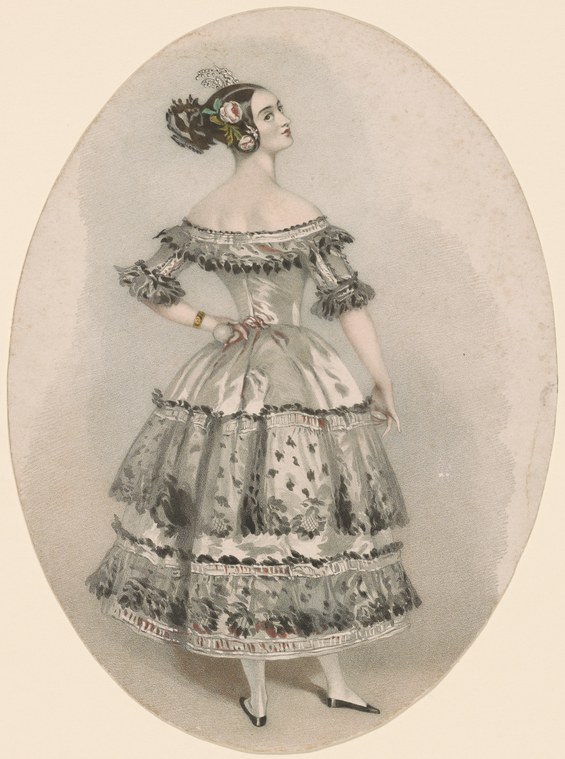
La cachucha
Unknown artist
- Collection:
- Prints depicting dance
- Source:
- New York Public Library
- Rights:
- Public domain — free to use, share and adapt.
- Recorded as:
- Public Domain
The Cachucha marked a critical moment in European dance history: the embrace of non-European movement vocabularies within the vocabulary of Romantic ballet, and the emergence of the dancer (particularly the female soloist) as a commercial and cultural icon whose image could be mass-produced and circulated. This print is a tangible record of how that commodification worked and how the dance itself was visually coded for audiences—through costume detail, through the careful presentation of the female body, and through the aesthetics of the theatrical portrait.
What you are looking at
A young woman in an off-shoulder white silk dress stands in profile against a neutral background, captured in a moment of theatrical poise. The dress is composed of three horizontal tiers: an upper section with gathered sleeves trimmed in dark fringe or tassel work; a plain white middle section; and a lower skirt with a striking patterned fabric (possibly with floral or decorative motifs) edged with additional fringe or ornamental trim. Her dark hair is elaborately arranged in ringlets piled high on her head and crowned with what appears to be a small jeweled or feathered ornament. She wears a simple bracelet and holds a fan in her gloved hand. The pose is characteristic of theatrical portraiture of the 1830s–1840s: the weight appears rested on one leg, the torso angled gracefully, the head turned toward the viewer in profile, the overall impression one of elegant stillness rather than active movement.
The dancing
A single female figure, positioned in a contemplative standing pose rather than mid-leap or in active dance motion. The weight distribution and angle of the spine suggest a trained posture—the kind expected of a professional dancer or theatrical performer. The arms are not in an extended or demanding position; one holds a fan at waist level while the other rests naturally. The profile view and the careful arrangement of limbs suggest the artist prioritized displaying the costume and the sitter's composed dignity over capturing the energy of movement itself.
The dance depicted
La Cachucha was a solo Spanish dance that became a sensation in European theaters during the 1830s and 1840s, particularly when performed by the dancer Fanny Elssler. It combined elements of Spanish folk movement with the technical vocabulary of Romantic ballet, featuring rapid footwork, hip articulation, and percussive rhythmic elements unusual for classical ballet of the period. This print depicts the costume of the dance—the tiered, fringed skirt and the off-shoulder neckline were iconic to the Cachucha as performed on the European stage—but the pose itself is a formal portrait stance rather than a depiction of the movement. The Cachucha's appeal lay in its exoticism and its earthiness, qualities that contrasted sharply with the ethereal, otherworldly aesthetic of the dominant Romantic ballet vocabulary.
How it was made
This is a hand-colored lithograph or engraving of the mid-nineteenth century. The delicate rendering of the fabrics, the subtle gradations of shadow in the flesh tones, and the careful articulation of the ornamental details suggest a skilled reproductive print, likely created for circulation as a theatrical souvenir or fashion plate. The medium allowed for relatively inexpensive mass production, making the image of celebrated dancers available to theater audiences and the fashion-conscious public. The oval frame is characteristic of mid-nineteenth-century portraiture and emphasizes the sitter as a discrete, commodified image.
About this work
This is a theatrical portrait of a woman in the costume of La Cachucha, a Spanish-inflected solo dance that captivated European audiences in the 1830s–1840s. The print preserves the visual record of an iconic costume—the tiered, fringed skirt and off-shoulder bodice that signaled the dance's exotic, earthy character—but presents it as a formal portrait rather than as an image of movement. The work belongs to a substantial tradition of dancer portraiture distributed as prints: objects that served both as theatrical promotion and as fashion and cultural documents. It offers evidence of how the Cachucha and Spanish dance more broadly were visualized and consumed in the European imagination of the period.
How to look at it
Focus on the costume: the artist has chosen to emphasize the material specificity of the dress through careful rendering of the tiered construction, the texture of the fringe, and the patterned fabric of the lower skirt. These details were the visual signature of the Cachucha. Notice also the formal portrait conventions at work—the profile view, the neutral background, the oval frame—which present the dancer not as a body in motion but as an icon to be looked at and consumed. The pose itself, though graceful, is static and contemplative, inviting the viewer to appreciate the costume and the sitter's composed presence rather than to imagine the energy and footwork the dance itself required.
The artist
The artist is not recorded in the catalogue. The style and finish of the work suggest it was created by a professional reproductive printmaker or theatrical illustrator of the 1830s–1840s, likely working in Paris or another major European theatrical center. Such prints were typically unsigned or attributed only to the publisher; the anonymity reflects the collaborative, commercial nature of theatrical print production.
The period
The 1830s and 1840s were the height of the Romantic ballet era in Europe, a period when choreographers and audiences became fascinated with exotic, supposedly 'natural' or 'primitive' cultures. Fanny Elssler's interpretation of the Cachucha—presented as an authentic Spanish dance, though heavily stylized for the ballet stage—was part of a broader appetite for Spanish and Orientalist themes in the arts. Simultaneously, lithography and color printing had made theatrical portraiture and fashion imagery accessible to a wide middle-class audience; dancers' likenesses became commodified cultural objects, distributed as prints, reproduced in journals, and collected. The image of the dancing woman became inseparable from questions of exoticism, costume, femininity, and the emerging culture of celebrity.
Where it lives
This print is held in the New York Public Library's collection of prints depicting dance, which assembles theatrical imagery, fashion plates, and documentary visual materials related to movement and performance. The collection reflects the NYPL's systematic gathering of evidence about how dance has been visualized and circulated in print culture.
Dance in this work
Questions about this work
What was the Cachucha, and why was it important?
The Cachucha was a Spanish-inflected solo dance that became a sensation in European theaters in the 1830s and 1840s, particularly as performed by the celebrated dancer Fanny Elssler. It combined rapid footwork and hip articulation with the technical training of Romantic ballet, and it represented a fashionable European fascination with exotic and supposedly 'authentic' non-European movement vocabularies. The dance was significant because it demonstrated how non-classical movement could be integrated into ballet and how the public appetite for exotic themes could reshape choreographic practice.
Is this print a portrait of a specific dancer?
The catalogue record does not identify the sitter, and the print itself carries no attribution or signature. It is likely a portrait of a celebrated performer of the Cachucha, possibly Fanny Elssler herself or one of her many imitators, but without additional documentation or research we cannot establish that with certainty. The print was created for circulation as a theatrical souvenir and fashion image, not necessarily as a unique or autobiographical work.
Why does the woman look so still, if this is meant to show a dance?
This is a formal theatrical portrait, not a documentation of the dance itself. The artist followed the conventions of mid-nineteenth-century portraiture, presenting the sitter in a composed, dignified stance designed to display the costume and the subject's status as a celebrated performer. The Cachucha's actual movement—its rapid footwork and dynamic energy—is not captured here; instead, the image preserves the visual and cultural identity of the dance through costume detail alone.
What does the costume tell us about the dance?
The tiered, fringed skirt and off-shoulder neckline are the visual signature of the Cachucha as it was presented on the European stage. The lower skirt's patterned fabric and ornamental trim signaled exoticism and earthiness—qualities meant to distinguish the Cachucha from the ethereal, otherworldly aesthetic of classical Romantic ballet. The costume was part of the dance's theatrical identity and its appeal to audiences seeking something perceived as foreign, sensual, and exciting.
More dance artwork





