49 works in this view — arrow keys or swipe to move between them.
Dance in Art
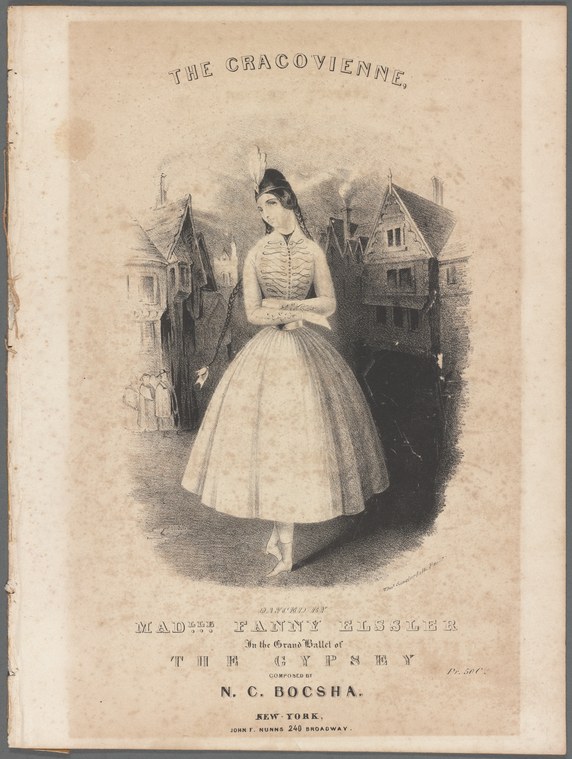
The cracovienne, danced by Madlle. Fanny Elssler in the grand ballet of The Gypsey composed by N.C. Bocsha
Unknown artist
- Collection:
- Prints depicting dance
- Source:
- New York Public Library
- Rights:
- Public domain — free to use, share and adapt.
- Recorded as:
- Public Domain
Fanny Elssler was one of the two supreme ballerinas of the Romantic era, and the Cracovienne was among her most famous roles. For historians of ballet, this print is evidence of how Romantic dance incorporated folk material and how star dancers were commodified and circulated as images; for dance practitioners, it shows the costuming, posture, and presentation conventions of mid-19th-century stage performance.
What you are looking at
A woman in Romantic-era theatrical dress stands alone in the center of a European village street, framed by Gothic Revival architecture—steep-roofed cottages with pointed gables behind her. She wears a corseted bodice with short sleeves, a full skirt that falls to mid-calf, and appears posed in a moment of stillness or preparation rather than active movement. The engraving's light falls from the left, casting her figure in sharp relief against the shadowed buildings. The composition is vertical and formal, emphasizing her isolation and the theatrical presentation of the figure; this is a publicity image, not a narrative scene.
The dancing
The dancer stands with weight slightly favored on one leg, the other prepared but not yet extended. Her posture is upright and composed, with arms held at her sides or slightly forward—the pose of a dancer between moments rather than caught in an action. Her body is presented in profile or three-quarter view, allowing the audience to assess the line of her leg and the silhouette of her full skirt. No partner is visible; this is a solo portrait.
The dance depicted
The title identifies this as the Cracovienne (Krakowiak), a Polish folk dance in a fast 2/4 time known for its energetic footwork and pride of bearing. The engraving shows Fanny Elssler, the Austrian ballerina, in this role from the grand ballet *The Gypsey* (also called *La Gypsy*), composed by N.C. Bocsha and produced in the 1840s. The Cracovienne was one of Elssler's signature character dances—roles that showcased her technical precision and interpretive gift for national and exotic material, a hallmark of Romantic ballet. This image documents not the moment of dancing but the dancer herself as a star, a presentation format standard for theatrical publicity of the period.
How it was made
This is an engraving, likely a wood engraving or steel engraving, printed as a sheet for distribution to the public and press. The technique allows precise tonal gradation through parallel lines, visible especially in the shadows of the buildings and the modeling of the fabric. Such prints were the primary way theater-goers could own an image of a favorite dancer; they were sold at the stage door, advertised in newspapers, and collected. The quality and finish indicate a professional commercial production, not a private or experimental work.
About this work
This is a theatrical publicity print documenting Fanny Elssler in one of her celebrated character-dance roles. The Cracovienne was central to Romantic ballet's expansion beyond classical French technique into the dances, costumes, and music of European folk and national traditions. Elssler's career, and her rivalry with Marie Taglioni, defined the 1830s–1840s ballet stage; her mastery of character work set her apart and made roles like this one commercially and artistically significant. The engraving preserves not a moment of performance but the image by which Elssler was known to the public—the dancer as a marketable personality and a vehicle for national exoticism.
How to look at it
Look at the posture: Elssler is presented standing tall and composed, with the weight-shift and ready stance of a trained dancer, but not in motion. The artist has chosen the moment of presentation or preparation, not the moment of dance—which is appropriate for a publicity print meant to be a portrait. The setting (the village street) gestures toward the folk origins of the dance without showing the dance itself. The full skirt and the line of her body reflect the silhouette that Romantic ballet audiences expected; note how the engraving's technique allows precise rendering of the fabric's volume and the articulation of the leg beneath it.
The artist
The artist is not recorded. The print was published by N.C. Bocsha's firm in New York (John E. Nones, 249 Broadway), indicating it was a commercial theatrical print made for American circulation during Elssler's tour. Elssler made two famous American tours, 1840–1842 and 1846–1847; this print likely dates to one of those periods.
The period
The 1830s and 1840s were the height of Romantic ballet, when the ballerina became the primary focus of choreography and when European folk dances were increasingly staged and refined for the concert hall. Marie Taglioni had dominated the early Romantic period with her ethereal technique and sylph roles; Fanny Elssler carved out a rival reputation through her brilliant execution and her embrace of character and national dances. The Cracovienne, along with roles in *La Volière* (the cachucha) and *Esmeralda*, allowed Elssler to showcase a different kind of virtuosity—earthiness, precision, and dramatic presence. This was also the period when lithography and engraving made theatrical images widely available, turning dancers into public personalities in a new way.
Where it lives
This print is held by the New York Public Library in its collection of prints depicting dance. It was published in New York by John E. Nones, suggesting it was produced during one of Elssler's American tours in the 1840s as a commercial theatrical souvenir and publicity image.
Dance in this work
Questions about this work
Who was Fanny Elssler?
Fanny Elssler (1810–1884) was an Austrian ballerina and one of the two supreme dancers of the Romantic ballet era. She rivaled Marie Taglioni in fame and reputation, but where Taglioni was known for ethereal roles, Elssler excelled in character dances and dramatic roles. She toured Europe and America extensively and was as celebrated for her personality and star power as for her technique.
What is the Cracovienne?
The Cracovienne (or Krakowiak) is a Polish folk dance in quick 2/4 time, characterized by energetic footwork, proud bearing, and a distinctive rhythmic bounce. When incorporated into ballet, as in Elssler's role, it retained these folk qualities while being refined for the concert stage. It exemplifies the Romantic-era practice of staging national and exotic dances as theatrical spectacle.
What was *The Gypsey* ballet?
N.C. Bocsha's *The Gypsey* (also known as *La Gypsy*) was a mid-19th-century grand ballet that gave Elssler a starring role. Like many Romantic ballets, it used an exotic or folk subject as a framework for showcasing the ballerina's technique across multiple styles and emotions. The Cracovienne was one of several character dances featured in the work.
Why was this image made and distributed?
This print was a commercial product made to capitalize on Elssler's fame during her American tours. Theater-goers could buy images of their favorite stars; newspapers used them for advertisement; and dancers themselves distributed them as publicity. Such prints were the 19th-century equivalent of a celebrity photograph or poster, and they made the dancer's image available far beyond the theater.
More dance artwork





