49 works in this view — arrow keys or swipe to move between them.
Dance in Art
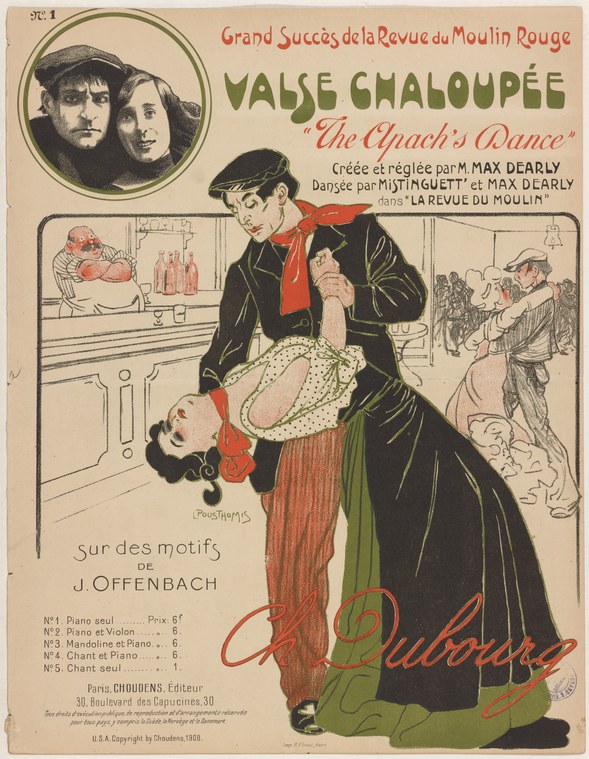
Valse chaloupée: "The Apach's dance," créée et reglée par M. Max Dearly, dansée par Mistinguett et Max Dearly dans "La Revue du Moulin"
Unknown artist
- Collection:
- Prints depicting dance
- Source:
- New York Public Library
- Rights:
- Public domain — free to use, share and adapt.
- Recorded as:
- Public Domain
Apache dance is poorly documented visually, and most evidence comes from descriptions rather than images. This poster captures the genre's signature lift and partnering style in the moment of its greatest popular success. It shows that early twentieth-century theatrical dance in Paris drew on ballroom vocabulary while inverting its social meanings—transforming the waltz into an image of transgression and physical excess.
What you are looking at
This is a promotional poster for a cabaret dance number performed at the Moulin Rouge in Paris. The composition is divided into two parts: at top left, a circular vignette shows two figures in intimate embrace—a man in dark clothing and a woman in light dress, their faces close together. Below this, the main scene depicts a man in a dark coat with a red scarf lifting a woman in a striped skirt and red corset off her feet in a dramatic dip or lift. She reclines backward, her body weight entirely dependent on his support, her face turned upward. The setting is a crowded cabaret interior with bottles and glasses visible on a bar counter and other patrons sketched in the background. The entire composition is rendered in a sketch or drawing style with careful line work, typical of Belle Époque theatrical advertising.
The dancing
The primary dancers are depicted in a close partnered embrace with pronounced asymmetry: the man stands upright and grounded, his body angled forward, while the woman is tilted back in a deep arch, her legs lifted and crossed. This is not a ballroom closed position but rather a dramatic theatrical lift—her body is essentially horizontal while his supports her full weight. The intimacy is emphasized by their proximity and the tilt of her head toward his. The secondary figures visible in the bar scene show onlookers in various postures of observation and conversation, establishing the social cabaret setting.
The dance depicted
This depicts a 'Valse Chaloupée' (literally 'swaying waltz'), choreographed by Max Dearly and performed by Mistinguett and Max Dearly in a 1900s Moulin Rouge revue. The term 'chaloupée' refers to a swaying or rocking motion, and the title 'The Apach's Dance' places it within the Apache dance tradition—a sensational theatrical genre that dramatized the violent, seductive encounters of Parisian underworld characters. The choreography here is not the restrained arm work of ballroom waltz but rather an acrobatic partnership emphasizing dramatic lifts, weight support, and theatrical posturing. The image captures the genre's signature blend of aggression and intimacy: the man's firm control, the woman's surrender to his physical dominance, the theatrical exaggeration of the lift.
How it was made
This is a color lithographic poster, a technique that allowed rapid production and broad distribution for theatrical promotion. The composition combines photographic naturalism (the faces in the portrait vignette) with caricatural line drawing (the cabaret scene below), a hybrid common in Belle Époque advertising. Lithography's capacity for tonal gradation and color separation meant that posters could achieve striking visual contrast while remaining economical to print in quantity—this work was designed to be pasted on Parisian streets and in métro stations to advertise the revue. The credit to 'Choudens, Editeur' at the bottom confirms this was a professional commercial production.
About this work
This poster advertises a specific dance number—the 'Valse Chaloupée'—performed by two of the Moulin Rouge's most celebrated performers at the height of the Belle Époque cabaret era. It is not a record of a waltz in the ballroom sense but of an Apache dance: a theatrical genre that used the waltz's triple meter as a framework for acrobatic lifts, dramatic weight shifts, and a narrative of seduction and domination. The image is a document of early twentieth-century Parisian popular dance, showing how the waltz was transformed from a respectable social form into a sensational stage spectacle. For dance historians, this is evidence of how cabaret choreography adapted and reimagined ballroom forms for theatrical effect and narrative drama.
How to look at it
Look first at the lift itself and what it tells you about the relationship being performed. The woman is not dancing but being moved—her weight is entirely passive, her body extended and vulnerable. The man's grip and stance convey control and physical dominance. This is not an image of equality or mutual participation but of one body subjugating another. The moment chosen is the peak of the lift, when the woman is most exposed and the man most visibly in command. This freezing of the moment of maximum imbalance is precisely what made Apache dance sensational to its contemporary audience and what distinguishes it from the reciprocal partnering of ballroom waltz.
The artist
The poster credits choreography to Max Dearly and notes it was created and staged ('créée et reglée') by him. Dearly was a principal dancer and choreographer of the Moulin Rouge during its peak years as Paris's most famous cabaret. Mistinguett was the venue's greatest star—a singer, dancer, and performer whose powerful stage presence and willingness to perform daring material made her a household name. The artist of the poster itself is not recorded, but the style is consistent with Belle Époque theatrical lithography, likely produced by Choudens' in-house design team.
The period
The Apache dance emerged in the 1890s and reached peak popularity between 1900 and 1910. It arose partly from the literary and artistic fascination with Parisian underworld life (the Apaches were street gangs) and partly from a public appetite for transgressive, sexualized performance. Simultaneously, the waltz itself was undergoing a transformation: in ballroom culture it was becoming faster and more athletic (the Viennese waltz), while in theatrical contexts like the Moulin Rouge it was being pushed toward acrobatic extremes. This poster dates to the era when cabaret dance was asserting itself as a distinct theatrical form, separate from both ballroom propriety and classical ballet.
Where it lives
This is a lithographic poster held in the New York Public Library's collection of prints depicting dance. It is a commercial advertising object, printed for public display and distribution, and represents the intersection of theatrical promotion, popular dance, and Belle Époque graphic design.
Dance in this work
Questions about this work
What is Apache dance?
Apache dance (danse apache) is an early twentieth-century theatrical genre that dramatized the criminal underworld of Paris through sensationalized, acrobatic partnering. It typically depicted violent or sexually charged encounters between a man and woman, making heavy use of lifts, throws, and moments of staged aggression. Though rooted in street culture, it was primarily performed in cabarets like the Moulin Rouge for paying audiences seeking transgressive entertainment.
Who were Mistinguett and Max Dearly?
Mistinguett (1875–1956) was the Moulin Rouge's greatest star—a singer, dancer, and performer whose commanding stage presence and repertoire of daring material made her a symbol of Belle Époque Paris. Max Dearly was a principal male dancer and choreographer at the venue who specialized in Apache choreography and in acrobatic partnering. Their collaboration produced some of the most celebrated and notorious dance numbers of the era.
How does this differ from ballroom waltz?
Ballroom waltz emphasizes closed position, shared weight, and reciprocal movement in triple meter. Apache dance uses waltz music and timing but abandons reciprocity: the man leads through lifts and physical domination, while the woman's body becomes an object to be moved. The waltz becomes a framework for acrobatic and narrative drama rather than a dance of mutual participation.
What does 'chaloupée' mean?
'Chaloupée' refers to a swaying or rocking motion—from the verb 'chalouper.' The 'Valse Chaloupée' is thus a waltz performed with exaggerated swaying, tipping, and weight shifts rather than the upright carriage of ballroom waltz. It emphasizes the body's displacement and instability, heightening the theatrical effect of the lifts.
More dance artwork





